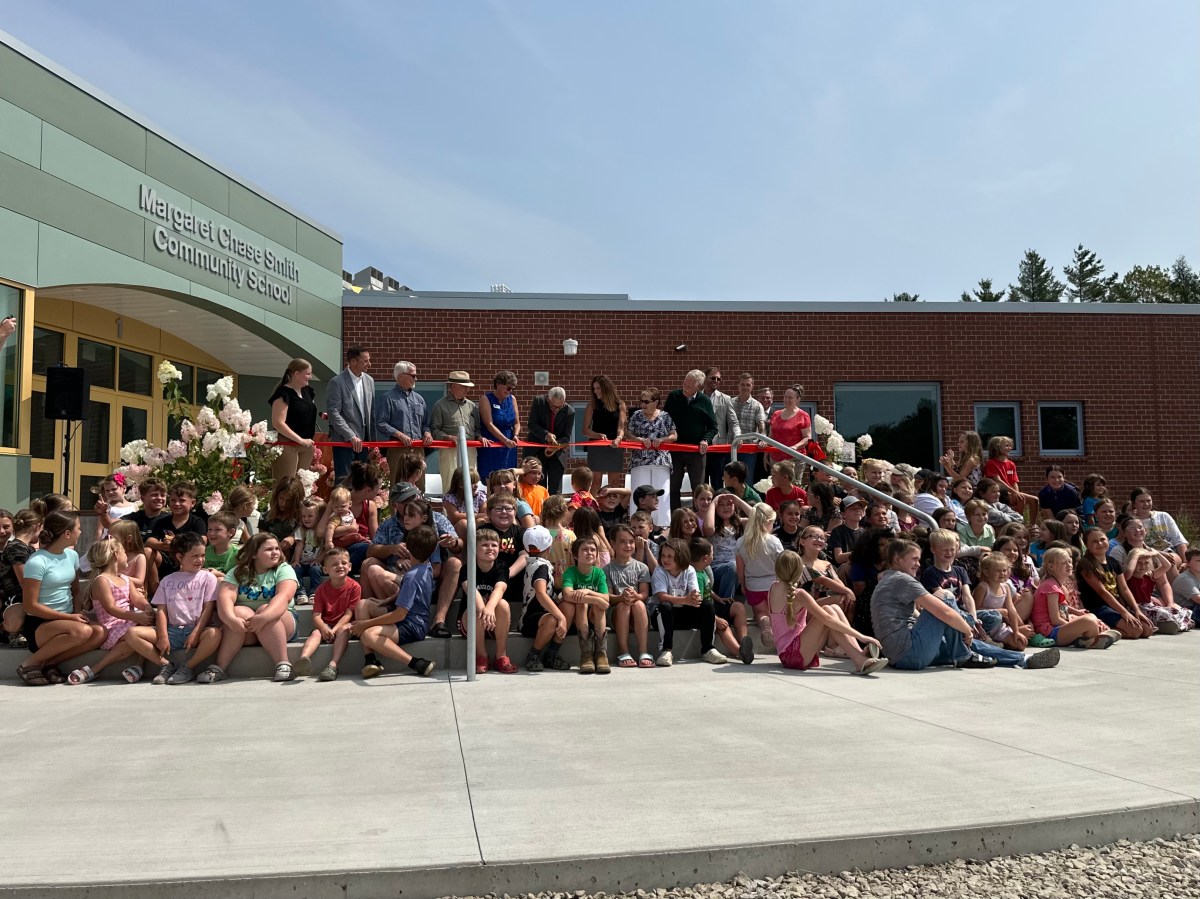
SKOWHEGAN — While it was a perfect summer vacation day last Tuesday, kids and their parents could not wait to get into the brand new Margaret Chase Smith Community School and Hight Family Early Learning Center, where they will officially start class in a few weeks.
Hundreds of community members, teachers and staff, the MSAD 54 school board, donors, Senator Angus King and Representative Jared Golden had all turned out for this joyful and groundbreaking occasion. The project is the first public school construction in the state to include an early childhood education wing within its walls, and it was completed at no additional cost to residents thanks to a unique, decade-long private, public venture.
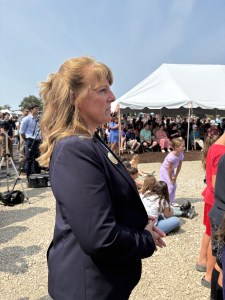
Principal Myla Kreider believes that the decade-long venture was completed in such a way because MSAD 54 is a community that “puts children and family first.” The infancy-to-elementary model is a realization of a 50 year partnership between the district and KVCAP Skowhegan, the social service agency that will be staffing the Early Learning Center. There will also be a food pantry on site.
“I’m excited that this is a true collaboration in one space, one campus,” Kreider continued. The school will serve more than 800 students from Canaan, Cornville, Mercer, Norridgewock, Skowhegan and Smithfield.
Sen. King, Rep. Golden and Senator Susan Collins helped secure a $1.9 million federal grant, but more than $3.3 million came from local donors. Sam Hight, President of Hight Auto Group, and his family spearheaded the capital campaign and made a $500,000 donation in recognition of how the community has supported them for over 100 years.
“In 1911, my great-grandfather, Walter, began selling Henry Ford’s Model T, an affordable and reliable automobile for the average family that helped support their new freedom, an embodiment of the American Dream,” Hight remarked as he unveiled a wall recognizing the more than 100 donors to the project.
“Today, my family, albeit in an incredibly minor role, has helped build a school that will provide the most crucial bridge to the American Dream—access to quality early education and care,” Hight said.
Data abounds on the positive impact of high quality early childhood education from infancy through pre-K. These programs promote children’s cognitive, social, emotional, and physical development so that, regardless of household income or resources, five and six year olds can start kindergarten on the same level.
“We’re not just educating,” said Lynda Quinn, Chair of the School Board. “We are providing a safe, inclusive space for all children in the community.”
Sen. King remarked that this should be a model for the state, where more than two thirds of families with kids under six have both parents in the workforce, and nearly a quarter of the population lives in a childcare “desert.”
“We need facilities like this, particularly the model in the Hight Center,” King said, describing the struggles parents face, balancing work, household management and spending quality time with their children. “Every kid needs a decent start to life.”
Golden said that as a congressman, there are certain communities that stand out to him because “they do so much themselves and [the Skowhegan area] does that. They solve problems together.” He also emphasized the crucial need for facilities like the new school, saying he has attended briefings where retired generals have testified that the dearth of quality early childhood education in the U.S. is a matter of national security.

Laura Darrington moved her family, including Ian, 10, and Jack, 4, from Idaho to Maine last year. She said they chose the Skowhegan area “because they really care about children and it’s a place to grow up and enjoy the outdoors. It’s a place where kids are important.”
Inside the building, students were most enchanted by their new lockers and bright yellow floors.
“I like it very much,” said Sophia LaPorte, 7. She’s starting third grade this fall. “It’s big and the playground is also big. I feel like I’m in middle school.”

“I like that the gym is huge,” said Madison Lee, 9. She came to the party with her parents, John Lee and Kim Dupray-Lee, and siblings Landon, 17, Nikelle, 3, and Oaklynn, 5 months. Landon, who’s excited for his future in the Navy, was jealous that he wouldn’t have the opportunity to attend, while John was anticipating higher quality education for all his children under the new model.
“Kim and I are Native American, Passamaquoddy, and I like that Native American history will be taught at all levels here,” he said.
After the speeches and tours, everyone spilled outside for the community barbeque on the new playground, a nature-based design with multiple play areas and adaptive equipment for children of all physical abilities. Sophia was now with her mom, Michaela LaPorte, and her sister, Audrey, 3.
LaPorte manages the Workforce Development program at Somerset Career & Technical Center, so she has seen the impact of educational models that layer academics with practical skills.
“I like what’s happening here at this new building,” she said, “bringing kids from smaller schools together.” She said it was a beautiful facility that will continue to strengthen community bonds.
Sam Hight joked that of all the community projects he has invested in over the years, this was “one of the more expensive ventures I have convinced the family to do,” but he believed the community investment in the school will “pay dividends for generations of Skowhegan families.
“In the words of Benjamin Franklin, who was an advocate of education as the empowerment of societal and personal advancement and thus greater opportunity, ‘An investment in knowledge pays the best interest.’”