

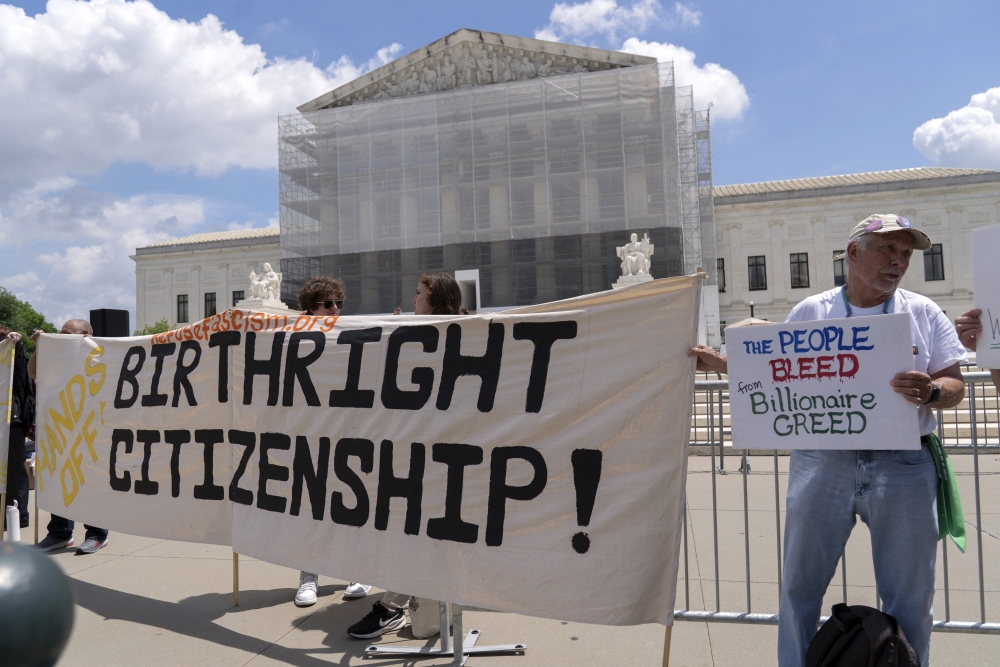
The U.S. Supreme Court announced Friday that it will consider a New England class action lawsuit challenging the president’s attempts to deny birthright citizenship.
The legal challenge was submitted on June 27 in U.S. District Court in New Hampshire by several New England based advocacy organizations, including the American Civil Liberties Union of Maine.
The lawsuit was filed on behalf of three U.S.-born babies and their parents, who are citizens of different countries.
The lead plaintiff is a mother from New Hampshire. A federal judge there agreed the case would likely succeed on the merits and previously approved an emergency request to temporarily halt the executive order from taking effect. The judge also provisionally agreed in July to give the plaintiffs national class action status.
The Trump administration appealed that decision to the 1st U.S. Circuit Court of Appeals on Sept. 5 and then filed another petition with the Supreme Court on Sept. 26.
Attorneys for the administration have argued in court records that the citizenship clause of the 14th Amendment was created for people who were freed from slavery and their children. They claim the president has the authority to restrict who gets citizenship.
“The government has a compelling interest in ensuring that American citizenship—the privilege that allows us to choose our political leaders—is granted only to those who are lawfully entitled to it,” Solicitor General John Sauer wrote in his petition to the Supreme Court.
The ACLU of Maine and others plaintiffs in the New Hampshire lawsuit said the president’s order is wrong and goes against long-standing precedent.
“The 14th Amendment is clear: babies born in the U.S. are U.S. citizens,” Molly Curren Rowles, executive director of the ACLU of Maine, said in a written statement Friday. “We look forward to the Supreme Court stopping this attempt to upend the basic American principle of birthright citizenship. We hope a decision in this critically important case can bring stability at a time when immigrant families across the country face increasing hostility, threats, harm, and uncertainty.”
The 1st Circuit case is paused while the Supreme Court weighs the case.
The ACLU of Maine and the attorney general’s office were both involved in previous challenges to the same executive order. After a federal judge granted their emergency request back then to halt enforcement, the Supreme Court overturned the decision.
Instead of weighing in on the legality of Trump’s executive order, the court ruled that individual judges lack the authority to grant nationwide injunctions.
