

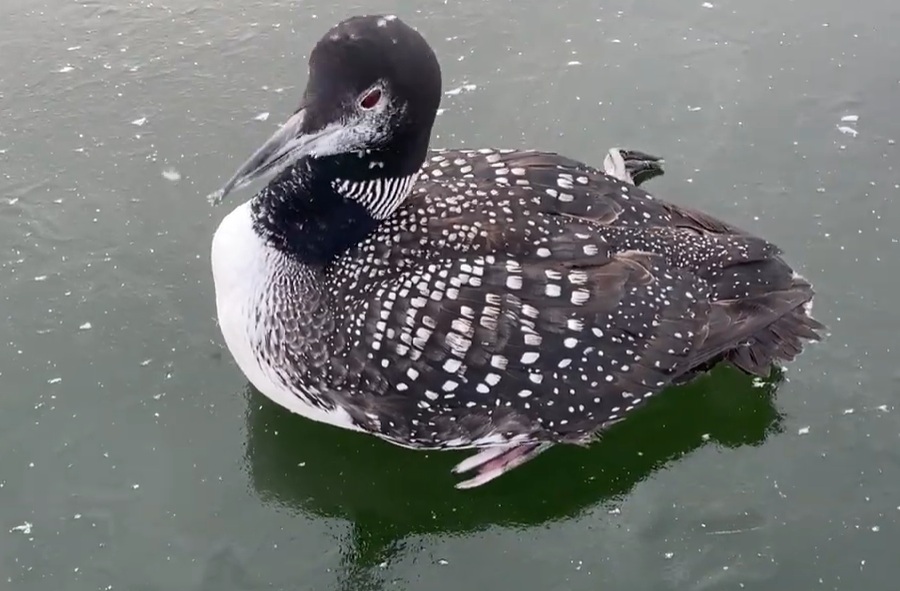
John Picone likely saved many humans during his career as a surgeon, but the life he saved Sunday was a first.
He was skating alone on East Pond in Smithfield just after noon when he passed a rock outcropping known as Loon Island. His heart skipped a beat when he spotted a loon stuck in a tiny pool of water surrounded by ice about 800 feet from shore. He knew that time was of the essence.
Picone, 66, of South Portland, is a member of Maine and New Hampshire Skating and Ice Report, a group of skaters who watch the weather and ice conditions and share information about good places to skate, always with a focus on safety first.
Picone was clad in a dry suit and helmet and armed with safety gear, including a throw rope bag, poles for testing the ice, clamps and claws to use for traction if he fell through the ice.
But his concern Sunday was the loon, which was stuck and unable to move. The cold had moved in so quickly that the bird didn’t have time to get off the pond before it froze, and it needed some 20 feet of open water in order to take off and fly.
A retired surgeon at Redington-Fairview General Hospital in Skowhegan, Picone wasn’t about to leave the loon stranded.
“I thought ‘Oh no, no no — we’re not going to leave this little guy out here,'” he recalled in an interview.
Picone skated toward the loon and spoke gently to it as he would a child, hoping to soothe and calm it. He sat with the loon for some time so it began to trust him, despite the fact that he was cold and his cellphone was dying. He called Avian Haven, a wildlife rehabilitation center in Freedom, as well as Biodiversity Research Institute, an outfit that often rescues loons. He also called members of his skating group.
Picone began to nudge the loon with the handles of his ice poles, calmly talking to it as he moved it slowly across the ice as one would a hockey puck. Once he reached the edge of the pond, he was able to get the loon on solid ground.
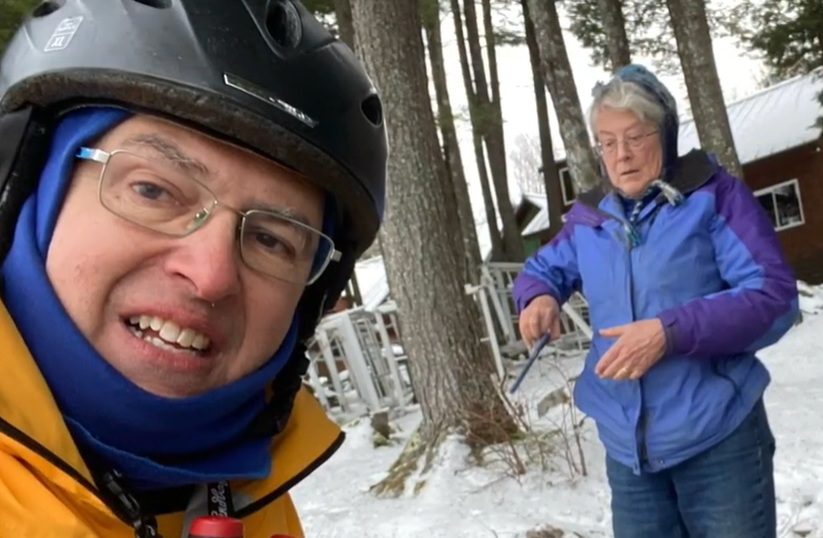
Ann Dorney, also a retired Skowhegan doctor and Avian Haven transport volunteer, soon arrived.
“She had this funny little flexible laundry basket and a smaller plastic box,” he said. “She scooped it into her basket. He liked it in there.”
Skaters from his group had shown up and one had gone to Brickett Point Road to meet Dorney. Then someone from Biodiversity Research arrived. Dorney drove the loon to Avian Haven.
Picone said he was relieved and heartened. All told, he had spent three hours with the loon.
“I was kind of like on Cloud 9,” he said. “I said, ‘It’s getting dark but I’m still going to skate some more.’ I was happy.”
Avian Haven’s executive director, Barb Haney, said Monday afternoon that an initial exam was performed on the loon, radiographs taken and its blood tested. There are signs of possible frostbite to its feet, but it’s good that the bird does not have high lead levels, according to Haney.
“He’s where he needs to be, that’s for sure,” she said. “We’re all rooting for this loon.”
Earlier in the day, Laura Moore, Avian’s admissions manager, said the loon was safe and warm.
“She’s here, she’s safe and hopefully the X-rays will show no breaks, ” Moore said.
Avian Haven staff suspect that the loon was in a late-molting state, in which it couldn’t get its feathers for flying before being iced-in on the pond, she said. When loons are molting, their feathers are being replaced with stronger ones needed to fly.
“When they’re molting, they can’t fly,” Moore said.
Moore said that within the last two days, three loons had been rescued from Pleasant Pond in Turner. When the first ice-over occurs, loons can get caught in small areas of water and thus are susceptible as prey to wildlife such as eagles.
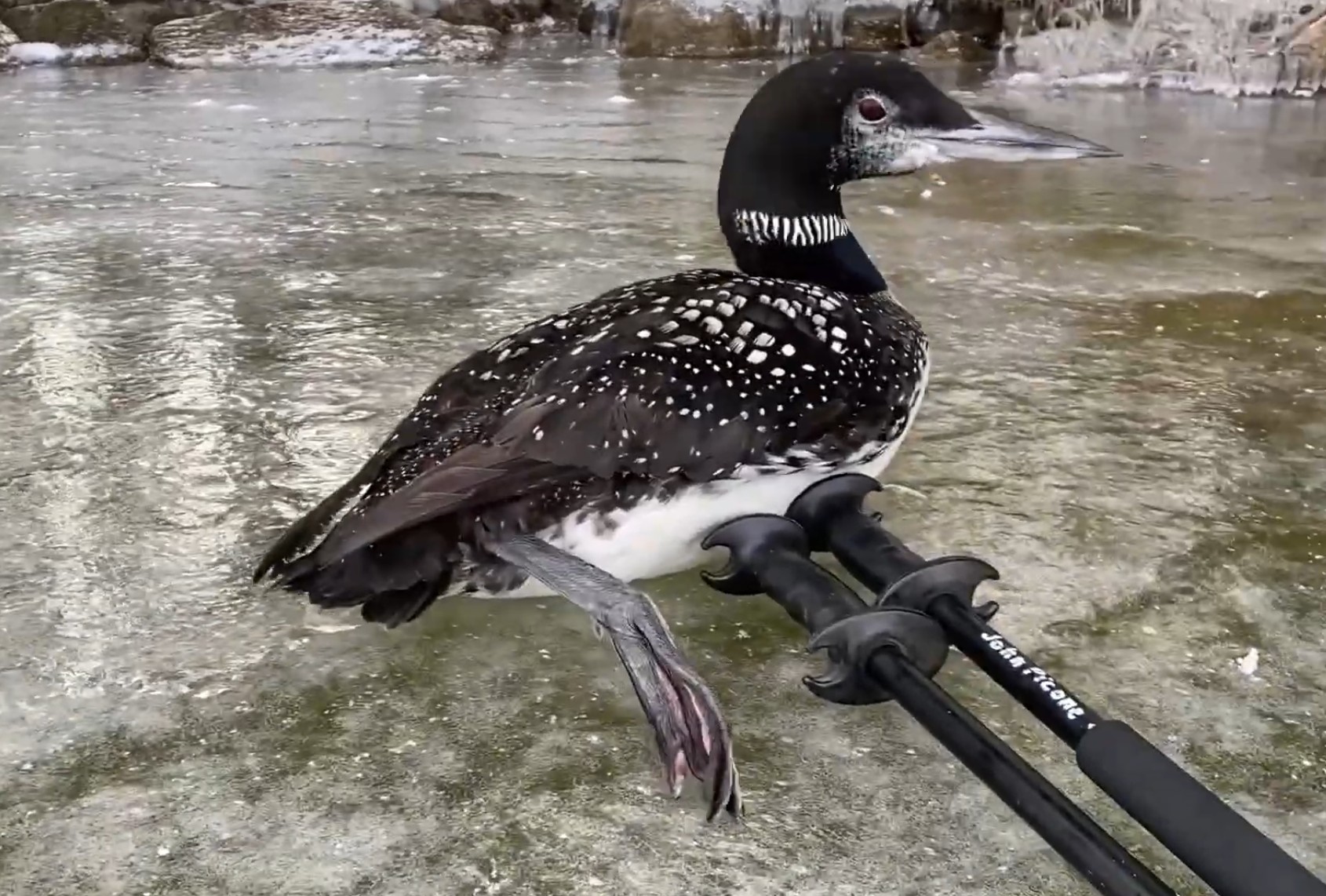
Moore praised Picone for his rescue of the loon.
“He did a wonderful job,” she said.
