

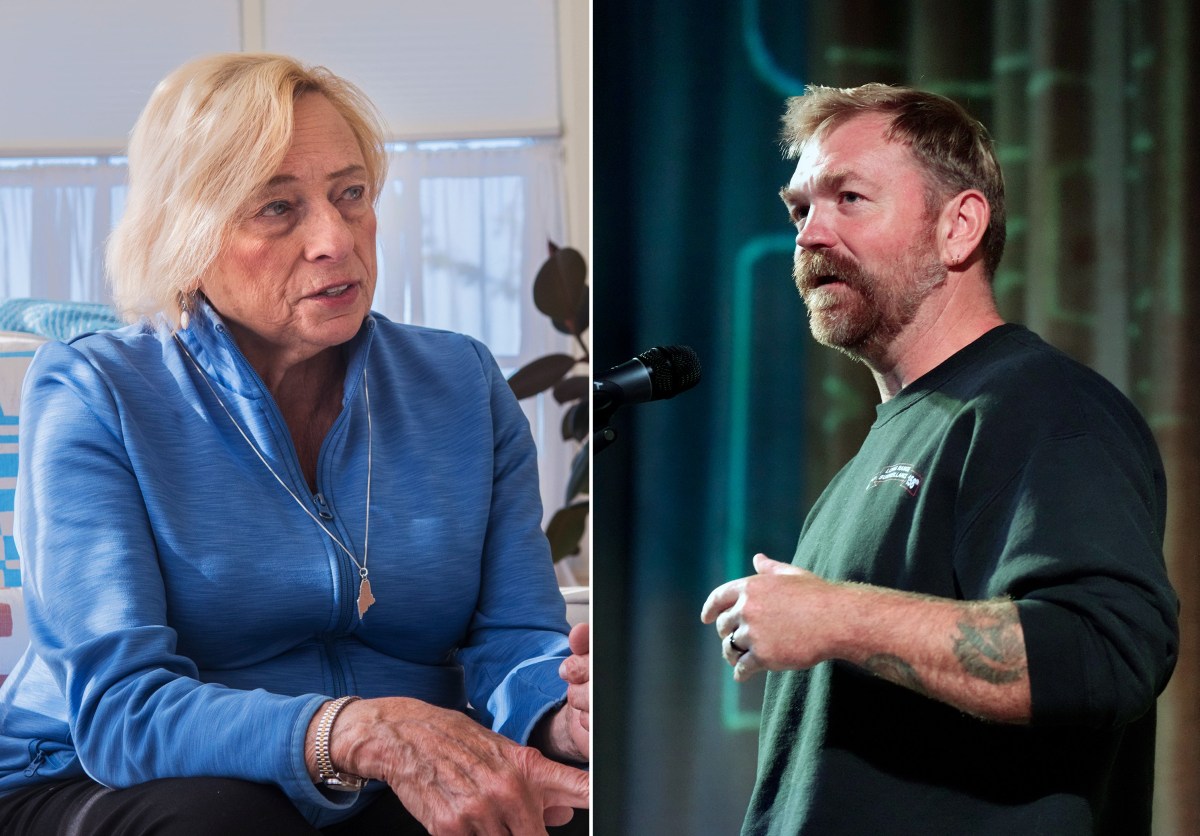
The U.S. Senate primary between Gov. Janet Mills and Graham Platner has been described as a generational battle for the future of the Democratic party. Nowhere is that more evident than by examining their online presences.
Mills, 77, is the departing governor who has two statewide election victories and decades of legislative experience under her belt. Her social media posts are reserved, consisting largely of photo-ops and links to news articles reminding viewers of her life in public service.
Platner, a 41-year-old oysterman and veteran from Sullivan, has pitched himself as an anti-establishment outsider. His pages are slick, video-heavy and well-coordinated, designed by consultants who have worked on other progressive campaigns around the country.
Social media’s sway on American politics is big and getting bigger. Four in 10 Americans say it is important for political involvement, and more than half regularly consume news through apps like Instagram, TikTok and X (formerly Twitter), according to two studies this year from the Pew Research Center.
“There are data analytics that now let you target specific voters or your most enthusiastic supporters, which lets you develop networks in a way that wasn’t possible before,” said Michael Socolow, professor of journalism at the University of Maine.
As social media has become increasingly critical to candidates’ messaging, establishing a memorable visual brand has become an equally important way to cement their place in voters’ minds. Through logos, websites, yard signs and more, graphic design can convey elements of a candidate’s policy and personality entirely nonverbally.
Still, in a state like Maine with an aging population and sharp urban/rural divide, it’s unclear how much impact social media and online presentation will have on the voters who will actually decide the election.
OLD VS. NEW
The ways Mills and Platner are each utilizing social media as a campaign tool highlight both their selling points as candidates and the differences between them.
Platner has embraced social media as a key aspect of his campaign’s outreach. His accounts consistently post a stream of specially designed graphics, vertical videos and memes engineered to be shared. Some of his most recent posts include screenshotted posts on X, labor union endorsements and videos of crowds at town halls across Maine.
The designers and staffers behind his campaign have worked for other progressive candidates across the country, including New York City Mayor-elect Zohran Mamdani and U.S. Rep. Alexandria Ocasio-Cortez, D-New York.
“It’s not Graham and a bunch of guys in Maine,” said Socolow. “It involves some national organization, which raises the question of just how organic the campaign’s tactics, strategies and designs truly are.”
Mills, on the other hand, seems more intent on reminding voters who she is than trying to go viral. Her social media pages are full of photo-ops from parades and food banks, links to news articles and brief statements about what she seeks to accomplish in office.
Perhaps as a result, Platner’s accounts cumulatively have more than twice as many followers as Mills’: Roughly 560,000 followers compared to about 208,000, respectively.
Platner has the farthest reach on Instagram, where his posts reach some 263,000 followers, compared to Mills’ 18,300. On Facebook, Platner has twice as many followers as Mills. The only platform where the governor’s following outpaces Platner’s is on TikTok, where she has about 132,000 followers to Platner’s 105,000.
Mills receives the most engagement between TikTok and Facebook. On the former, she primarily posts television interviews and occasional video edits. Her posts on the latter consist of brief text posts and links to news articles. While her posts’ performance vary by each platform, a video of Mills doing a shotski at a University of Maine tailgating event received hundreds of likes and thousands of views everywhere it was shared.
“As a politician nowadays, you’ve really got to know: How does your audience consume information? What is their preferred method of being talked to?” said Judith Rosenbaum, chair of the University of Maine’s communication and journalism department and professor of media studies.
Platner’s posts have gotten the most attention on Instagram and X, where a steady stream of digital graphics, podcast appearances and hot takes on news of the day routinely drums up several thousand likes. But unlike Mills, his audience is boosted by an audience of nationwide progressives. It’s not uncommon to find out-of-staters wishing Platner luck in the comments beneath his posts. A lot of his campaign’s early donations also came from outside Maine.
The platforms each candidate uses and the types of content they share show how they view Maine’s electorate. Platner is trying to galvanize hyper-online young voters on Instagram and X, while Mills is playing to older audiences on Facebook.
“It’s important for Platner to remember that (X) isn’t real life,” Socolow said. “I think Facebook is the most important platform in Maine politics, and that’s entirely due to the demographics, which both skew older.”
Social media also can be a disruptive campaign tool. In October, days after Mills entered the race, years-old Reddit comments resurfaced showing Platner criticizing police and calling rural white Americans “actually stupid,” among other remarks. He has since disavowed the comments, saying “it was just dumb stuff on the internet” from a period of loneliness and isolation.
That scandal and myriad of others swarming around Platner have rippled through social media before filtering through to the nationwide news cycle. The advent of digital media has provided candidates — and opposition researchers — an opportunity to speak directly to voters on a massive, previously impossible scale.
“The vast majority, especially of younger populations, get almost all of their information from social media, from news to information about political campaigns,” said Rosenbaum. “And the mainstream media, such as television, will often pick up what they’re saying from social media.”
WHAT’S IN A LOGO?
Even on a purely visual level, both Mills and Platner’s brands immediately tell you who they are — and how they differ.
Mills is reusing the logo from her 2018 and 2022 gubernatorial runs, albeit with a slimmer font this time. It shows three trees silhouetted beside her name in a green-and-blue color scheme, evoking images of Maine’s century-old “Lone Pine” flag design.
Haley McNulty, the campaign’s digital director, said Mills is sticking with the logo “because it is deeply familiar to Maine people.”
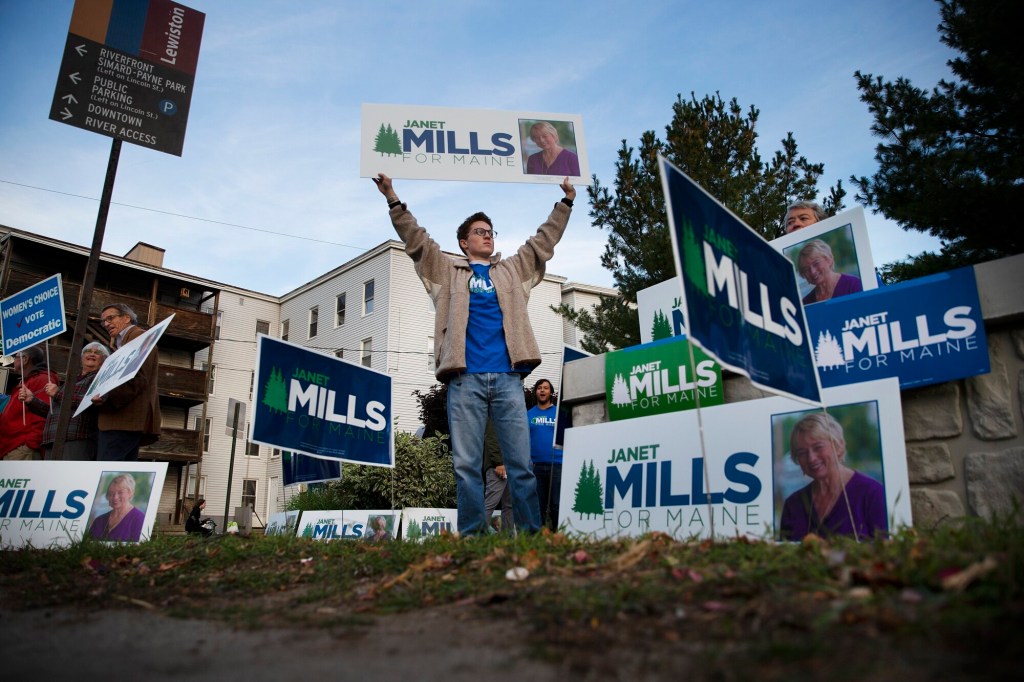
“We believed it was important to carry forward a symbol that Maine people connect with her leadership and strong record of delivering results,” McNulty wrote in an email.
Platner’s brand follows many of the same design cues as other progressive candidates: Bold fonts, a balance of bright and muted colors, and digital graphics that could work just as well as T-shirts or concert posters. (Plus a few that were actual concert posters)
From the logo to the website, Platner’s aesthetics were designed by E.J. Waltemire, an Ohio-based graphic designer who has created visual identities for dozens of progressive candidates and causes across the country.
In Platner’s logo, his name stretches upwards and silhouettes the shape of Maine inside the letter ‘P.’ The brand sticks to a more traditional red, white, and double-blue color scheme reminiscent of Platner’s military service. Waltemire said he designed Platner’s brand with a gritty, “utilitarian” style inspired by his personality and platform.
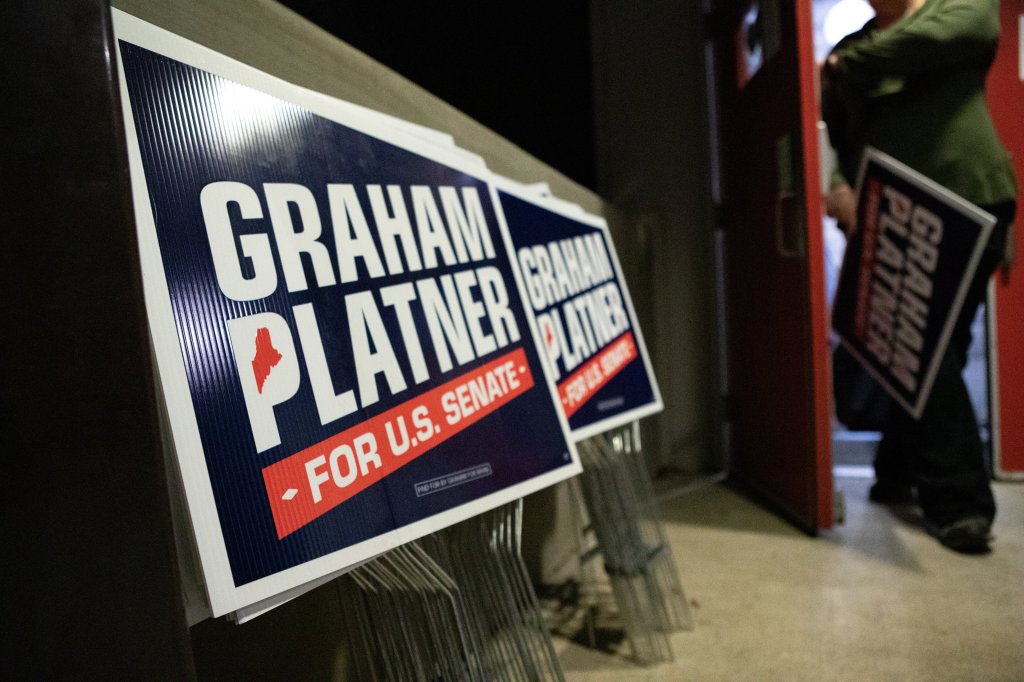
“There’s no frills, no BS. The font felt bold and like it had some working-class roots to it,” Waltemire told the Press Herald. “I think it stands up as an identity for Graham. I couldn’t take Graham’s logo and put it on another candidate, or vice versa.”
WILL IT WORK?
Social media presences, podcast appearances, and influencer endorsements have been attributed with helping both Democrats and Republicans win elections across the country in recent years. The question remains whether those trends will translate to Maine’s Senate race.
There’s both an age and geography gap in terms of who is consuming information through social media. Older, rural populations engage with digital media less than younger, urban populations.
Maine’s population is the oldest in the country on average. About 1.5% of the state’s residents — as many as 20,000 people, largely in rural areas — still lack any kind of internet access. As a result, it will be difficult for either candidate to win solely on the back of a well-coordinated digital strategy.
“You see candidates (in Maine) doing a lot of town halls as well as having an active social media presence. That is what you have to do if you want to reach both the northern counties, the central counties, and the southern counties,” said Rosenbaum.
There isn’t much, if any, precedent in Maine for the kind of digital campaign Platner is running. No candidate’s online reach has been as wide as his, and few have been able to consistently draw crowds like he has.
While the state has a history of supporting outsider candidates facing off against established politicians, it’s anyone’s guess if either Platner or Mills will be able to translate Instagram likes and Facebook shares into electoral victories. But with months to go until the primary election and nearly a year until the general, they’ll have plenty of time to try.

We invite you to add your comments. We encourage a thoughtful exchange of ideas and information on this website. By joining the conversation, you are agreeing to our commenting policy and terms of use. More information is found on our FAQs. You can update your screen name on the member's center.
Comments are managed by our staff during regular business hours Monday through Friday as well as limited hours on Saturday and Sunday. Comments held for moderation outside of those hours may take longer to approve.
Join the Conversation
Please sign into your CentralMaine.com account to participate in conversations below. If you do not have an account, you can register or subscribe. Questions? Please see our FAQs.