

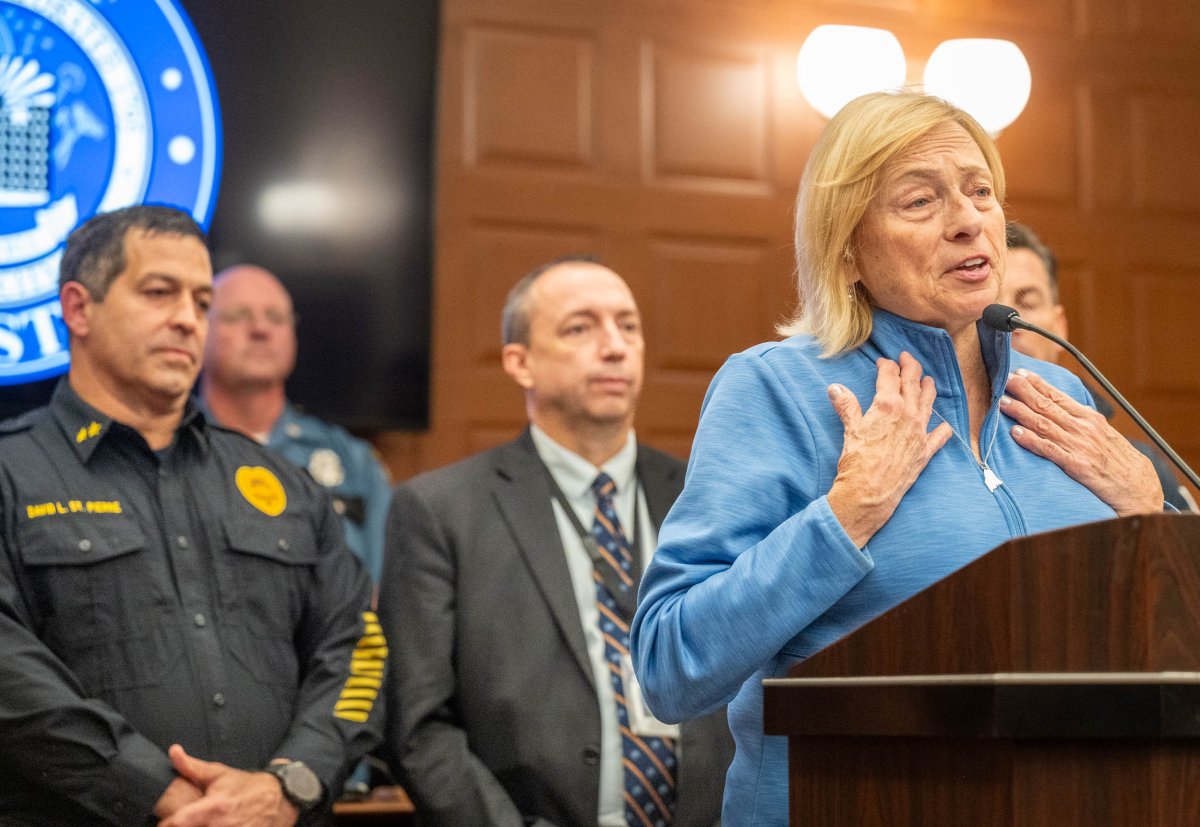
Gov. Janet Mills announced Monday she will allow a bill to become law that limits the ability of local and state police to work with federal immigration authorities.
Mills had previously decided to hold the bill — one of the most controversial of the legislative session that ended in June — after it was passed by lawmakers. She said in July that she would wait until the start of the next legislative session to make a decision, at the time citing concerns about the bill being “overly broad and confusing.”
The governor announced her decision Monday in an op-ed in the Portland Press Herald in which she reiterated her concerns, but also said she could not ignore how President Donald Trump has “weaponized” U.S. Immigration and Customs Enforcement in his second term.
“LD 1971 is imperfect, and we should not need it, but the times call for it,” Mills wrote. “We cannot turn a blind eye to ICE’s unacceptable actions, and so I have chosen to allow LD 1971 to become law.”
Mills, a Democrat who is running for U.S. Senate, also announced she would repeal an executive order signed by former Republican Gov. Paul LePage in 2011 that called for enhanced cooperation between state and federal officials on immigration enforcement.
“Under any other president, this may be acceptable, but under this Trump administration, it has become a broad and dangerous promise that Maine will not make,” Mills wrote.
Bill follows ramped up deportation efforts
Rep. Deqa Dhalac, D-South Portland, the sponsor of LD 1971, said Monday she was happy to see Mills support the bill, but disappointed the governor had not done so sooner.
“When the Legislature enacted this bill last June, we made it clear that defining the boundaries between state law enforcement and federal immigration authorities was critical to safeguarding our communities,” Dhalac said in a written statement.
The bill would prohibit state, county and local law enforcement officers from investigating, detaining or searching a person solely for immigration enforcement purposes.
It follows ramped up enforcement of immigration laws and deportation efforts by the Trump administration. While Trump originally said he would focus on deporting violent criminals who are in the country illegally, his administration has detained people who were not accused of crimes. In some cases, authorities have deported people without allowing them due process.
Recent actions impacting people in Maine have drawn concern here. For example, earlier this year, a state trooper pulled over a carpenter and part-time DJ who was on his way to a music festival. The traffic stop led to a two-month ordeal for the man, a Brazilian national who had overstayed his visa. He was detained in Texas for weeks before he was eventually released on bond.
The bill would also prohibit local officers from being placed under the supervision of federal authorities to work on immigration enforcement, and would ban local law enforcement from using federal immigration officers as interpreters.
It would still allow local officers to participate in various task forces with federal agencies, and to assist federal agents in criminal investigations. Local officers would be able to execute warrants and share information on suspected criminal activity. Additionally, federal immigration agents could interview someone in custody with a court order.
Police, Republicans criticize decision
Mills did not sign LD 1971 within the 10-day window given to her by law after the bill passed. It was then held on her desk with the option for her to either veto it or allow it to become law without her signature at the start of the next legislative session, which is scheduled for Jan. 7.
A spokesperson for the governor said Monday she has been weighing the bill since the spring and “continues to be appalled by the tactics of the Trump administration when it comes to immigration enforcement.”
“She made her decision, and when she makes her decision, she tells the people of Maine,” spokesperson Tony Ronzio said in an email.
It will still be many months before the bill takes effect. Bills that are held and then become law go into effect following the session they were held over to, typically 90 days after adjournment, which is likely to be in mid-July.
The Maine Chiefs of Police Association sent a letter to Mills last week asking her to veto the bill.
“While we are disappointed in this outcome, we respect the legislative process,” said Scott Stewart, president of the association and Brunswick police chief, in an email. “As law enforcement professionals, we remain committed to upholding our oath to serve the citizens of Maine. However, LD 1971 will present us challenges and obstacles for us.”
The letter from the chiefs association said the bill “increases the risk that dangerous offenders may walk free before (federal authorities) can respond.” The organization said the bill adds burdensome new record-keeping and disclosure requirements without additional resources, and that it would force police agencies to contract for paid translation services, which could be costly.
“There is also a broader concern that LD 1971 could draw national scrutiny,” the letter said. “The Trump administration has repeatedly taken a hard line against states and municipalities that adopt restrictive cooperation policies, threatening funding cuts and increased enforcement actions.”
Mills said she too has concerns about the bill’s impact on law enforcement, but believes officers will adapt to the new requirements. “Public Safety Commissioner (Mike) Sauschuck stands ready to offer them guidance and to reinforce their ability to work with federal agencies on human trafficking, fentanyl importation and other serious crimes,” Mills wrote.
Mills’ decision comes as she wages a competitive primary battle for U.S. Senate against Graham Platner, a Sullivan oyster farmer and veteran. Republicans on Monday criticized her announcement, including David Jones, a candidate for governor, who called Mills’ move “a political stunt to rally her left-wing base, win the primary, and block Trump.”
The bill passed largely along party lines in the Legislature last spring, with only two House Democrats joining with Republicans in opposition.
“Limiting cooperation between Maine law enforcement and federal authorities — a longstanding tradition due to Maine’s extensive foreign border — shows a reckless disregard for public safety and will put Maine’s public at risk,” Maine House Republicans said in a statement.

We invite you to add your comments. We encourage a thoughtful exchange of ideas and information on this website. By joining the conversation, you are agreeing to our commenting policy and terms of use. More information is found on our FAQs. You can update your screen name on the member's center.
Comments are managed by our staff during regular business hours Monday through Friday as well as limited hours on Saturday and Sunday. Comments held for moderation outside of those hours may take longer to approve.
Join the Conversation
Please sign into your CentralMaine.com account to participate in conversations below. If you do not have an account, you can subscribe here. Questions? Please see our FAQs.