

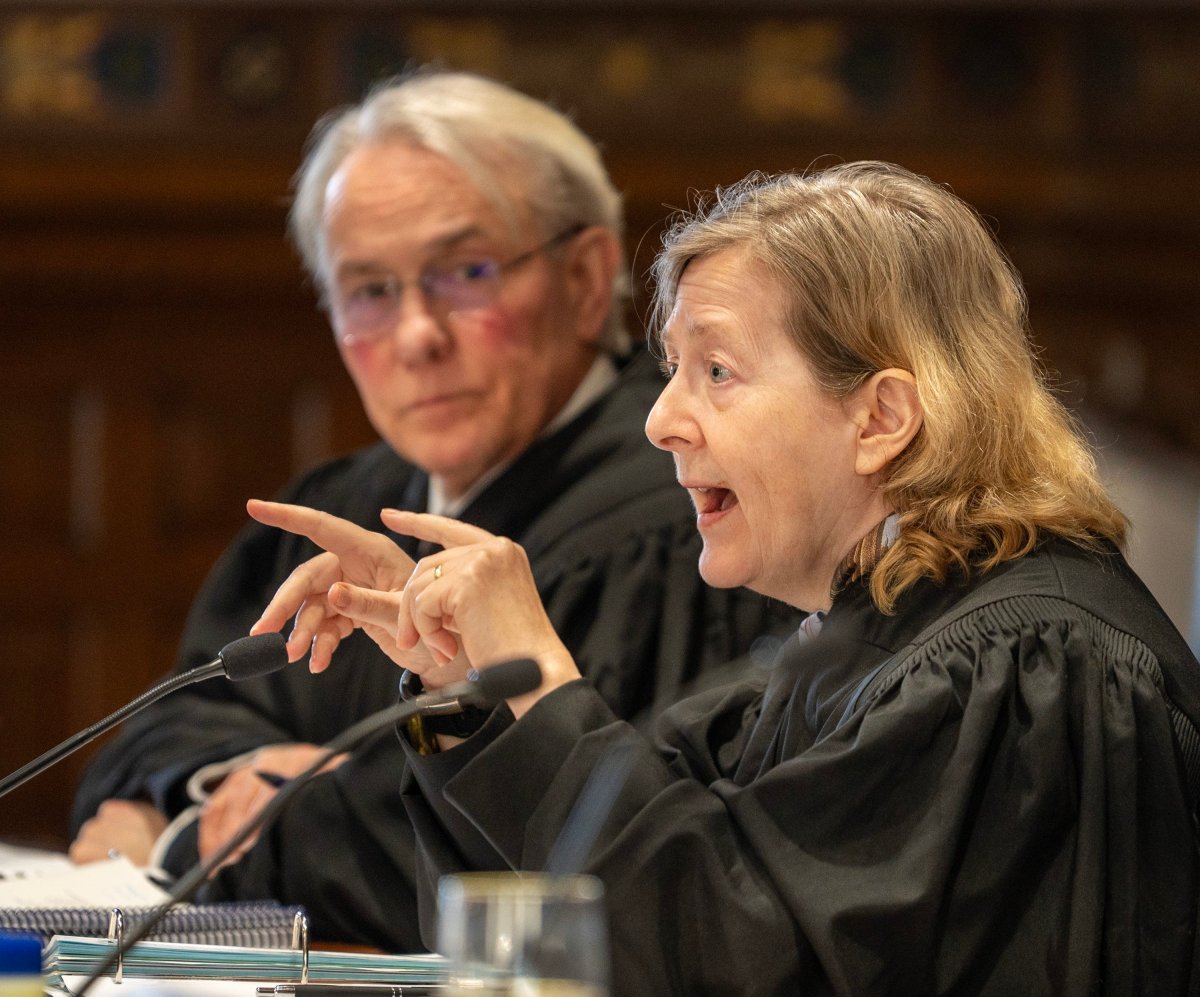
A panel of Maine judges is weighing whether to publicly reprimand a justice on the state’s highest court who has been accused of wrongdoing by the state’s Committee on Judicial Conduct.
Catherine Connors, an associate justice on the Maine Supreme Judicial Court, did not recuse herself in 2024 from two major foreclosure cases, which overturned precedent set by rulings in earlier cases that protected homeowners not appropriately notified that they had defaulted on their loans.
As a private attorney before joining the court, Connors regularly represented banks and banking interests and worked for them on the cases that led to precedent-setting decisions that she was a part of overturning last year.
The judicial conduct committee has said Connors violated a portion of the state’s rules for judges by failing to recuse herself from a case in which a “reasonable person” might believe she had a personal interest.
In one of the 2024 decisions by the supreme court, Connors joined the majority, and the court was split 4-3.
“This is something that involved foreclosure cases and, unfortunately, the law changed and a lot of people are going to be hurt by that,” John McArdle III, an attorney for the state’s Committee on Judicial Conduct, said during oral arguments on Monday. “And the law wouldn’t have changed if Justice Connors didn’t sit on the case. The law would have remained the same, because it would have been a tie, three-to-three.”
This is the first time in the committee’s 47-year history that it has sought discipline against a member of the state supreme court, McArdle said.
The committee’s investigation stemmed from a complaint filed against Connors by a foreclosure attorney in January 2024. Her peers on the high court said in June they could not consider her case after the judicial conduct committee filed its official request because of newly established rules that require an independent panel of judges for complaints involving the supreme court.
A panel of judges from both District and Superior courts was assembled and heard arguments Monday. There is no timeline for their decision.
An attorney for Connors said on Monday the justice had no obligation to recuse herself and had reached out to an advisory committee for the court, seeking an opinion on whether she should recuse herself from one of the cases. They said it was fine for her to consider the case.
“There is no conflict of interest in this case, either alleged or even suggested in the materials,” said attorney James Bowie, who is representing Connors.
Bowie said during the hearing Monday that none of the many attorneys involved in the 2024 cases, on either side, asked Connors to step away. He said McArdle was unable to cite any similar cases that ended in discipline for judges.
“Judges throughout the United States, but certainly in a state as small as the state of Maine, have lives as lawyers before they become judges,” Bowie said.
McArdle said Connors did not present the advisory committee with all of the information it needed when she asked whether to recuse herself. He also said that Connors committed to recusing herself from such cases during a confirmation hearing with state lawmakers in 2020. The two sides disagreed on Monday whether Connors had promised to recuse herself for her first couple of years as a justice or for the entirety of her time on the court.
McArdle also said the Judicial Conduct Committee is not accusing Connors of being biased. He said the committee is concerned of the appearance of bias, which he said the rules of conduct are designed to prevent.
“It looks bad,” he said. “It looks bad because the facts suggest the question, can this judge be fair? That’s a fair question. The fact that a reasonable person can ask that question means there’s a violation.”

Comments are not available on this story. Read more about why we allow commenting on some stories and not on others.
We believe it's important to offer commenting on certain stories as a benefit to our readers. At its best, our comments sections can be a productive platform for readers to engage with our journalism, offer thoughts on coverage and issues, and drive conversation in a respectful, solutions-based way. It's a form of open discourse that can be useful to our community, public officials, journalists and others.
We do not enable comments on everything — exceptions include most crime stories, and coverage involving personal tragedy or sensitive issues that invite personal attacks instead of thoughtful discussion.
You can read more here about our commenting policy and terms of use. More information is also found on our FAQs.
Show less