
Richard Russo, a novelist, lives in Portland.
At Maine Needs, I’m given a sheaf of request forms to browse through. The organization gets two or three hundred of these a day from organizations — hundreds of them — throughout the state. These request forms, I soon realize, are stories.
A provider who works for the Portland School District needs diapers — sizes 2, 4 and 5 — for three different families. Why? Because the fathers have been detained by ICE, and the mothers, terrified, are trying to make ends meet until the situation can be resolved.
Another family in Westbrook with an autistic child needs four suitcases, as well as diapers and wipes. Having fallen behind in their rent, they’re being evicted from their apartment. With all the nearby shelters full, they have no place to go. I imagine them cramming everything they own into the suitcases.
Another case worker is acting on behalf of an unhoused man who has the exact opposite problem. All his belongings have been stolen so now he needs, well, everything. Both he and his caseworker are embarrassed to present Maine Needs with such a long list, but the man in question was on the cusp of getting the very housing he’d been trying to land for many months when the theft occurred.
Some people who need just about everything haven’t any idea where to start. Consider the couple that a self-described “life navigator” named Demi is trying to help. They just narrowly escaped dying in a fire that burned down the house they were living in. Unable to afford renter’s insurance, they are now both broke and broken. Another organization put them up in a budget motel for three nights, after which a friend loaned them a winterized RV that has neither a generator nor heat.
After a week of shivering in the bitter cold, they’re still in shock. Demi urges them to make a list of everything they need, but where do they begin? Do they even have a notepad? A pen? What would they put on the list?
But this is where Maine Needs excels. The people who volunteer there are not in shock and they’ve seen it all. They know that this couple will need big things like clothing and pots and pans, yes, but also small ones. Deodorant. Mouthwash. Sponges. Cleaning kits.
Volunteers and caseworkers alike have seen people break down and sob when offered such things. I hear it over and over as I read these request forms. People need essential, often expensive items: warm clothing, pots and pans. But they also need things that are less tangible. They need hope. They need dignity. If they had these, maybe they could focus on something other than mere survival.
One volunteer I talk to admits that the needs of poor people in Maine are so great, so tidal in their persistence, that volunteers can become numb. But then comes a request that shocks them. A provider who works for Maine Health has a client who is 27 and pregnant. She needs shirts, leggings, sweatpants, a winter jacket.
It’s the unexpected, crushing detail that knocks the provider (and me) sideways. Please don’t include baby things in this order, the request form says. Why not? Because the mother is facing incarceration and probably will not be raising her child. Items intended for the baby would only intensify her suffering, her shame.
Many of the people with the most critical needs in Maine are women fleeing domestic violence, and they flee not just because they need to, but because they need to right now, right this minute. There’s no time to take with them what they’ll need tomorrow, or even an hour from now.
Such is the case with a woman that Courtney, a provider, is trying to help. Had there been time, the woman would have thrown razors, tampons, paper towels, toiletries, laundry and dish detergent, pillowcases, baby shampoo, toothpaste and toothbrushes, as well as cooking utensils, into a bag. She’ll definitely need all these things and so much more in her new apartment, but of course there wasn’t time, and she was frightened, not just for herself but for her 6-year-old son. He needs stuff, too. Underwear and socks and shirts and pants and hoodies.
And here’s the detail that gets me, that causes my throat to close. School is starting next week, and the boy will need a backpack for his supplies. I can see this kid in my mind’s eye, clear as a bell, and I can imagine what it would be like for him to arrive at school without the backpack that all the other boys have, the thing that will set him apart, mark him as different, as somehow less than the other kids.
Except he needn’t worry. Maine Needs will find him a backpack. And who knows? Maybe now that he has this one essential thing, he’ll make a friend that first day of school. Maybe he and his mom will be OK. This is the story I tell myself, because right now, right this minute, I need this to be true. His hope is my own.
So many stories, most of them with their own idiosyncratic surprises. A provider who works for an organization called Maine Pre-trial has a client who’s just been released from incarceration with little but the clothes on his back. He’s now expected to find a place to live and begin a new life there. To this end he needs boots, a winter coat and hat, sweatpants and sweatshirts. What he doesn’t know yet — how could he? — is that he has other unimagined needs as well.
A group called Capitol Region Public Defenders has noticed that when their clients “look their best” in court (not dressed in sweatpants and sweatshirts, I’m guessing) they have better outcomes. So, add those nicer clothes to the list.
And then there’s the newly arrived Muslim family of eight who need cleaning supplies. Cleanliness, their provider explains, is of central importance in Muslim culture. I’m about to move on to the next request form when I see an oh-by-the-way footnote that makes me grin. “Do you guys ever get hijabs or abayas?”
What also strikes me as I read through these request forms is how often providers contact Maine Needs when they don’t require anything except to share unexpected moments of joy. I come across one such message from a pediatrician who writes to describe the moment she handed a boy a pair of brand-new boots. What she wishes more than anything is that she had a photo of the kid’s face when he saw those boots and understood that they would actually be his. Now, he told his provider, he could actually look forward to snow, to his new life in Maine.
Barbara, my wife, had a similar experience soon after she discovered Maine Needs and started volunteering there. A request came in from a case worker for a pair of size 7 pink, high-top sneakers. These, the case worker stressed, were the only thing this girl wanted, which struck Barbara as a shame, because really? What were the odds?
Still, a large shipment of donations had come in the previous afternoon, and they hadn’t been sorted yet, so why not have a look? And there they were. Pink, high-top sneakers. Except … just the one pair, and what were the odds they’d be size 7? Wouldn’t it be better if there were no pink high-tops than to have just the one pair in the wrong size?
Wincing, Barbara picked them up, lifting the tongue of the shoe. Size 7. And in that moment, the girl who wanted these shoes, who needed them, became even more real than she’d been earlier.
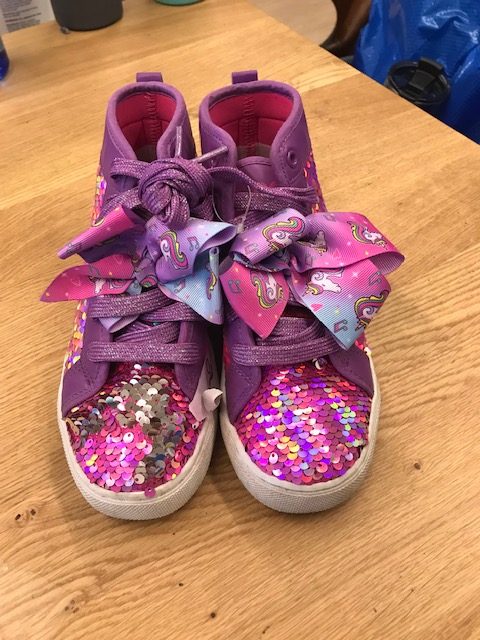
To celebrate, Barb took a photo of the sneakers — bright, radiant pink, dazzling with sparkles — and had it posted on the organization’s social media platform, where it offered the organization’s other volunteers not just validation but a sense of wonder. And yes, joy.
These days, storytellers like me are often reminded that other people’s lived experience belongs to them and them alone, but these request forms demand not just empathy but moral imagination.
What would it mean if I were able to read them without conjuring up the person who desperately needs diapers and can’t afford them?
I mean, be real. The family with the autistic child is not supposed to remind me that one of the people I love most in the world is also on the spectrum?
OK, moral imagination is a storyteller’s stock-in-trade, but I’m happy to report that we don’t have a monopoly on it.
To those who volunteer at Maine Needs, their work is not abstract. They too see the hundreds of request forms that rain down on the organization every day as stories, and not just stories but stories about their neighbors.
Better yet, thanks to Maine Needs, providers all over the state no longer need to prioritize, to decide which of those neighbors need help the most. What’s that worth?
There are hundreds of requests like these pouring in and being fulfilled by volunteers, six days a week. If you want to be part of meeting these needs, please give what you can at maineneeds.org.
We invite you to add your comments. We encourage a thoughtful exchange of ideas and information on this website. By joining the conversation, you are agreeing to our commenting policy and terms of use. More information is found on our FAQs. You can modify your screen name here.
Comments are managed by our staff during regular business hours Monday through Friday as well as limited hours on Saturday and Sunday. Comments held for moderation outside of those hours may take longer to approve.
Join the Conversation
Please sign into your CentralMaine.com account to participate in conversations below. If you do not have an account, you can register or subscribe. Questions? Please see our FAQs.