

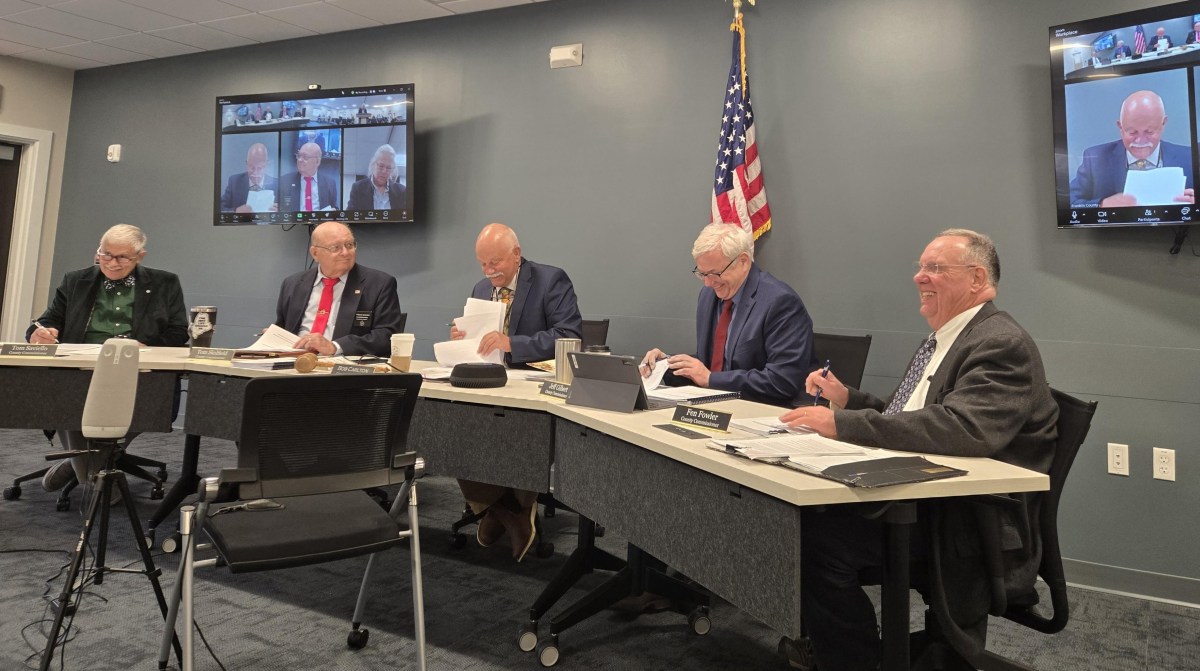
Franklin County commissioners voted 4-1 on Tuesday to adopt a resolution that calls for commissioners who took a health insurance stipend as of July 1 to repay it, retroactively.
The funding for the stipend — $6,845 per person annually — was eliminated from the 2025-26 budget by the county’s Budget Advisory Committee, setting off a dispute over who has final say on the spending plan.
That was decided in the committee’s favor, but four of the commissioners — Chairman Bob Carlton of Freeman Township, Vice Chairman Tom Skolfield of Weld, Jeff Gilbert of Jay and Fen Fowler of Farmington — continued to receive the benefit when the new budget went into effect July 1.
Those commissioners will need to repay $2,619.70 each, county Administrator Amy Bernard wrote in an email Wednesday.
Carlton opposed the resolution; Tom Saviello of Wilton, Skolfield, Gilbert and Fowler favored it.
Saviello didn’t take the stipend beginning on July 1. Skolfield recently stopped receiving the benefit.
Fowler drafted the resolution to repay the money.
“I feel we have to bite the bullet, otherwise it is not going to go away,” he said.
Fowler pointed out that it is a “hard pill to swallow” but he knows he’s not alone in seeing health insurance costs rise.
He said he thinks about the 54,000 Mainers who will see their health insurance costs go up on Jan. 1, as subsidies through the Affordable Care Act expire.
“I think if we do bite the bullet … and we start to build a strong conversation with the budget committee and have a productive working relationship, they can help us solve some of the problems facing our county,” Fowler said.

Comments are not available on this story. Read more about why we allow commenting on some stories and not on others.
We believe it's important to offer commenting on certain stories as a benefit to our readers. At its best, our comments sections can be a productive platform for readers to engage with our journalism, offer thoughts on coverage and issues, and drive conversation in a respectful, solutions-based way. It's a form of open discourse that can be useful to our community, public officials, journalists and others.
We do not enable comments on everything — exceptions include most crime stories, and coverage involving personal tragedy or sensitive issues that invite personal attacks instead of thoughtful discussion.
You can read more here about our commenting policy and terms of use. More information is also found on our FAQs.
Show less