

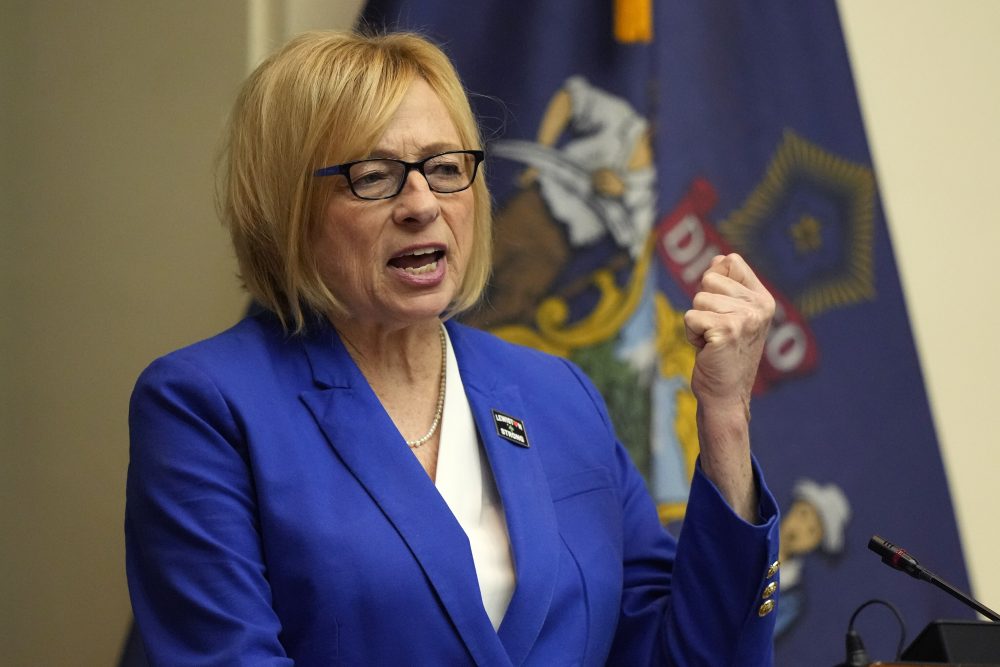
Gov. Janet Mills will outline her priorities for her final year in office in a Jan. 27 speech that will set the agenda for the legislative session and provide fodder for a contentious election cycle.
Mills will use her final State of the State address to thank Mainers for allowing her to serve as governor. She’ll highlight progress made by her administration, and address the ongoing affordability challenges residents continue to face.
“I am proud of the progress we have made together, but, as we all know, there are still many challenges ahead,” Gov. Mills said in a written statement. “Maine people are struggling to get by, and by working together, we can take action to help them and make life more affordable for folks across our state.”
Her address comes at the beginning of what promises to be an extraordinarily partisan session with the entire Legislature, the governorship, two congressional seats and a U.S. Senate seat on the line.
Mills, 78, is positioning herself to run for U.S. Senate. She’s locked in a competitive Democratic primary against a political upstart, Graham Platner, a 41-year-old combat veteran and oyster farmer who has received the backing of national progressives.
The winner will take on Republican Sen. Susan Collins, 73, in the fall.
The stakes of the session are high, with lawmakers confronting challenges such as a lack of affordable housing, rising property taxes and concerns about how federal spending cuts will affect access to food and health care.
Several state lawmakers are also looking for promotions, with two senators and a representative running for governor and a representative running for Congress.
In her statement about the speech, Mills gave no hints about how she will handle some of last year’s outstanding business. Mills must take action on 61 bills that were enacted by lawmakers last session. Since she did not sign any of them within 10 days of enactment, she can either veto or allow them to become law without her signature.
Mills will also propose a supplemental budget to plan for an additional $250 million in state revenue predicted by the state’s nonpartisan budget forecasters. An additional $165 million is projected in the current budget, plus an another $83.3 million next year.
Republicans, who are in the minority in the House and Senate, will continue their calls for tax cuts. Democrats will likely seek additional funding for programs and services, including for 150 bills already approved but unfunded, and for additional measures to fill gaps in food assistance and health care caused by federal cuts.
Mills said she hopes lawmakers will come together and work in the best interests of Maine people.
“I have always strongly believed that lawmakers, regardless of party affiliation, share a deep desire to improve the lives and livelihoods of Maine people,” she said. “I am optimistic that we can have productive and respectful debates with one another and make important progress on issues that matter to the people we faithfully serve.”

We invite you to add your comments. We encourage a thoughtful exchange of ideas and information on this website. By joining the conversation, you are agreeing to our commenting policy and terms of use. More information is found on our FAQs. You can update your screen name on the member's center.
Comments are managed by our staff during regular business hours Monday through Friday as well as limited hours on Saturday and Sunday. Comments held for moderation outside of those hours may take longer to approve.
Join the Conversation
Please sign into your CentralMaine.com account to participate in conversations below. If you do not have an account, you can register or subscribe. Questions? Please see our FAQs.