

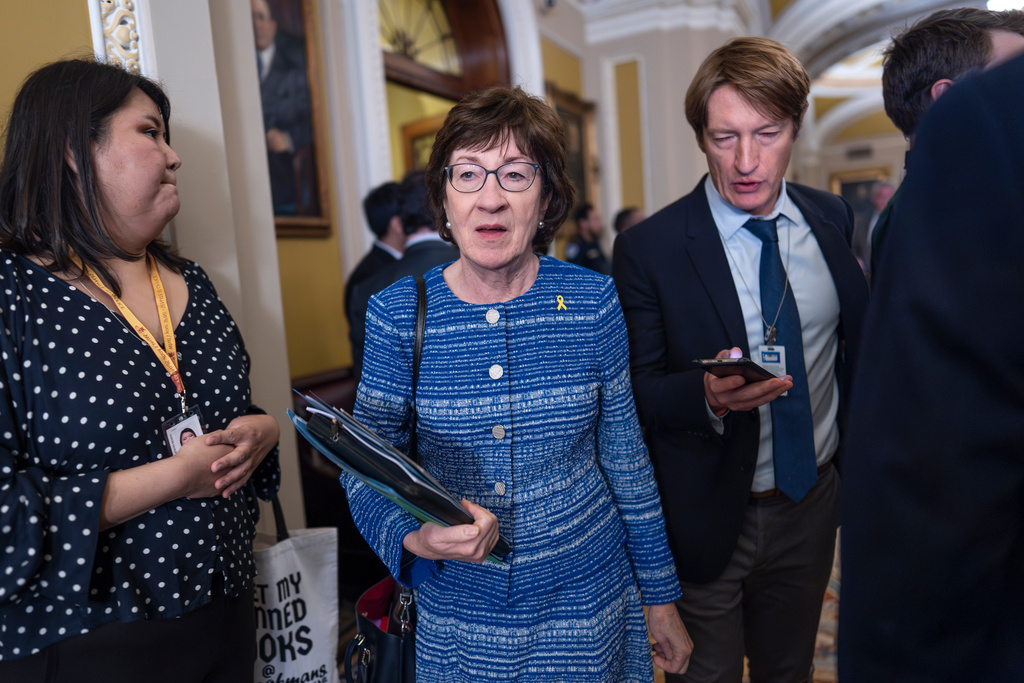
Republican U.S. Sen. Susan Collins is used to handling the difficult political situations she’s often put in by her party’s standard bearer.
But President Donald Trump’s decision to capture and try Venezuelan President Nicolás Maduro raises a new challenge for Collins as she walks a thin line between supporting her party’s leader and trying to win a sixth term.
In an interview with the Press Herald Tuesday, Collins defended the administration’s arrest of Maduro, pointing to a $25 million bounty for his capture and extradition to the U.S. that was placed by former President Joe Biden, a Democrat. She noted Maduro has been indicted and should face trial in U.S. courts, a process now underway.
But she also disagreed with Trump’s contention that America would “run” Venezuela in the aftermath of Maduro’s capture.
“To me, the Venezuelans should run their own country,” Collins told the Press Herald. “I do not believe that the president should commit us to any long-term military involvement in Venezuela. That would require congressional authorization under the War Powers Act.”
Collins said Congress should have been notified before the operation, but stopped short of saying that the administration needed prior approval. Such approval, she said, would be needed if the U.S. plans to put “boots on the the ground” and run the country for a prolonged period. (Trump has said he’s not afraid to do this.)
Administration officials have offered conflicting descriptions of U.S. plans. While Trump has said the U.S. will “run” Venezuela and has not ruled out sending ground troops, Secretary of State Marco Rubio says the U.S. will use the mission as “leverage” to influence the country.
Whether the legally questionable operation will have a long-term impact on the Senate race — and if so, who could benefit — remains to be seen. Political analysts said that will depend on how the situation unfolds and future U.S. involvement. Collins’ Democratic opponents were quick to push her to do more to stand up to Trump.
Andrew Rudalevige, a government and legal studies professor at Bowdoin College, said the role the intervention will play in Maine’s Senate race depends on whether Maduro’s capture was a limited law enforcement operation or a long-term project to install a U.S.-friendly regime.
“If it morphs into that latter, where we’re effectively attempting to re-create a new regime in Venezuela, and it turns into an analogue of Iraq, or Afghanistan or older 19th- and 20th-century Latin American operations by the U.S., then I think it does have some legs,” Rudalevige said.
Nicholas Jacobs, a political science professor at Colby College, said the raid will raise more questions about Congress’ willingness to “stop an imperial presidency.” It could also highlight Trump’s previous vow to end “forever wars” and focus on America first.
“If this sticks at all, it won’t be about Venezuela,” Jacobs said. “If (Trump’s) unsuccessful, it makes the midterm election even more a referendum on Trump’s presidency in a way Republicans probably hoped to avoid.”
In addition to Trump’s Venezuela mission, he has also raised possible U.S. action against Colombia and Greenland.
Collins has a complicated relationship with Trump. She hasn’t supported any of his campaigns for president and voted to impeach him after the Jan. 6, 2021, Capitol riots. She has at times enabled his agenda, while also leaving enough room to criticize his actions.
Not surprisingly, Collins’ political opponents are criticizing her for not taking a tougher stand.
Gov. Janet Mills and political newcomer Graham Platner, who are both vying for the Democratic nomination to take on Collins, said the administration violated both the U.S. Constitution and international laws in Venezuela.
Platner, a combat veteran and oyster farmer, called the operation “international gangsterism,” and said in a fundraising email that the U.S. had “illegally invaded a foreign country and kidnapped its leader.”
“From Iraq to Venezuela, you can count on Susan Collins to continue to enable illegal foreign wars,” said Platner, who fought in Iraq and Afghanistan.
Mills acknowledged on social media that Maduro was a “brutal dictator who oppressed and murdered his own people,” while accusing Trump of moving the U.S. closer to a “costly, unnecessary and unjustified war.”
Mills called on Collins to put a hold on Defense and State Department nominations until the administration clarifies Trump’s statement that the U.S. will run the country.
She also called on Collins to use her power as chair of the Senate Appropriations Committee to hold hearings and add language to future budget bills prohibiting U.S. funds from being used in Venezuela, for its governance or on military support for oil operations without congressional approval.
“We have had enough of Senator Collins feigning concern about the president’s abuses on the one hand while she rubber-stamps his agenda and his actions on the other,” Mills said in a press release. “I call on Susan Collins to use the power she claims to have as Maine’s senior senator to demand accountability from the Trump administration and stand up to his dangerous and self-motivated power grab.”
Collins told the Press Herald that questions about the military operation and future plans are best conducted in a classified briefing, which she said the entire U.S. Senate will receive on Wednesday morning.
Collins dismissed calls for her to use the appropriations committee to rein in future military action in Venezuela, saying senators are hard at work trying to pass budget bills to avoid another government shutdown at the end of the month.
Both Mills and Platner criticized Collins for voting against a bill in the Senate that would have required congressional authorization to use military force in Venezuela. The November vote came as the administration was bombing boats suspected of carrying narcotics. It was defeated 51-49.
A Collins spokesperson told the Press Herald last month that the senator’s vote stemmed from vague language in the bill and did not authorize any new military attacks or actions on Venezuela.
Ronald Schmidt, a political science professor at the University of Southern Maine, said Collins’ vote could come back to haunt her, though voters have historically been willing to give her a pass when it comes to Trump’s actions.
“This could wind up costing her in the election, but it also might not,” Schmidt said. “By the time the election comes around, Maine voters, if they’re thinking about Venezuela at all, might be focused on Trump, and not her.”

We invite you to add your comments. We encourage a thoughtful exchange of ideas and information on this website. By joining the conversation, you are agreeing to our commenting policy and terms of use. More information is found on our FAQs. You can update your screen name on the member's center.
Comments are managed by our staff during regular business hours Monday through Friday as well as limited hours on Saturday and Sunday. Comments held for moderation outside of those hours may take longer to approve.
Join the Conversation
Please sign into your CentralMaine.com account to participate in conversations below. If you do not have an account, you can register or subscribe. Questions? Please see our FAQs.