
Everyone occasionally indulges in some magical thinking. Some ritually buy a lottery ticket once a week despite knowing the odds are never in their favor; others regularly knock on wood, just in case; and then there are those who send up a prayer to someone or something they’re not even sure they believe in. Most of us are more likely to turn to the unknown when we desperately want something.
When literary agent and author Samantha Browning Shea was two years into trying to conceive a child with her husband, she turned to her own version of magical thinking. Raised by a mother who believed in New Age spiritualism, Shea was a skeptic, and yet while undergoing fertility treatments, she became more open to the mystical and magical. In an essay for Literary Hub, Shea wrote about how she bought tall white candles, an offering bowl and a spell book: “On the eve of my first egg retrieval, I performed my first spell.”
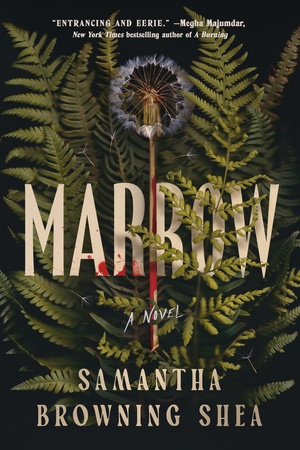
Now a mother of two, Shea was profoundly inspired by the experience of wanting so badly to become pregnant that she went against her own rationalist outlook. The result is her debut novel, “Marrow,” set on a fictional Maine island by the same name. The book follows Oona, a pregnant woman in her early 30s who has suffered five miscarriages and is determined to avoid another one.
Oona grew up on Marrow, on an old Girl Scout campground that her mother, Ursula, turned into the Bare Root Fertility Center. Kicked out at 18, Oona has been longing to return for years but has never felt like she could. In part, this is because her husband, Jacob, is against it. At first, it seems like Jacob is maybe simply a controlling husband who drinks too much —and, to some extent, he may be. But as the plot unfolds we learn that Jacob also grew up on Marrow, and that he is intimately aware of the circumstances of Oona’s banishment and has good reason to believe it might be wiser for her to stay away.
Of course, unwise decisions are the stuff novels are made of, and so “Marrow” begins with Oona throwing up in the bathroom of the ferry returning her to the lush island. She’s somewhat disguised, having dyed and cut her hair, and is using the name of a woman who was supposed to attend Bare Root’s summer session but who never confirmed her arrival time. Oona’s precautions aren’t foolproof, which is fine since she’s not planning on staying long — only through the weekend when she and the other patients are meant to receive a protection spell during the Beltane celebration.
What Oona notices immediately upon arriving at Bare Root is how much fancier it’s become since her childhood. It resembles a spa retreat, a place where prospective mothers struggling with their fertility get pampered with reflexology, acupuncture and hearty meals. Yet everyone there knows that there’s more to it than that — Ursula isn’t just a skilled midwife with knowledge of herbs, she’s a bona fide witch. At least, that’s what she claims and part of how she sells the facility to her clients.
“Bare Root made a promise to its attendees: By the end of the Summer Session, they would come to learn enough of the basics of fertility magic that they would be able to use Craft to help themselves,” Shea writes. “Of course, their success would depend entirely on whether they actually had power (a fact the Center, conveniently, failed to mention on its website).” For those who do have power, “the summer could be transformational. It could mean the difference between failure and success, between motherhood and… well, whatever else one could have.”
Things begin to go wrong for Oona pretty quickly, but she’s surprisingly granted a reprieve and allowed by her mother to stay on the island until she gives birth. Gradually, Oona begins to believe in her own power, even though Ursula always insisted she didn’t inherit any. And while at first her desire for motherhood was rooted in the ability to become a real witch, as her pregnancy progresses, Oona begins to imagine and even look forward to the baby she will give birth to if all goes well. There’s the rub, of course — Oona believes she’s miscarried so many times because she’s cursed, and she’s determined to undo whatever harmful magic is upon her and keep this pregnancy.
While “Marrow” has a strong backbone, it’s deeply uneven, with some convoluted plot points that feel like they were inserted simply to draw out certain mysteries. A false-bottom drawer appears relatively early in the novel, for example, but though Oona was literally in the midst of snooping when she finds it, she doesn’t open it. Many chapters later, it proves to indeed be the hiding place for a book she’s been looking for, and much else besides.
Such quirks are forgivable. More frustrating is that the book isn’t clear on whether or not it believes in the magic it’s selling, making it difficult for the reader to be all in on Oona’s search for her own power. Still, “Marrow” delivers an atmospheric drama and a messy and recognizably yearning protagonist.
Ilana Masad is a fiction writer, book critic and author of the novels “All My Mother’s Lovers” and “Beings.”
Comments are not available on this story. Read more about why we allow commenting on some stories and not on others.
We believe it's important to offer commenting on certain stories as a benefit to our readers. At its best, our comments sections can be a productive platform for readers to engage with our journalism, offer thoughts on coverage and issues, and drive conversation in a respectful, solutions-based way. It's a form of open discourse that can be useful to our community, public officials, journalists and others.
We do not enable comments on everything — exceptions include most crime stories, and coverage involving personal tragedy or sensitive issues that invite personal attacks instead of thoughtful discussion.
You can read more here about our commenting policy and terms of use. More information is also found on our FAQs.
Show less