


High school sports coverage is proudly supported by Maine State Credit Union.
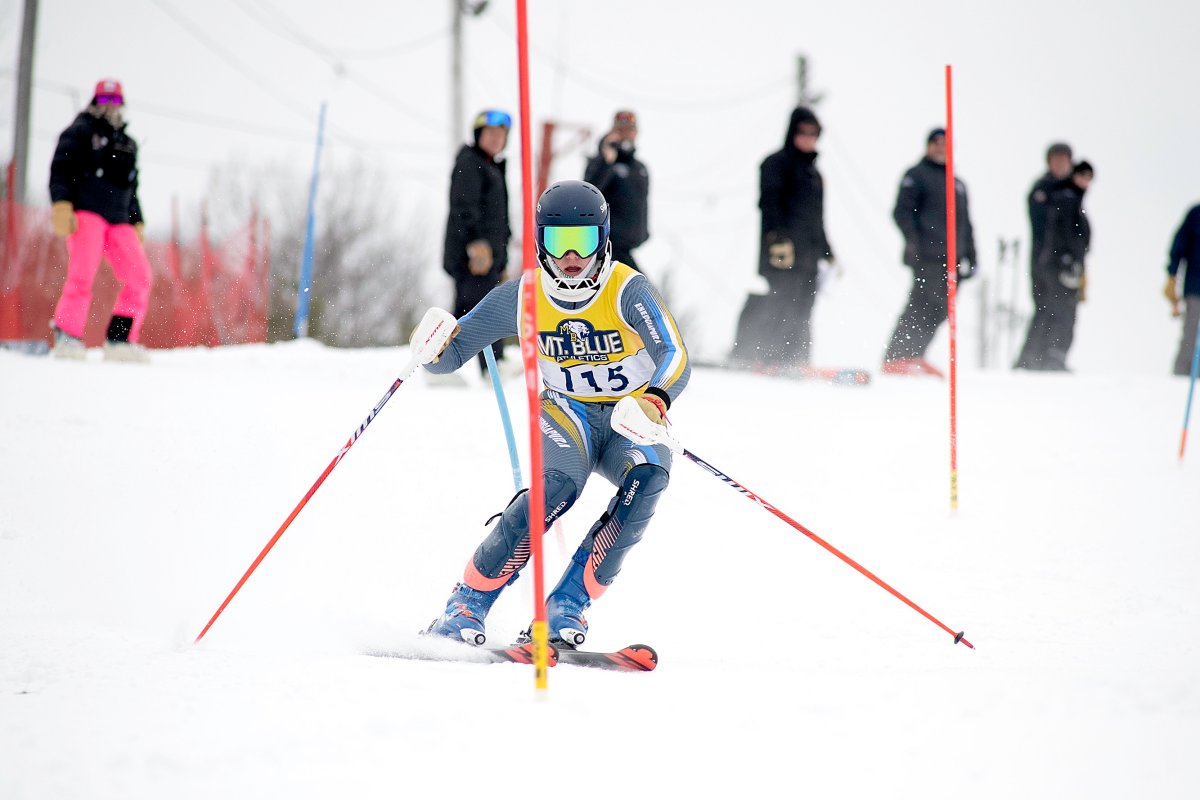
For Clara Ferrie, the seconds before a ski race are always the same. The palms get sweaty. The adrenaline rises. And the heartbeat ramps up.
“I try to just take some deep breaths and calm myself down,” the Scarborough sophomore said. “I take a moment to calm my body down. And then, you go.
“It’s sometimes pretty overwhelming, you have 100 people up there cheering you on and you’re just trying to breathe and stay calm and focused. And then they say, ‘3, 2, 1, go.'”
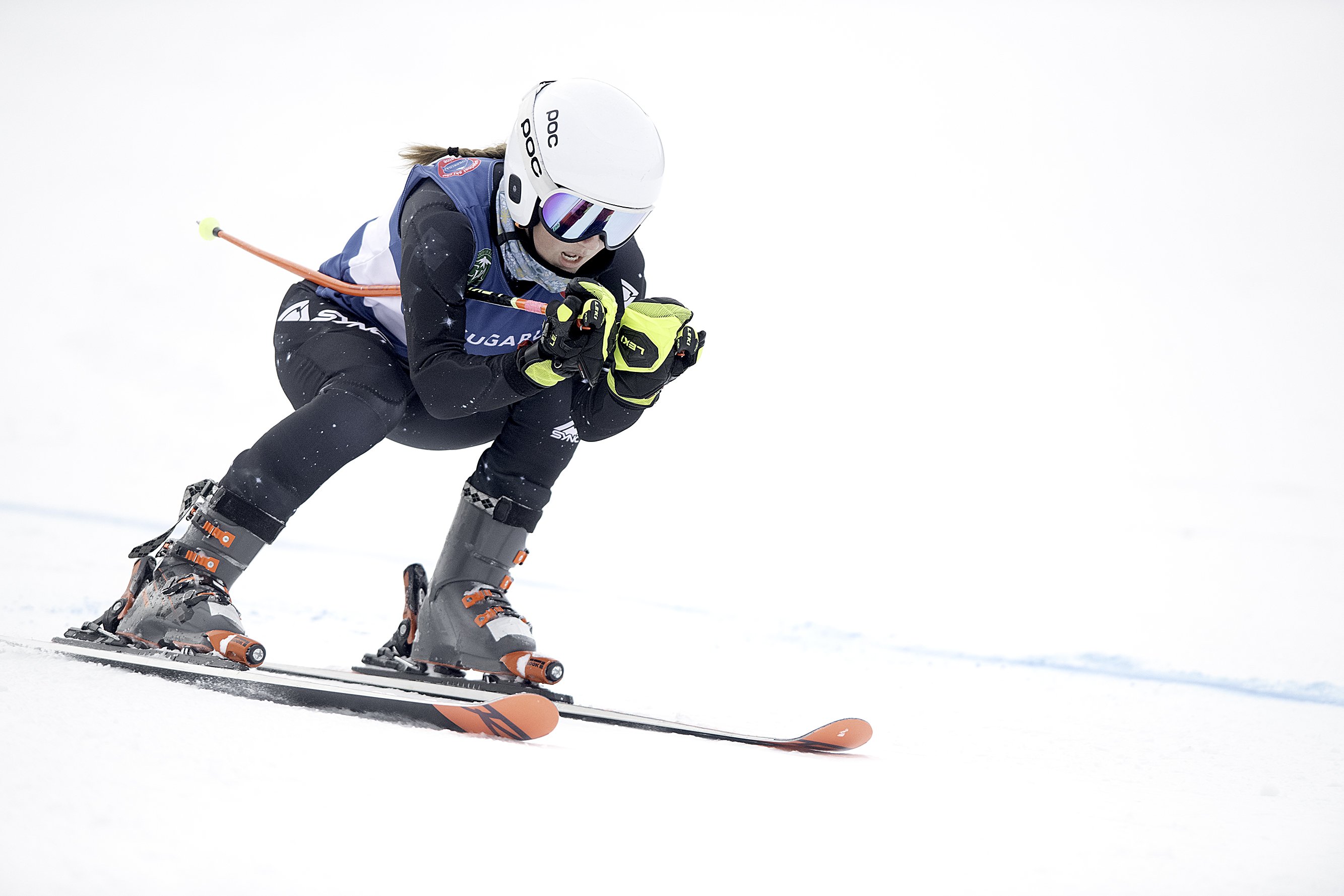
It’s a sneak peak into the white-knuckle environment of Alpine ski racing. Mastering the technique needed to become a good skier, who swishes and glides and carves and slides, is one thing.
But becoming a racer requires something different. There’s a mental component needed, a fearlessness and unkillable confidence. And the ones who compete for victory have it.
“You need to have no fear,” said Ferrie, the Class A runner-up in giant slalom last year. “If you have anything in the back of your mind that’s stopping you from pushing yourself to your limits, you’re not going to win.”
Asked what racing requires, York’s Cooper Dodge, the reigning Class B slalom champion, had his answer before the question was finished.
“The biggest piece of skiing is all mental,” the senior said. “You can put all this work in, you can put all this effort in. But the second you step into the start gate and you doubt yourself … you can put yourself in a position where you make a silly mistake you never make.”
Maranacook coach Ronn Gifford raced, and he has led the Black Bears’ boys and girls teams to nine combined state championships. He said one word sums up the key to being a fast skier.
“To be successful, they need to be really strong,” he said. “That has many facets to it. But two of the main facets are they need to be very strong physically, and they need to be very strong mentally.”
That physical strength comes in the form of the core, leg and upper body power needed to maintain balance and hold up throughout the run. Falmouth coach Evan Keefer said the best skiers often play other sports in order to build up their athleticism.
Keefer also noted that the best racers have their technique and knowledge on how to attack the trail dialed in, so that there’s no wasted effort or motion.
“You have to be able to edge a ski, be able to initiate your turns with your feet versus your body,” said Keefer, who before taking over at Falmouth coached for 10 years at Waterville Valley in New Hampshire. “(It’s) being able to pressure a ski in the fall line. … As we used to say, skiing isn’t very complicated. It’s just hard.”
To do all that at a speed needed to win high school slalom and giant slalom events, however, requires more than good form.
“You’ve got to be able to push yourself to the edge of what’s possible in order to be fast,” Keefer said. “I used to have a coach (who said) if I didn’t say ‘Oh, no,’ or ‘Oh, you-know-what’ at least three times in a race, I was slow.”
Keefer’s top skier, defending Class A slalom champion Ian Christie, said that mindset is hard to teach.
“There’s definitely a fearlessness that comes over any good ski racer,” he said. “You have to be able to accept whatever mistakes you’re going to make on the way down, and not be afraid of making them. … I don’t know if it necessarily has to be in you from birth, but it definitely has to be self-learned.”
Gifford called it a willingness to open the “throttle.”
“We all have a built-in governor (for) what we feel comfortable in terms of going fast,” he said. “(There are) accomplished recreational skiers, but when it comes time to go over steeper pitch, their governor kicks in, their fears kick in. … We talk about learning to push that governor.
“There are definitely those who have that ability innately. … There are others who may have the talent, but don’t have the ability to let that go.”
One of his skiers at Maranacook, Phoebe Bell, has been skiing since she could walk and racing since she was six. Pushing her boundaries is the only way she knows.
“I don’t think I ever thought about slowing down, or anything like that. It was always in me to go fast,” said Bell, the Class B slalom runner-up last year. “I visualize what I’m about to do right before my run, but then after, I don’t even think about it anymore. I just go. It’s second nature to me. If I overthink it, that’s when things can go wrong.”

Other ski racers who have proven themselves to be among the best in the state find different ways to settle into the right state of mind. Falmouth’s Christie said he’ll talk to himself during a run. Kennebunk’s Jimmy McClellan, a sixth-place finisher in Class A giant slalom last year, said he focuses on channeling his nerves into an attack mode.
“My heart, right before going down the hill, is definitely in my throat,” he said. “I try to fire myself up as much as possible. I try to get mad, I try to get angry, and the first gate, I try to hit it as hard as I can to set the tone.”
Sometimes, the key is not thinking at all.
“I just shut my brain off entirely,” said Yarmouth senior Logan MacLeod, last year’s Class B girls slalom and giant slalom champion. “Sometimes I can’t even remember what I did during the run, I get to the end and I’m like ‘What just happened?'”
Confidence, she said, is everything.
“It takes a lot of skill to be able to go down an icy course,” she said. “(We) know that we can do this, we’ve done it before, and we could do it a million more times.”

We invite you to add your comments. We encourage a thoughtful exchange of ideas and information on this website. By joining the conversation, you are agreeing to our commenting policy and terms of use. More information is found on our FAQs. You can update your screen name on the member's center.
Comments are managed by our staff during regular business hours Monday through Friday as well as limited hours on Saturday and Sunday. Comments held for moderation outside of those hours may take longer to approve.
Join the Conversation
Please sign into your CentralMaine.com account to participate in conversations below. If you do not have an account, you can register or subscribe. Questions? Please see our FAQs.