

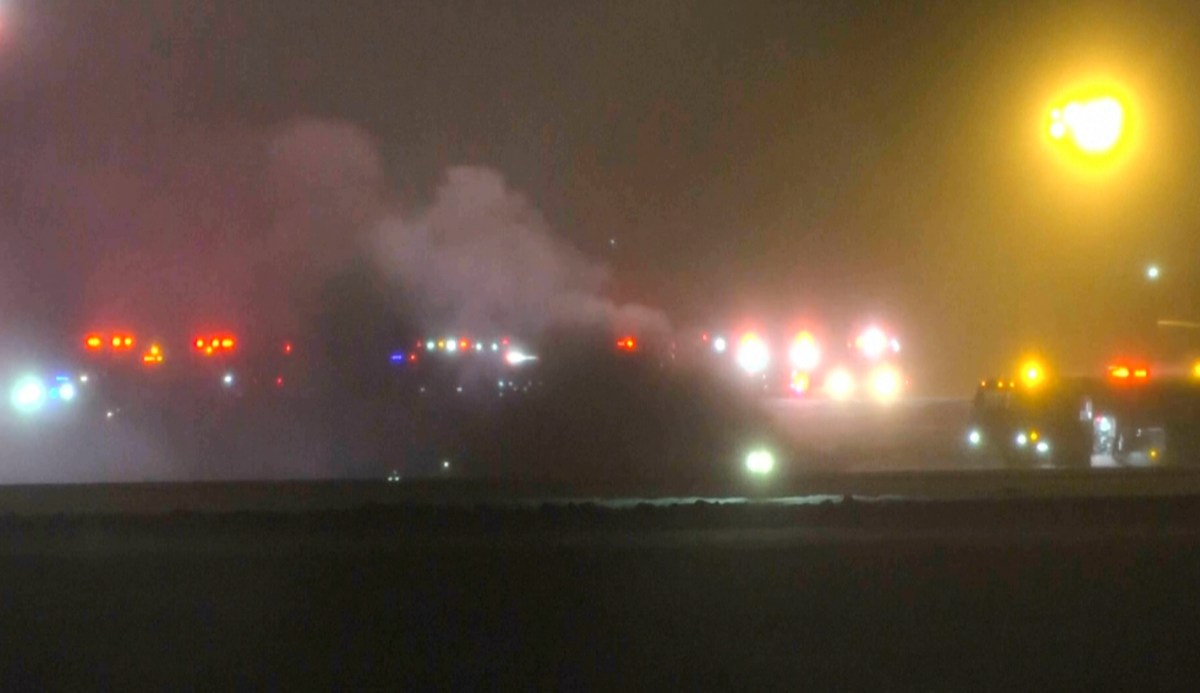
At least six people were killed Sunday in the deadliest passenger plane crash in Maine in over 40 years.
A private jet owned by a Texas LLC crashed at the Bangor International Airport around 7:45 p.m. while attempting to take off during a snowstorm. The storm, which affected much of the U.S., caused thousands of flight cancellations nationwide — the most in one day since the pandemic, The Associated Press reported.
Authorities have not released the identities of those onboard, and the cause of the crash is not yet known.
A county commissioner in Texas said Tara Arnold, of the Houston-based law firm Arnold & Itkin, was on the plane. The personal injury law firm appears to be linked to the LLC that owns the plane.
Leslie Briones, a Harris County commissioner, when asked about the crash during a news conference in Texas, said she knows Arnold and her husband well from having previously worked at the law firm.
“Tara, she is just a phenomenal person, a bold leader, and somebody who has, or had, a heart of service,” Briones said. “My heart and my prayers are with Kurt and her children and all the affected members.” Briones said she was still awaiting details about the crash.
The National Transportation Safety Board is leading the investigation. Crews had not arrived as of Monday afternoon and could be delayed by the weather, according to a spokesperson for the agency.
Local and federal officials have reported different information about how many people were on the plane.
A preliminary incident report the Federal Aviation Administration released Monday morning said seven passengers were killed and one crew member was seriously injured. At a 10 a.m. news conference held at the airport, Airport Director Jose Saavedra refused to say whether there were any survivors, emphasizing that the investigation is ongoing and that officials were awaiting guidance from federal partners.
Hours later, airport officials said the flight manifest showed there were six people onboard.
“No one from the incident was transported to the hospital, and all on the flight are presumed to be deceased,” spokesperson Aimee Thibodeau said in a news release sent just before 1:30 p.m. Monday.
On a phone call, Thibodeau said the information reported by the FAA was subject to change and the updated figures reflect “our latest information that we have here at the airport.”
Asked about the discrepancy, an FAA spokesperson deferred updates about the crash to the NTSB and local law enforcement.
“Our preliminary report is all we have right now, but it’s always preliminary and subject to change,” the spokesperson said.
THE CRASH
The aircraft was attempting to take off when it inverted and caught fire, according to the preliminary FAA report.
Photos and videos from the Sunday night scene showed a plume of black smoke rising from the overturned airplane, which was resting in a snowy field.
The plane, a Bombardier Challenger 650 jet, is owned by KTKJ Challenger LLC, based in Houston, according to FAA records. It was manufactured in 2020.
Texas comptroller records show the LCC’s registered agent as Jason Itkin, and the listed address matches that of Arnold & Itkin, a personal injury law firm based in Houston. A spokesperson representing Arnold & Itkin said late Monday morning that he could not confirm the firm’s connection to the plane or comment on the crash.
Sunday’s incident comes months after the Bangor airport reported its first fatal crash. In August, a single-engine aircraft crashed while attempting to land, killing the pilot, who was the sole occupant.
Sunday’s crash is the deadliest in Maine since 1985, when a Bar Harbor Airlines flight crashed in Auburn, killing eight people, according to a review of NTSB investigations. Among those killed was a 13-year-old Manchester girl, Samantha Smith, who had previously traveled to the Soviet Union to advocate for peace as fears of nuclear war loomed, the Sun Journal reported.
The deadliest passenger plane crash in state history happened in 1979, when a Downeast Airlines flight went down in Rockland, killing 17 people.
More than a dozen agencies, including the Bangor Police Department, Maine State Police and over 10 local fire departments responded to the scene overnight Sunday, Thibodeau said.
SNOWY NIGHT
Snow began to fall over the Bangor airport around 5:30 p.m., a forecaster with the National Weather Service’s Caribou station said Sunday night.
Visibility had dropped to about three-quarters of a mile by 7:08 p.m., and it remained that low until about 9 p.m., the NWS said. By then, the airport had about 4 inches of snow on the ground, and the rate of snowfall was picking up.
“We had crews on site to address the weather event,” Saavedra, the airport director, said. “The weather was a factor in many operations.”
There were commercial planes landing and departing around the time of the crash, Saavedra said.
At least a dozen planes landed at the Bangor airport Sunday, while at least eight took off, according to data tracked by FlightAware. Among them was a commercial flight from Orlando that arrived at the airport at around 7:40 p.m.
Asked what types of conditions could prompt the airport to close, Saavedra said officials consider several factors, and closures are determined on a “case by case” basis.
‘HISTORY OF PROBLEMS’
This particular plane model “has a history of problems with icing on takeoff” that has caused previous crashes, aviation safety consultant Jeff Guzzetti told The Associated Press.
Even a little bit of ice on the wings can cause serious problems, so this plane would have needed to be deiced before takeoff, the former federal crash investigator said. It’s not clear when or if that was done.
Asked by a reporter whether there had been any requests to de-ice the plane, Saavedra said “There were de-icing operations occurring at that time,” but did not say explicitly whether they included the plane that crashed.
In 2002, a Bombardier CL-600-2B16 crashed at Birmingham International Airport in the United Kingdom, beginning to roll rapidly “immediately after takeoff,” according to a report by the UK’s Air Accidents Investigation Branch. A failure to de-ice the plane before takeoff was listed as one of several possible factors.
In 2004, a CL-600-2A12 “collided with the ground during takeoff” in Colorado. An NTSB review found that the probable cause was the flight crew’s failure to properly check the wings for ice and snow. In 2005, the FAA released new safety guidance instructing operators of Challenger 600-series aircraft to more carefully inspect the plane’s wings for ice buildup and frost, the Washington Post reported at the time.
Staff Writers Gillian Graham and Drew Johnson contributed to this story.

Comments are not available on this story. Read more about why we allow commenting on some stories and not on others.
We believe it's important to offer commenting on certain stories as a benefit to our readers. At its best, our comments sections can be a productive platform for readers to engage with our journalism, offer thoughts on coverage and issues, and drive conversation in a respectful, solutions-based way. It's a form of open discourse that can be useful to our community, public officials, journalists and others.
We do not enable comments on everything — exceptions include most crime stories, and coverage involving personal tragedy or sensitive issues that invite personal attacks instead of thoughtful discussion.
You can read more here about our commenting policy and terms of use. More information is also found on our FAQs.
Show less