


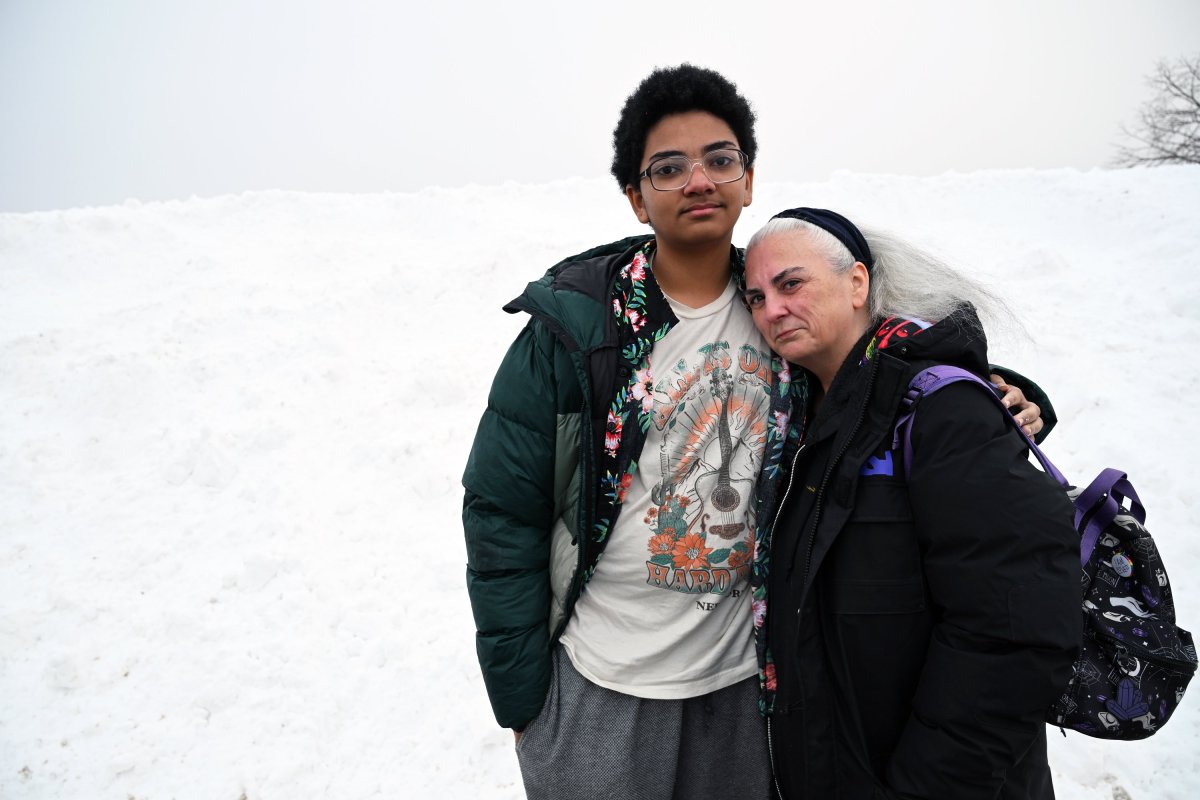
Cooper George was doing what other 13-year-old boys do when they’re home alone: he played video games.
Then, his friend texted in a group chat saying Immigration and Customs Enforcement activity was ramping up.
It was Jan. 12, a week before a surge that federal agents have dubbed “Operation Catch of the Day” began in Maine.
George knew that ICE officers had been scoping out some places near his home in Westbrook. But if they were increasing their operations, did that mean they were going door to door? Were they going to come to his house?
He immediately stepped away from his screen and rummaged through his bag to look for his passport.
George has been carrying proof of his U.S. citizenship, like his passport or birth certificate, for about a year now, ever since he heard about ICE agents showing up in schools last spring.
He’s afraid he could be arrested because he’s mixed race. He’d seen news reports in other states of other U.S. citizens of color who said they had been stopped or detained by immigration officers.
Since President Donald Trump retook office and announced plans to crack down on illegal immigration, people of color have said they anticipate being stopped by federal agents.
A Supreme Court ruling in September cleared the way for immigration agents to stop people based on their race, language, job or location.
Federal officials say they’ve arrested more than 200 people so far in Maine and contend that they’re focused on detaining people with criminal records and illegal immigration statuses.
But family members, immigrant advocates and area officials have said that many of those detained so far are either in the country legally or haven’t committed any crimes.
Some citizens, like George, have started carrying proof of citizenship with them in an effort to prevent arrest if they are approached.
But this one afternoon, he couldn’t find his passport.
George texted his mom to ask where it was. He was pacing, on edge. When he found it, he went into his bedroom, turned off all of the lights and closed the blinds. He thought if the house seemed empty, maybe ICE agents wouldn’t check it.
He lay in bed and listened to every noise, every creak outside his door.
Now, he’s always on high alert, looking around for ICE agents as he walks to the African Supermarket to grab a snack.
“I know the next turn I make they may be waiting there, and I can be taken away,” he said.
George said he’s been worried about being racially profiled by police officers since George Floyd’s murder in 2020. He was just 8 when that happened.
Angela Butts, George’s mother, said that because she is white, she doesn’t worry about her own safety like she does for her children’s.
“I recognize that I exist in the world differently than they do,” she said.
The strategy is to “grab first, ask questions later,” Butts said. Anyone who is not white is a target, whether they’re a U.S. citizen or not, she said.
‘JUST A TARGET TO THEM’
He pulled the car over when he saw flashing blue lights. Minutes later, two more SUVs drove up, blocking him in while federal agents questioned him about his immigration status and where he was born.
The man, who lives in southern Maine and was born in South Asia, told the agents he is a U.S. citizen and didn’t have any violations or commit any crimes. The Press Herald agreed not to publish his name, town of residence or country of birth because of his safety concerns.
It was around after 7:30 a.m. on Jan. 21 and he had just left the Planet Fitness in South Portland. Someone had warned him that they had seen ICE agents waiting in the parking lot. Still, he got in his car.
They stopped him a few doors down from the gym. They were wearing masks and didn’t identify themselves as ICE agents, but he said he recognized their tactical uniforms from videos he’d seen online.
He said the officers told him they ran his license plate and nothing came up on their end. They asked him for identification and soon had agents blocking his car in all directions.
He hasn’t had many interactions with police, he said, so it was frightening to be surrounded law enforcement “as if I murdered someone.”
Though the agents let the man drive away a few minutes later — an officer thanked him for cooperating — he thinks he was stopped only because he was one of the few nonwhite people around. The incident has left him worried that he might be detained or stopped again if he speaks out, even though he is a citizen.
“Sometimes I feel like, because of my skin color, I’m just a target to them,” the man said.
His wife is angry — her husband has never committed a crime, she said, and the stop was a clear example of racial profiling.
“Everyone needs to be a little careful,” she said, adding that ICE’s tactics have made the couple fearful for their son’s safety as well.
The man said he now encourages people to carry any documentation supporting their immigration status.
“At this point, it has become scary for everyone,” he said. “It should not be like this at all.”
CHILDREN’S SAFETY
Becky is a legal citizen, a born and raised New Englander who grew up in Massachusetts and now lives in South Portland. Her ancestry in Massachusetts goes back generations. She’s biracial and identifies as Black.
She has two kids and said she has started carrying her documentation with her for the past few days, just in case. She’s afraid to leave her house.
“I don’t know if at any point they’re going to stop me,” she said. “Anyone who is Black or brown or has a different-sounding last name can be taken away, whether they’re a citizen or have their work visa.”
She asked not to use her full name out of fear of being targeted by federal immigration enforcement.
She said she’s been racially profiled before, by police and private citizens. “Being Black in this country, you always have to deal with racial profiling going back to slavery times,” she said. “This is nothing new.”
So Becky said she no longer goes into public alone. A neighbor helped her over the weekend when she went grocery shopping and ran errands. They stayed away from big box stores, which have served as staging areas for ICE agents. She might start only ordering things online, she said.
Becky’s still sending her oldest child to school, only after she called the teacher to make sure the school’s protocols gave her confidence her kids would be safe.
“I’m not just worried for her, I’m worried for her classmates,” she said.
For Delia, a mom in Brunswick who asked not to use her last name out of concern for her privacy, her worry over ICE operations has put a strain on her family’s daily routine.
Becky knows of a few other community members who have instructed their grown children to carry their documents on them, even though they were born in the United States.
Delia and her wife used to drop off their 8-year-old son at the bus stop in the morning, leaving him with other trusted parents in the neighborhood. But with news about immigration agents targeting bus stops and school buildings, they worried about their son, who is mixed-race. What would happen if ICE agents show up and start asking questions without a parent around?
“We didn’t want to put our friends in that position,” she said.
But the family also worried about what would happen if an ICE agent saw Delia with her son — “two pretty obviously Brown people,” she said. So, Delia’s wife and mother-in-law, who are both white, opted to take turns waiting at the bus stop, before dropping the couple’s 5-year-old daughter off at her separate school.
Becky and her family witnessed one of these arrests last week near the Maine Mall. People who appeared to be federal law enforcement officers apprehended a man and put him into a minivan with out-of-state plates, according to witnesses.
She filmed the scene while her husband and children waited in the car.
The honking was too loud, her kids said in the backseat, and so was the screaming. They are 3 and 5 years old.
“They were asking what was going on,” Becky said. They kept asking if they would be safe.
She could only hope that they would be.
Staff Writer Katie Langley contributed to this story.


