

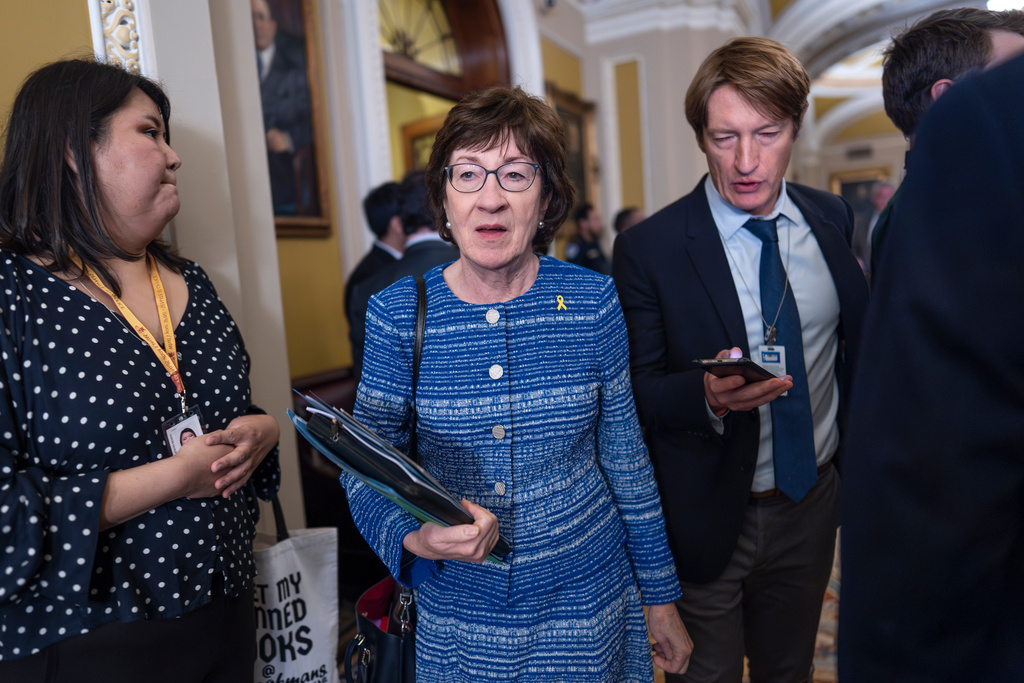
Whether intentional or not, the Trump administration just handed Republican U.S. Sen. Susan Collins an important win ahead of her reelection campaign.
In a series of radio interviews Thursday, Collins, who was recently criticized by the president, took credit for the Department of Homeland Security’s decision to halt its enhanced immigration action in Maine. She said the pause came about after a series of conversations with embattled DHS Secretary Kristi Noem.
“I’m obviously very pleased that my direct conversations with Secretary Noem has produced results,” Collins said in an interview on WVOM.
Collins, New England’s lone remaining congressional Republican, often tells voters she’s a doer who gets results for Maine, even if it means standing up to her party.
For days, her Democratic and Democrat-aligned colleagues had publicly complained about the lack of information coming from the Trump administration over immigration enforcement in Maine. Democratic Gov. Janet Mills, who is running to be her party’s candidate to take on Collins in the fall, publicly requested a meeting with Trump this week — to no avail.
Meanwhile, Collins was quietly working Trump officials.
In radio interviews, Collins said that she began reaching out to Noem last week with a series of questions. On Monday, she asked Noem to pause the operation. Then, she followed up with phone calls and text messages, highlighting cases reported in the media of people without criminal convictions who have been detained. Those included asylum seekers who are legally present, she told Maine Public’s “Maine Calling.” Collins did not respond to interview requests from the Press Herald.
On Thursday, Collins got to deliver big news. Immigration and Customs Enforcement would pause its operations in Maine, she told news outlets in an early morning release.
“Susan Collins is doing what she’s always done best: leaning on her unparalleled access to people in power,” Nicholas Jacobs, a political science professor at Colby College, said in an email. “She’s not going to show up on the streets of Lewiston … Rather than public confrontation, she’s going to work behind the scenes to make a difference.”
Her Democratic opponents are skeptical that federal officials will keep their word, and they remain worried about people who have been detained, and who remain difficult to track in the federal system.
Graham Platner, a 41-year-old combat veteran and oyster farmer who is seeking the Democratic nomination to take on Collins this fall, mocked the senator for securing a “pinky promise” from Noem. He made the comments at a protest he organized outside her Portland office Thursday morning. (The protest was planned before Collins’ announcement.)
“I don’t believe it,” Platner told dozens of protesters. “I don’t take the word of an administration that continues to break the law. I don’t take the word of an administration that continues to stomp our constitutional rights. We need to see material change.”
In the interview with “Maine Calling,” Collins admitted she has not gotten answers about how many federal agents planned to withdraw from Maine, or whether it has already happened. Nor has she gotten any information about what might happen to people without criminal records who have been detained.
A DHS spokesperson would not confirm Collins’ claim of an ICE drawdown, saying in a statement to the Press Herald that: “DHS will continue to enforce the law across the country, as we do every day.”
Collins noted that normal immigration enforcement by federal agents would continue. Maine has seen high-profile arrests by ICE and U.S. Border Patrol for months.
But she called this month’s enforcement surge “far too indiscriminate.”
The Maine Democratic Party blasted Collins, saying the agreement with Noem was “just another calculated political move” to provide cover for Collins’ support for a controversial funding bill pending in the Senate for DHS and ICE.
“Collins is trying to save face on the same day the Senate is set to vote on a DHS funding bill she has been leading the charge to pass without a single reform or guardrail to ICE’s reckless, dangerous behavior,” spokesperson Kristi Johnston said in a written statement. “Mainers see straight through this, and they won’t forget it.”
Senate Democrats were planning on blocking the bill, which includes funding for body-worn cameras and additional training, after agents killed a protester in Minnesota last weekend. But Democratic Minority Leader Chuck Schumer had been seeking additional concessions on ICE, including prohibiting agents from wearing masks, and a deal to avert the shutdown was reached Thursday night.
Democrats also criticized Collins for working with Noem, who’s faced calls even from some in her own party to resign in the wake of the Minnesota shootings.
Mills called for Noem’s ouster and urged Collins to put a hold on DHS funding until federal agents change their enforcement tactics.
“Instead, she is doing the opposite: leading the charge in handing ICE additional funding with no substantive reforms and no measures of accountability,” Mills said in a written statement Thursday. “That is absolutely wrong.”
Despite all the criticism, Mark Brewer, director of political science at the University of Maine in Orono, said Collins’ announcement about the ICE surge leaving Maine is a win for the five-term Republican.
“It’s hard for me to imagine any way in which this is something other than a pretty big positive for Collins,” he said. “She’s able to reach out directly to a cabinet-level member of the Trump administration, make a request like this and then have that request honored.”
While some die-hard Trump supporters may criticize Collins, Brewer said she won’t likely suffer in November when those voters are presented with a choice between Collins and the winner of the Democratic primary between Mills and Platner, a progressive backed by Sen. Bernie Sanders of Vermont.
“If you’re a diehard MAGA person, what are you going to do?” Brewer said, referring to Trump’s Make America Great Again movement. “You’re not voting for Platner. You’re not voting for Mills. So, you’re either going to vote for Collins or stay home.”
It’s also possible that Thursday’s events represented an olive branch from the Trump administration to Collins. For months, Collins had been walking a tightrope ahead of the 2026 election — a task made more difficult by her complicated relationship with Trump.
While she has provided key votes in support of Trump’s agenda, Collins has not supported any of his campaigns for president, and she voted to impeach him for his role in the Jan. 6, 2021, riot at the U.S. Capitol.
Trump gave Collins a pass when she ultimately voted against his signature One Big Beautiful Bill Act after Collins provided a key procedural vote to advance the bill.
But that truce ended when Collins opposed his administration’s efforts to claw back funding to Maine, and the feud got more bitter when she was among a handful of Senate Republicans who backed a resolution seeking to force Trump to get congressional approval for any additional military action in Venezuela.
Trump condemned Collins and other defectors for their “stupidity,” saying they “should never be elected to office again.”
Jacobs, the Colby professor, suggested that DHS’ retreat from Maine was driven more by Trump’s own self-interest. Recent polls showed that even some Republicans have grown uneasy with the flood of images from the federal government’s violent crackdown in Minnesota.
“I think Donald Trump would rather lose the Senate than do Susan Collins any favors,” Jacobs said.
