
Surviving Maine’s winter seems truly a remarkable feat for many of our feathered friends, but that is from the perspective of a mammal with a large prefrontal cortex and a fireplace. Most birds are perfectly adapted for the cold, and finding food is their primary concern in the winter. With the recent deep snow storms, I wanted to highlight a few interesting phenomena we see with our birds as they adapt to the worst of the winter.
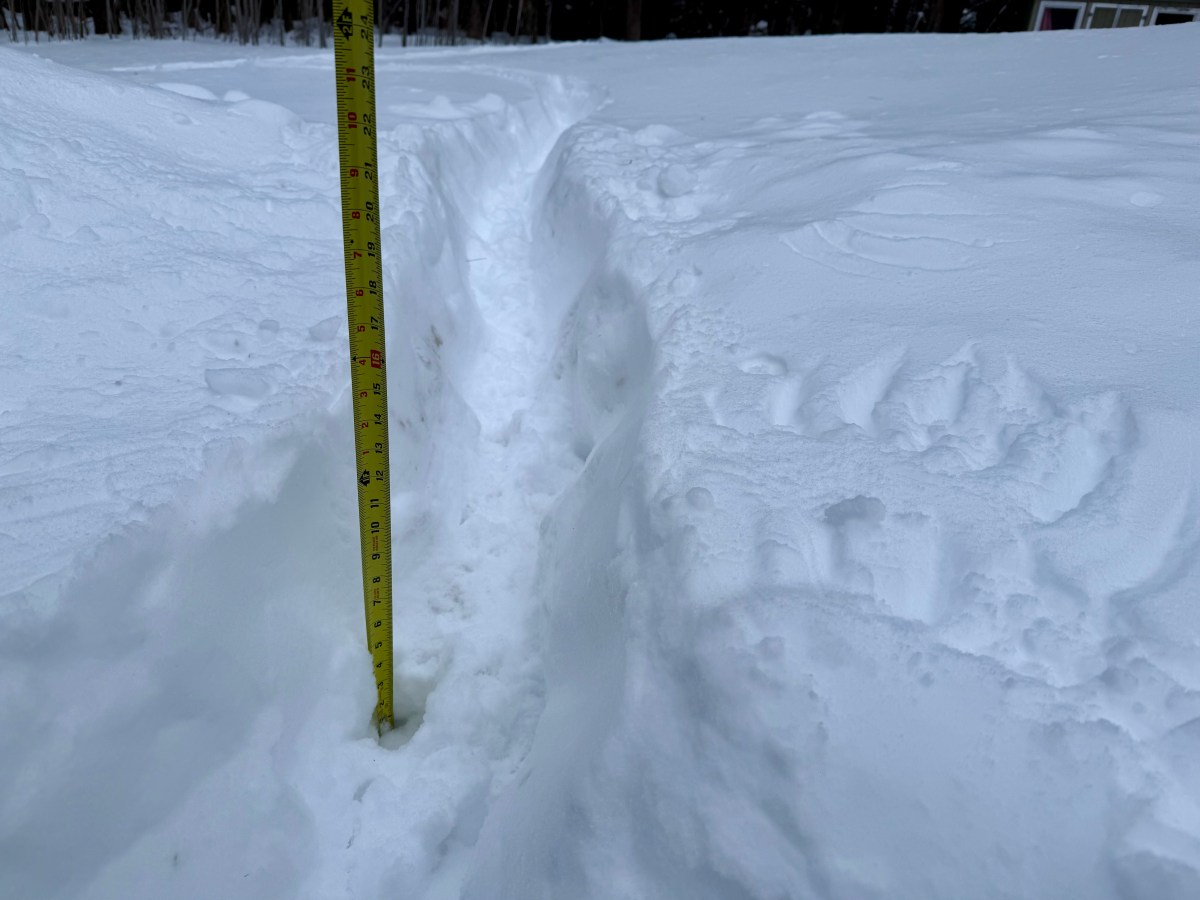
I’ll start with one of my more entertaining backyard birds, the wild turkey. I’ve written about my love-hate relationship with them before, as they tear up my backyard all summer to dig out sandy patches to take a dust bath in, but also bring their adorable chicks around and help eat all the ticks and insects I don’t want. We are surrounded by tall white pines, which a group of 45 turkeys fly up into each evening to roost. In the winter, we end up with several well-trodden paths that the turkeys take each day, slowly packing down the snow. After the deep snow of the big storm at the end of January, we ended up with some of the most impressive canyons carved through the fluffy snow where the turkeys were plowing their way to access the road. I measured one of the paths at 14 inches to the snow, plus another inch or so their feet would’ve sunk. That’s close to half of the bird being in the snow.
Turkeys are primarily ground feeders, and in the winter will often seek out wooded areas with dense cover where snow won’t be as deep. Here they can scratch through the snow and the leaf litter to uncover acorns and other seeds … unless there is so much snow that they need to look up for food. Twice, on the day immediately after the deep snow, I spotted groups of wild turkey foraging in crab apple trees. These large birds are not really built for maneuvering around the small branches of these fruit-bearing trees, but they were making it work, or at least putting in the extra effort for the food that was still accessible.
Winters can also be a challenging time for owls in Maine. Barred owls are unfortunately common as roadkill because they get hit by cars while they are going for the easy meal of a mouse running across the road. Road sides with short mowed grass (and thus seeds) create a perfect habitat for rodents. Packed roads (and cement) are hard for them to go under, so they become vulnerable to owls and hawks while they are crossing above ground. Many of these shrews and voles will spend the winter in the subnivean layer, between the hard ground and the top of the snow. This is typically a safe place, except that owls, whose hearing is so good that they can sense their prey through the snow, can punch through and grab the unsuspecting victim when the snow is shallow enough.
Sometimes, however, this layer can be too deep for owls to effectively hunt, so we often get reports of owls in unlikely places after big storms. At the end of January, we saw a report of a long-eared owl, typically one of the most elusive owls in Maine, sitting on a railing in a downtown Portland backyard, near a bird feeder. Unlike a Cooper’s hawk that goes for songbirds at feeders, the owl was more likely going after rodents attracted to spilled seed from the feeder. At the same time, we got a report from central Maine of a boreal owl, even rarer than the long-eared, that was stalking a chicken coop. Again, the owl wasn’t interested in the chickens (a barred or a great horned owl might be, but boreal owls are smaller than most chickens), it was after the mice, who were going for the chicken feed.
Feeder birds were yet another highlight of this snowy storm. It is always entertaining to see the increased activity at feeders before a storm hits. Many birds have built-in barometers and can sense when a storm (low pressure) is coming in, so they’ll increase feeding ahead of and during a storm. We also see increased activity at feeders following a storm because that food is easy to access (as we talked about with the turkeys above).
It is hard to keep track of one individual bird’s behavior, but one that I found interesting recently was a bullock’s oriole that has been visiting a feeder in Blue Hill. This is the western sister-species to our Baltimore oriole, and we’ve seen a handful of winter records in recent years, typically of individuals at backyard bird feeders. This one was first spotted in November, and has been an almost daily visitor (except for a short gap in the middle of December). It stayed regularly until Jan. 11, then disappeared. Well, on Jan. 26, just after the deep snow, the oriole was back at the feeders. It is fun to think about all the rare birds that could be wandering around the state, not supplementing their diet with feeders, just going unrecognized.
While the cold temperatures and deep snow might seem like a downer, my hope with this article is to point out some of the fun things you can watch for in your backyards or in local public spaces in winter. And in just a few weeks, we can start to expect some of the earliest winged migrants coming back. What are you seeing this winter? Send questions about wildlife to [email protected], and I’ll try to answer them here.
Have you got a nature or wildlife question of your own? It doesn’t have to be about birds! Email questions to [email protected] and visitwww.maineaudubon.org to learn more about birding, native plants, and programs and events focusing on Maine wildlife and habitat. Maine Audubon Staff Naturalist Doug Hitchcox and other naturalists lead free bird walks on Thursday mornings starting at 8 am, at Maine Audubon’s Gilsland Farm Audubon Sanctuary in Falmouth.
We invite you to add your comments. We encourage a thoughtful exchange of ideas and information on this website. By joining the conversation, you are agreeing to our commenting policy and terms of use. More information is found on our FAQs. You can update your screen name on the member's center.
Comments are managed by our staff during regular business hours Monday through Friday as well as limited hours on Saturday and Sunday. Comments held for moderation outside of those hours may take longer to approve.
Join the Conversation
Please sign into your CentralMaine.com account to participate in conversations below. If you do not have an account, you can register or subscribe. Questions? Please see our FAQs.