

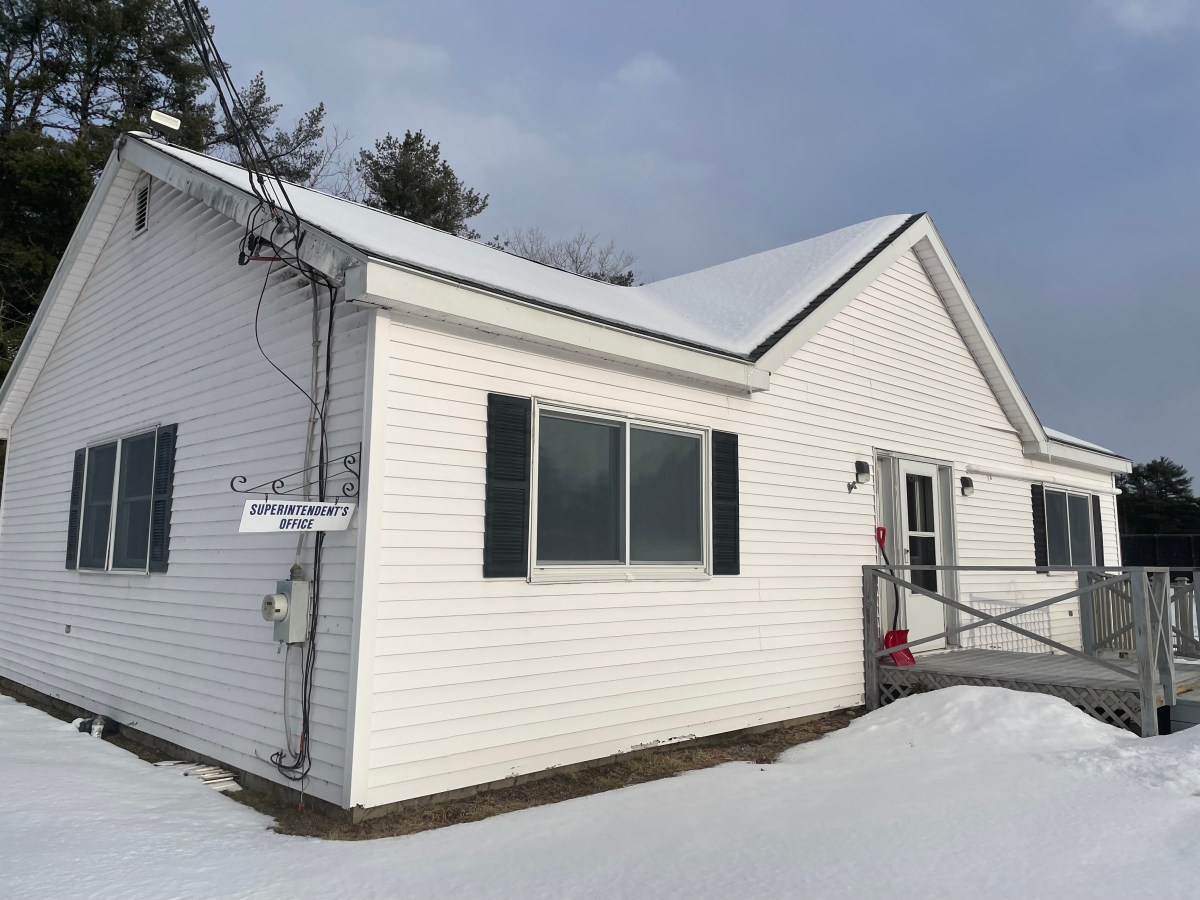
WISCASSET — In this Midcoast town on the banks of the Sheepscot River, the student population has declined by 30% over the last decade.
Third-year Superintendent Kim Andersson cited many reasons for the shift: an aging population, the late 1990s closure of the Maine Yankee nuclear power plant (an important source of jobs), a controversial mascot change, multiple district restructurings, leadership turnover, the COVID-19 pandemic.
Still, Andersson sees opportunity. All of the nearby communities have school choice, meaning their towns have no public high school and students can attend any public or private school they want. She wants them to choose Wiscasset.
“Yes, numbers are dwindling; yes, costs are increasing. But also I’m getting creative. I’m trying to address that. I’m finding alternative revenue sources,” she said. “And we have kids here.”
The challenges Andersson faces exist in many school districts across the state, which have collectively seen enrollments decline for more than two decades. Newly released data from the Maine Department of Education shows a drop of 2,134 students since last year, and 11,994 fewer than a decade ago.
The trend seems likely to continue. The number of young people in Maine is expected to decrease by 12% between 2018 and 2028, according to a 2021 report from the state’s economist, and the young families that are here are having fewer children than previous generations.
For individual districts, steadily declining enrollment has implications for everything from how much state funding they get to staffing levels to course offerings to infrastructure. It has forced some to begin uncomfortable conversations about consolidating schools.
“Education costs don’t go down directly proportionately for every student that leaves a district,” said Amy Johnson, a co-director of the Maine Education Policy Research Institute. “If you have a class that loses 1% or 3% or 5% (of students), you can’t hire 5% less of a teacher. You still want to have a teacher to be there for that classroom.”
Some districts are bucking the trend, which creates a different set of challenges and opportunities. Maine School Administrative District 51 in Cumberland and North Yarmouth, for example, is currently using 33 portable classrooms while it awaits construction of a new elementary school and expansion of another.
RIPPLE EFFECTS
The Maine Department of Education does not track the reasons for declining enrollment, but state data mirrors K-12 public enrollment around the country. The National Center for Education Statistics predicts the number of students will drop by 6% between 2020 and 2030, attributed to nationwide birth declines and more school choice options.
Homeschooling also has risen in recent years in Maine, spiking after the pandemic and remaining elevated since 2021.
But the ripple effects of declines within districts are clear.
“When enrollments decline, schools are expected to spend less,” a June 2025 MEPRI study on Maine’s school funding formula reads. “However, facility and teacher costs, in particular, do not typically decrease until a tipping point is reached.”
Johnson is one of the authors of the study. She said that “tipping point” is why gradual enrollment decline is so challenging.
Maine’s funding formula, currently under review by lawmakers, relies heavily on per-pupil costs. For each student a district loses, they lose the state allocation that came with that student. Johnson said without big, difficult choices like consolidation, the situation is “a recipe for a lot of under-resourced schools.”
MEPRI has also studied the implications of declining enrollment for the state’s school construction backlog. A spring report about that issue says it leads to more deferred maintenance and a lack of upkeep, as reduced enrollment results in a higher operational cost per square foot.
How much the state prioritizes consolidation over rebuilding small schools, Johnson said, is a critical part of the ongoing discussion, but a difficult one because Maine is organized into so many small districts.
“We have a lot of old schools, and if a bunch of them are half-empty, there need to be bigger policy conversations within each region about the best sites, best locations and the best way to consider cost sharing to make sure that all students have access to safe facilities,” she said.
Consolidation can improve financial efficiency for districts and options for students, said Chloe Teboe, director of communications for the Maine DOE, but there are, of course, downsides.
“There is often a great sense of community pride associated with hyper-local schools, and so consolidation is not always an option that (districts) choose to pursue,” Teboe said.
‘A PERFECT STORM’
In Regional School Unit 2, the Hallowell-based district that includes the towns of Dresden, Farmingdale and Monmouth, enrollment has long been declining, and the district also saw a big drop in 2023 when Richmond withdrew from the RSU.
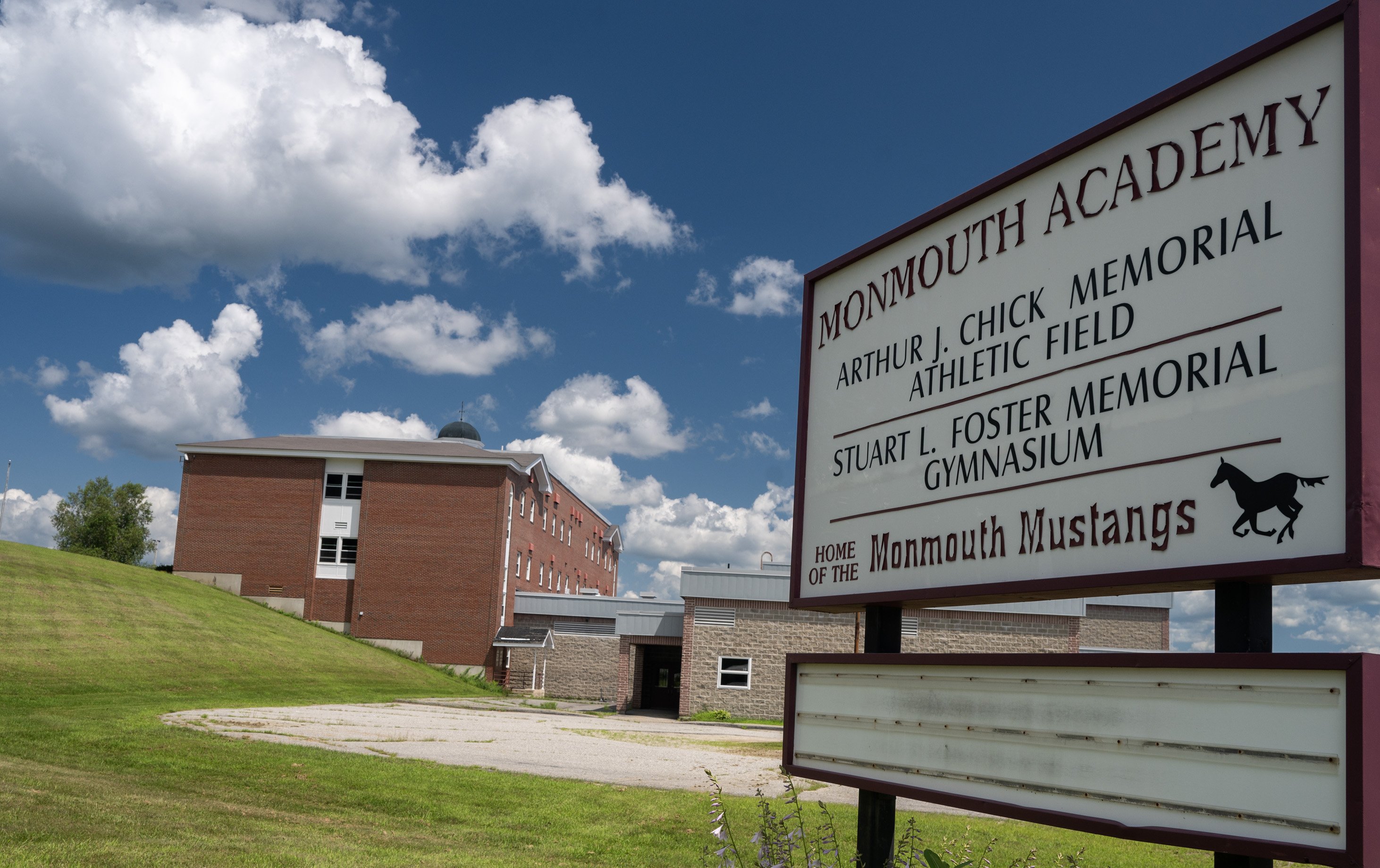
Superintendent Rick Amero said in addition to the statewide demographic pressures, the problem in his district is a lack of affordable homes for families with school-age children. Property values are too high, and most people moving in are retirees.
“And then the effects just really get magnified,” he said. Higher property values mean fewer students, and also reduce how much in state subsidies the district receives; with fewer students, the district also gets less per-pupil based aid. And the fewer residents actually have children in the district, the less people are willing to support school budgets or bond projects.
“It’s kind of a perfect storm in that sense,” Amero said.
Amero said he’s a big believer in small schools — he attended and worked in them himself — but he worries they will be increasingly difficult to maintain. With fewer students, the economies of scale to keep a school running become more complex; RSU 2 has decreased staff through right sizing, which has come at the expense of opportunities for students.
“You’re going to have less elective courses, less learning experiences,” he said. “But you still need to offer the calculus class that might only have four students in it now.”
Johnson, with MEPRI, said that kind of pressure is common at schools experiencing gradual enrollment declines, and it comes at the expense of local taxpayers. They either need to reorganize, or just operate less efficiently.
“Which means all that extra money that’s required to operate that school, that they’re not getting from the funding formula — they have to raise those costs locally,” she said.
OPPORTUNITIES
In RSU 2, Amero sees possibilities to grow enrollment, like being better at advertising what schools are doing well, and improving options for students through collaboration with nearby high schools so both districts can offer their students more specialized classes or programs.
Andersson, the Wiscasset superintendent, has been leveraging every funding opportunity she can to make the district a better place for its current students, and an attractive option for new families, even as the district’s state subsidy declines.
There’s the new gym at the Middle High School, which she financed with interest from COVID-era federal funds. There’s the revamped pre-K facility, paid for by a state grant program, as well as a new football field scoreboard and newly paved parking lot. She updated the website and has been focused on marketing, something she, like Amero, said public school districts are not often focused on.

“The kids are proud,” Andersson said. “And that makes a difference. If the kids think they’re worthwhile.”
Wiscasset also is applying, along with adjacent Boothbay-Boothbay Harbor Community School District, for a state grant to build a consolidated high school that would contain a technical school, higher education and career training programs.
Amid the overall decline, some districts have seen the opposite, including MSAD 51, which has been growing steadily for 10 years.
Back in 2009, the district commissioned two external studies on enrollment that predicted a decade of decline. That led to the the closure of North Yarmouth Memorial School. By 2015, enrollment had stabilized, and then it started growing. Now, the district’s three remaining buildings are overcrowded, and it’s using 33 portable classrooms to accommodate all of the classes; construction is underway for a new elementary school and expansion at another.
The district has had to add two to four new teachers each year, plus additional support staff, and Superintendent Jeff Porter said that means MSAD 51 can meet more needs.
“When you have more students, you add more staff to your district, and you’re able to broaden your services that you have for students,” Porter said.
He pointed to new housing developments, and the district’s location as an increasingly desirable quiet Portland bedroom community, as reasons for the growth.
The same goes for Lisbon, a growing community conveniently situated between the Lewiston-Auburn and Brunswick-Topsham areas, where the student population rose nearly 14% in the last five years, although enrollment did drop for 2025.
Superintendent Richard Green said that growth has precipitated one big advantage: an increased state subsidy. With more state money, the district added a second assistant principal at its elementary school and added more support staff, like guidance counselors and positive behavior interventionists.
Like Cumberland, there have been growing pains, too — the district is renovating its middle school to accommodate the larger student population, something local taxpayers supported through a $6 million bond. It’s set to open for students by August 2027.

We invite you to add your comments. We encourage a thoughtful exchange of ideas and information on this website. By joining the conversation, you are agreeing to our commenting policy and terms of use. More information is found on our FAQs. You can modify your screen name here.
Comments are managed by our staff during regular business hours Monday through Friday as well as limited hours on Saturday and Sunday. Comments held for moderation outside of those hours may take longer to approve.
Join the Conversation
Please sign into your CentralMaine.com account to participate in conversations below. If you do not have an account, you can register or subscribe. Questions? Please see our FAQs.