

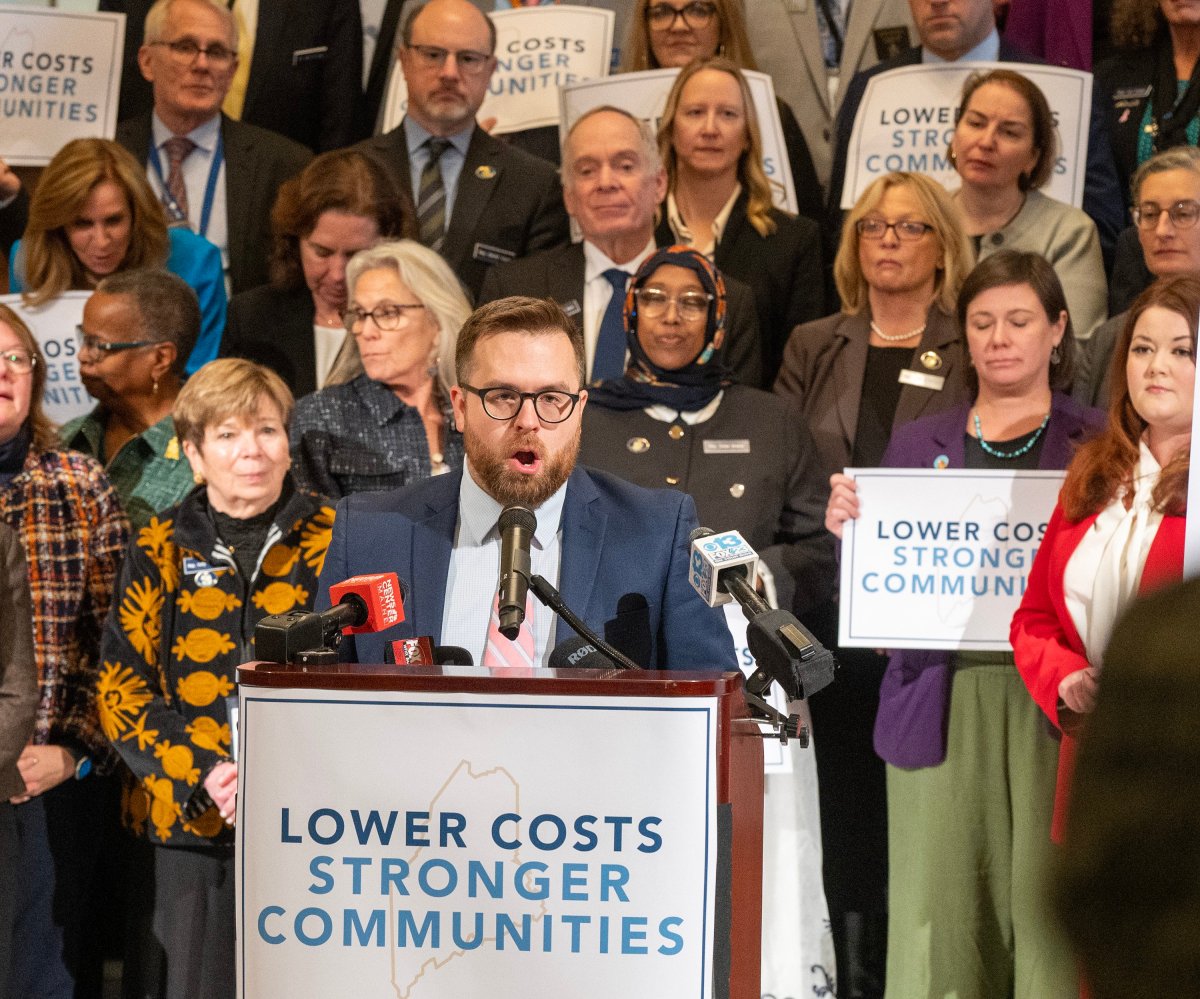
As Mainers, like many people across the country, feel the pressure of rising prices, affordability has moved to the heart of state lawmaking.
In her final State of the State speech, Gov. Janet Mills announced a range of proposals aimed at cushioning costs for Mainers, including making a free community college program permanent and sending $300 “affordability checks” to more than 700,000 residents. Those pitches were expanded upon in the supplemental budget proposal she released Wednesday.
Weeks earlier, Legislative Democrats had unveiled a package of more than 20 affordability-minded bills as the legislative session kicked off.
At the time, Senate President Mattie Daughtry, D-Brunswick, said shifting federal policies and economic uncertainty are “making it harder for families to get ahead.”
“Maine people are doing everything right — working hard, caring for their families, and contributing to their communities — but too many are still being squeezed by rising costs they can’t control,” Daughtry said in a written statement.
Recent polls have shown that the cost of living is top of mind for Maine voters, but Democrats and Republicans have offered starkly different visions on how to tackle the cost crunch.
At a news conference in early February, Maine’s Republican leaders decried Mills’ proposals as a “spending spree.” They argued instead that lowering tax burdens is key to improving affordability.
Republicans are pushing for Maine to conform to federal policy signed into law last year by President Donald Trump exempting certain tips and overtime wages from taxes — which Mills last year directed the state assessor not to implement until state lawmakers have a chance to weigh in.
Sen. Bruce Bickford, R-Androscoggin, who sits on the Taxation Committee, claimed that conforming Maine’s laws to federal statutes could save taxpayers more than $130 million through a heightened standard deduction, no tax on tips and overtime, and a deduction for certain seniors.
Most of this year’s affordability proposals with momentum are sponsored by Democrats. But in a closely divided Legislature, lawmakers might need to come to a bipartisan consensus to enact meaningful change.
As the legislative session builds momentum, here are some of the key affordability bills up for consideration.
TAX BREAKS FOR NONWEALTHY MAINERS
Some of the bills are designed to give money back to Mainers.
One, LD 1954, aims to do so by offering a “Maine Affordability Tax Credit” that would reimburse low- and middle-income Mainers up to a few hundred dollars annually.
The bill would establish a base credit of $200 for single people, and that credit would scale up to $340 for married people and heads of households with children or dependents.
The credit would scale down for households with annual incomes above certain thresholds: $40,000 for single people, $60,000 for heads of a household and $80,000 for married people filing jointly, according to the latest language.
It would replace the existing “sales tax fairness” credit, which has been around for about a decade but offers smaller reimbursements. Daughtry, who sponsored the bill, said the existing credit seems to be relatively unknown by the Mainers she has spoken with.
SAVINGS ON ENERGY
Another handful of Democrat-sponsored bills take aim at energy costs, which have risen significantly in recent years.
LD 1949 would direct the Maine Public Utilities Commission to develop metrics to review electricity rates for any potential chances to contain rising costs. The measure cleared a key committee this week.
Another pair of bills, LD 995 and LD 2078, are designed to offer more immediate relief to electricity ratepayers.
LD 2078 would create a new, refundable tax credit intended to offset energy costs for low-income households. Single filers could get up to $335, and heads of a household and married filers could get up to $600 depending on their number of dependents.
Lawmakers will have to decide whether to provide funding for LD 995, which was carried over from the last session. If enacted, the measure, sponsored by Rep. Melanie Sachs, D-Freeport, would provide $15 million in assistance to low-income electricity ratepayers over two years.
Between November 2024 and November 2025, energy prices rose 6.3% throughout the Northeast, more than double the overall rate of inflation for that same period, according to the Bureau of Labor Statistics.
CHILD CARE
Child care has been burning a hole in the pocket of Mainers for years.
LD 1555, sponsored by Rep. Tavis Hasenfus, D-Readfield, would offer employers thousands in tax credits to offset the cost of child care for their employees. Under the bill’s latest amended language, employers would be credited up to $36,000 to cover half the costs of in-house child care or payments made to a third-party provider. The exact size of the credit would depend on the number of covered children and families.
Another bill, LD 1099, which was sponsored by Rep. Kelly Murphy, D-Scarborough, and carried over from last year’s session, would exempt diapers from state sales tax. The policy would apply to disposable and reusable diapers for all ages.
Maine is currently the only New England state without a sales tax exemption for diapers, Michael Allen, associate commissioner for tax policy at the Department of Administrative and Financial Services testified last year. But he argued that there may be more targeted ways of helping Maine’s poorest families, noting that such an exemption would apply to all shoppers.
HELP WITH WAGES
A bill carried over from last year would raise the income threshold at which certain salaried workers are no longer required to earn overtime pay. Under current law, those making more than $45,300 in salary are not required to be paid overtime, but LD 599, proposed by Sen. Mike Tipping, D-Penobscot, seeks to raise that limit significantly.
The new cutoff would be $58,656 per year, and it would be pegged to average salary data from the U.S. Department of Labor starting in July 2027.
That change would expand overtime protections for roughly 21,000 workers across the state, including about 7,000 who currently work unpaid overtime, according to James Myall, an analyst with the left-leaning Maine Center for Economic Policy.
LD 2129, sponsored by Sen. Donna Bailey, D-York, would bar debt collectors from garnishing wages for medical debt and from placing a lien on a debtor’s primary residence. That bill has yet to be heard in a committee.
And another pair of bills, LD 34 and LD 1414, aim to address pay disparity.
The former, a bill sponsored by Sen. Teresa Pierce, D-Cumberland, would raise the minimum salary for teachers from $40,000 — the minimum since 2022 — to $45,000 starting in the 2026-2027 school year. From there, minimum salaries would increase $2,500 annually until the 2028-2029 school year.
Pierce’s proposal comes as schools throughout Maine contend with shrinking enrollments and ballooning budgets.
LD 1414 would give certain child care workers who care for infants and toddlers an additional $120 in supplemental income each month. It would also compel the Department of Health and Human Services to create a grant program aimed at expanding the availability of overnight child care, according to draft language submitted last month by Daughtry, the bill’s sponsor.
HOUSING
Legislative Democrats have also proposed measures to extend tax credits for affordable housing and to create new grants aimed at helping first-time buyers purchase a home.
Statewide, the median home sale price hit an all-time high of $426,000 in October, and 2025 set a new annual record for median sale prices.
LD 2077, sponsored by Rep. Wayne Farrin, D-Jefferson, would require the Maine State Housing Authority to offer grants of up to $15,000 for low- and middle-income first-time homebuyers. The grants would lower the buyers’ overall mortgage rates. Eligibility would be tied to the area median income, in line with federal rules.
At a hearing before the Housing and Economic Development Committee, representatives of the Maine Association of Realtors, Habitat for Humanity Maine and the Maine Black Chamber of Commerce voiced their support for the measure. They argued it would extend homeownership opportunities to younger Mainers and others currently priced out of the market.
But the bill faced opposition from the conservative-leaning Maine Policy Institute. Analyst Montana Towers argued in his testimony that a new targeted grant would “effectively pick winners and losers in the housing market,” because only some would benefit even though everyone faces the same housing costs.
Another bill, LD 2116, presented by Rep. Ambureen Rana, D-Bangor, would make a now-temporary state tax credit for affordable housing projects permanent, stripping away a 2028 expiration date.
So far, that credit, which Mills signed into law in 2020, has helped create or preserve more than 1,000 units of affordable housing, according to testimony from the Governor’s Office of Policy Innovation and the Future.
But critics have argued that extending the credit’s lifespan would fail to address the underlying drivers of Maine’s housing crunch. Towers argued that lawmakers should instead focus on streamlining permitting and limiting zoning and density restrictions.
“The Legislature should prioritize policies that empower private builders, reduce red tape, and let the market meet the needs of Maine people,” Towers told the Taxation Committee.
It’s not clear when the Tax Committee will take action on that bill.
Staff Writer Billy Kobin contributed to this story.

We invite you to add your comments. We encourage a thoughtful exchange of ideas and information on this website. By joining the conversation, you are agreeing to our commenting policy and terms of use. More information is found on our FAQs. You can update your screen name on the member's center.
Comments are managed by our staff during regular business hours Monday through Friday as well as limited hours on Saturday and Sunday. Comments held for moderation outside of those hours may take longer to approve.
Join the Conversation
Please sign into your CentralMaine.com account to participate in conversations below. If you do not have an account, you can register or subscribe. Questions? Please see our FAQs.