
They’re back, and they’re still fake.
The Maine Department of the Secretary of State is warning residents — again — about text messages that claim to be from the state but are actually a scam.
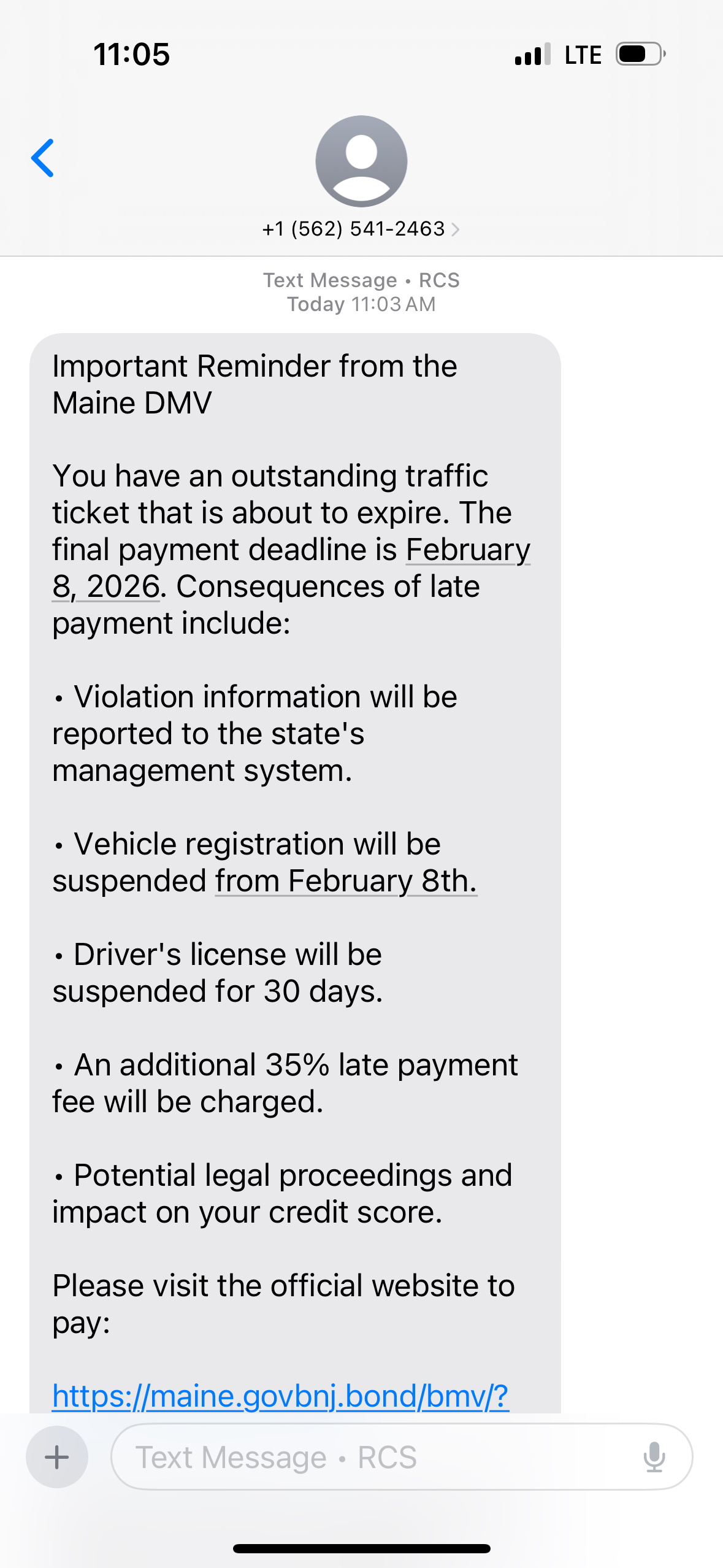
Phony messages, purportedly from the Maine “Department” of Motor Vehicles, have been sent to Mainers statewide and threaten a variety of punishments for alleged violations. The message urges the recipient to follow a link to a website to pay a fine so they can avoid loss of driving privileges or potential litigation.
But the messages and website are fake and not associated with the state, the secretary of state’s office said in news release Monday.
“Similar fake texts are appearing with increasing frequency,” Secretary of State Shenna Bellows said in a written statement. “Unfortunately, this is likely a sign that the scammers are finding success and new victims each time they send out a new batch of texts.”
Bellows’ office had warned in June of a near-identical smishing scam in which mass texts are sent, hoping to deceive the recipients. In both instances, a telltale sign that the messages were not legitimate is reference to a “Department” of Motor Vehicles instead of the actual Bureau of Motor Vehicles.
Officials also noted that government agencies typically use mail, not text message, to communicate sensitive information like alleged violations.
In its Monday news release, the secretary of state’s office said Mainers should never click a link in unsolicited messages or give out sensitive information without ensuring the legitimacy of the source. Also, any correspondence that says payment must be made quickly is a red flag and indicates that it’s likely a scam.
Scams, especially those in which bad actors impersonate government entities, have been on the rise in Maine over the past few years.
Across the first three quarters of 2025, Mainers made 1,434 reports of scammers impersonating government officials or agencies, according to data collected by the Federal Trade Commission. That’s up from 1,058 such complaints across all of 2024.
In 2024, 357 Mainers were the victim of phishing or spoofing scams — more than 10 times the number reported in 2023, according to the FBI.
We invite you to add your comments. We encourage a thoughtful exchange of ideas and information on this website. By joining the conversation, you are agreeing to our commenting policy and terms of use. More information is found on our FAQs. You can update your screen name on the member's center.
Comments are managed by our staff during regular business hours Monday through Friday as well as limited hours on Saturday and Sunday. Comments held for moderation outside of those hours may take longer to approve.
Join the Conversation
Please sign into your CentralMaine.com account to participate in conversations below. If you do not have an account, you can register or subscribe. Questions? Please see our FAQs.