

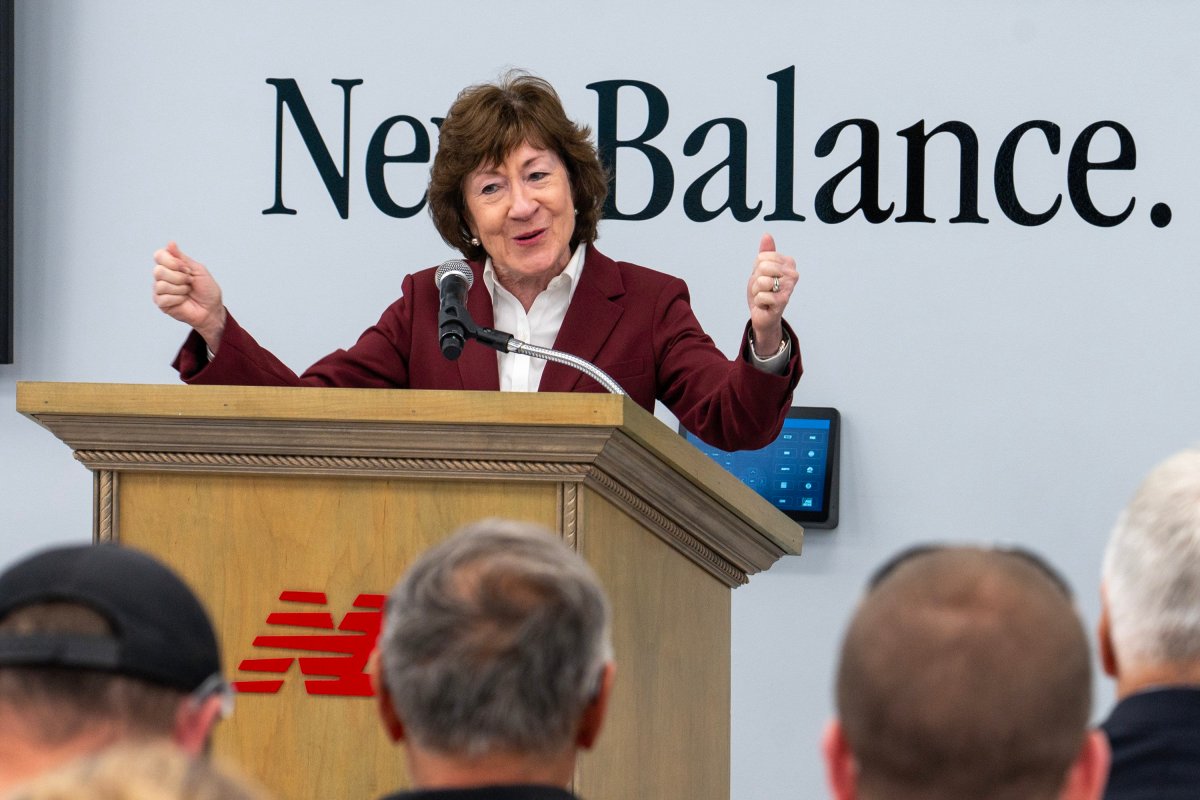
Susan Collins formally announced on Tuesday that she is seeking her sixth term in the U.S. Senate, portraying herself as a pragmatic, bipartisan lawmaker more interested in getting results than scoring political points or making viral content for social media.
Collins’ announcement, which she made in a column in the Bangor Daily News and in a social media video, was not a surprise. Collins has repeatedly indicated her intent to run in one of the most closely watched and competitive races in the country.
“True leaders bring both sides together to seek common ground, not shout the loudest or seek the most social media clicks,” Collins wrote. “I have a proven record of working for you, and I’m running for reelection because my experience, seniority and independence matter.”
Collins’ social media video shows her unboxing a new pair of gray sneakers from New Balance, a Massachusetts-based company with factories in Maine whose chief executive officer, James David, has so far donated at least $1 million toward Collins’ reelection campaign.
“This is perfect for 2026, because I’m running,” Collins says.
The five-term Republican’s announcement comes one week after President Donald Trump signed into law five more budget bills she helped negotiate as chair of the Senate Appropriations Committee. The measures contain more than $425 million in earmarks for projects in Maine.
Collins is widely considered the most endangered Republican senator running in the 2026 cycle. She’s the last New England Republican in Congress and the only Republican running in a state won by Democrats in the 2024 presidential election.
Looming large over the Senate race is Trump, who said Collins and four other Republicans “should never be elected to office again” for supporting an effort to rein in the use of military force in Venezuela.
Collins must walk a fine line as she looks to put together a coalition of moderates and conservatives. In the op-ed, she noted her relative independence in a hyperpartisan era.
“Too many current and aspiring members of Congress think their job is to either be a rubber stamp or a reflexive obstructionist,” she said. “As the most bipartisan senator, I reject those extreme philosophies. Instead, I routinely partner with members on both sides of the aisle to build consensus on policies aimed at affordability, economic stability and opportunity.”
While Collins positions herself as a moderate dealmaker, Democrats contend that she has been a reliable vote for Trump.
In statements Tuesday, local and national Democrats highlighted Collins’ crucial vote to confirm Brett Kavanaugh to the U.S. Supreme Court, an appointment that eventually resulted in the end of federal abortion rights.
“Susan Collins has spent the last 30 years betraying Maine,” Maine Democratic Party Executive Director Devon Murphy-Anderson said in a written statement. “She now faces some of the lowest approval ratings of her career because Mainers see through her political games and fake shows of concern. In November, we will reject her at the ballot box.”
Collins also cast a key vote to advance the One Big Beautiful Bill Act, which contained nearly $1 trillion in cuts to Medicaid. She ultimately voted against the bill, which became law after Vice President JD Vance broke a 50-50 Senate tie.
“Mainers have had enough of Collins’ three-decade career in the Senate, and in 2026, they will vote her out,” Democratic Senatorial Campaign Committee spokesperson Maeve Coyle said in a written statement.
As Democrats tried to tie Collins to Trump, national GOP leaders highlighted her dedication and independence.
Senate Majority Leader John Thune called Collins a “proven leader who delivers results” and noted her “work ethic and effectiveness.” And Sen. Tim Scott, chairman of the National Republican Senatorial Committee, said she is “a battle-tested leader whose fierce independence has led to historic wins for Maine.”
Before taking on Collins, Democrats must navigate a competitive primary between Gov. Janet Mills and Graham Platner. Mills, 78, is the two-term governor who is preferred by Senate Minority Leader Chuck Schumer of New York. Platner is a 41-year-old combat veteran, political newcomer and oyster farmer backed by progressives and Sen. Bernie Sanders of Vermont.
Mills took aim at Collins’ core arguments for reelection — her seniority and leadership of the Senate Appropriations Committee.
“Seniority without a backbone is just tenure, and after decades in Washington, Senator Collins has failed to demonstrate the leadership required in this dangerous moment in history,” Mills said in a written statements, referring to Trump’s efforts to expand presidential powers.
Platner criticized Collins for not honoring her early pledge to serve two terms in the Senate.
And in a statement, he pledged to “deliver this seat back to the people of Maine.”
“In November, the movement we are building will turn the page not just on Senator Susan Collins, but also on her politics of hollow promises,” Platner said.
Collins is suffering from low approval ratings, but she has defied expectations before.
In 2020, she won by nine points over former State House Speaker Sara Gideon, even though Joe Biden won the statewide presidential vote by nine points. The race drew about $200 million in spending. But Gideon’s loss was not due to a lack of funds. The Democrat finished the race with $15 million left in the bank.

Comments are not available on this story. Read more about why we allow commenting on some stories and not on others.
We believe it's important to offer commenting on certain stories as a benefit to our readers. At its best, our comments sections can be a productive platform for readers to engage with our journalism, offer thoughts on coverage and issues, and drive conversation in a respectful, solutions-based way. It's a form of open discourse that can be useful to our community, public officials, journalists and others.
We do not enable comments on everything — exceptions include most crime stories, and coverage involving personal tragedy or sensitive issues that invite personal attacks instead of thoughtful discussion.
You can read more here about our commenting policy and terms of use. More information is also found on our FAQs.
Show less