
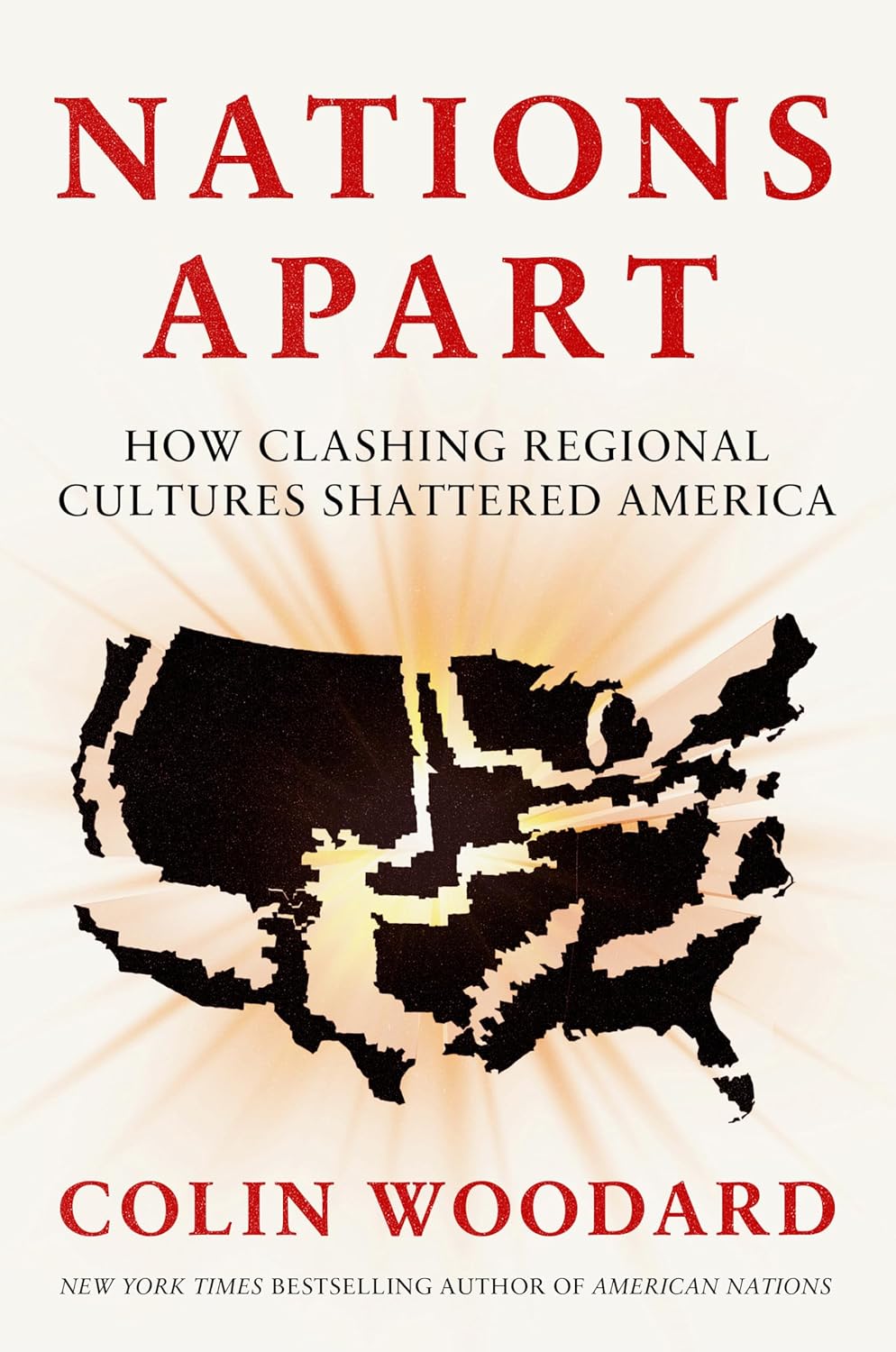
In his 2011 bestselling book “American Nations,” Colin Woodard put forward a powerful thesis to try to understand the very different politics to be found in different parts of the United States. Far from being “E pluribus unum,” he suggested, we are a fractious federation of regional “nations,” whose worldviews reflect their very different origins, mostly dating from Colonial times. In the 15 years since (during which a second book, “American Character,” dug deeper into the same issues), these differences have intensified to the point that they threaten to rip the country apart. Hence “Nations Apart,” in which Woodard warns we are about to reach a tipping point.

“The single-minded pursuit of individual freedom,” writes Woodard in his introduction, “is driving us to the brink of despotism.” And that was a year ago. In the 14 months since he finished his manuscript, the attacks on liberal democracy have accelerated grotesquely. It’s worth noting that the author covered the bloody breakup of Yugoslavia as a journalist and mused at the time that such a thing could never happen in “a free society like my own.” Now, when he describes the U.S. as Balkanized, he knows whereof he speaks.
Woodard counts nine major “nations,” most of which have spread east to west across the country from the sites of their birth on the Atlantic coast, bearing with them the ethos of their various founders. For example, “Yankeedom” (New England) still prizes the communitarian leanings of its Puritan settlers. “New Netherland” (New York City and surroundings) maintains the commercial spirit of the Dutch Golden Age. “Midlands” –– “America’s great swing region” –– reflects the welcome Pennsylvania’s founding Quakers extended to settlers regardless of creed or nationality, as well as their suspicion of authority. “Tidewater,” mainly Virginia, was the province of the British aristocracy’s younger sons who tried to re-create the country estates to which they had been born.
Interestingly, of all the nations, “Tidewater” has changed most radically since its founding, the result of the late 20th century ballooning population of federal workers around Washington, D.C. By contrast, “Greater Appalachia,” settled by the feisty clans of the British border regions, prides itself on how little things have changed for centuries. The “Deep South,” settled by British sugar planters from Barbados, Woodard points out, was an “ethno-nationalist authoritarian regime until the late 1960s.” Other regions—the “Far West”, the “Left Coast,” and the Hispanic Southwest, “El Norte” — all have similarly identifiable beginnings.
It is important to understand that these regions are superimposed over state lines. The data that goes into defining them has been collected county by county. Parts of Ohio, for instance, belong to three different “nations”: Yankeedom, Midlands and Greater Appalachia.
“Nations Apart” is accompanied by copious graphs and maps, the product of Nationhood Lab, an interdisciplinary research project at Salve Regina University in Newport, R.I. It was founded by Woodard three years ago to analyze and refine his American Nations theory. These graphs and maps demonstrate vividly how the “nations” align almost perfectly with the political demographics of the country. Though they provide impressive confirmation of his theory, the black and white format can tax the eyeballs of a reader trying to decipher the precise shade assigned to each nation.
Armed with this impressive battery of data, Woodard examines and breaks down the attitudes of each nation to an “existential suite of public policy and U.S. sociological problems,” as Nationhood Lab puts it. These policies include tinderbox issues like immigration, guns, climate change and abortion. In some of these, he suggests, common ground could be found if the message were tailored to different constituencies: “Successful advocates will frame their arguments differently depending on what regional population they’re trying to persuade.”
For example, it turns out that across all “nations,” the support for background checks on guns is comparable “to the percentage who agree that the Earth is round.” But it depends how you frame the solution. Similarly, there is broad agreement — “supermajorities” — that climate change is happening, although why and what to do about it, not so much. There is, however, no agreement on abortion between Southern Baptist dominated Greater Appalachia and the Deep South on one hand, and the more liberal nations on the other. Despite his solution-oriented mindset, Woodard sees little prospect of rapprochement on this issue any time soon, and it will “continue to corrode the ties between states and their underlying regions at a time when they’re already dangerously weak.”
After all the impressive number crunching, it was a pleasure to read the more philosophical chapters about the creation myths of the various “nations.” Before embarking on this quest Woodard cautions that “few of them stand up to careful scrutiny.” Indeed, he describes the intellectual debates as if “half a dozen countries were fighting over the nation’s steering wheel, while half a dozen others were protesting from the back seat that they’d been forced into the car against their will.”
Woodard finished writing “Nations Apart” just after the 2024 election. It concludes with a pair of chapters, one on democracy, the other on authoritarianism. One traces the trend from Tea Party to Trump. The other reads today as a prescient warning of our current slide into autocracy. Despite his objectivity, Woodard has no illusions about which side will save the republic.
Woodard’s message is urgent and could hardly be more timely. I believe he is absolutely right. At the same time, absorbing that message provoked a thought experiment: I wonder how an intellectual with Woodard’s gifts from the Deep South or Greater Appalachia would portray this new American dilemma.
Thomas Urquhart is the author of “For the Beauty of the Earth,” and “Up for Grabs! Timber Pirates, Lumber Barons and the Battles Over Maine’s Public Lands.”
We invite you to add your comments. We encourage a thoughtful exchange of ideas and information on this website. By joining the conversation, you are agreeing to our commenting policy and terms of use. More information is found on our FAQs. You can update your screen name on the member's center.
Comments are managed by our staff during regular business hours Monday through Friday as well as limited hours on Saturday and Sunday. Comments held for moderation outside of those hours may take longer to approve.
Join the Conversation
Please sign into your CentralMaine.com account to participate in conversations below. If you do not have an account, you can register or subscribe. Questions? Please see our FAQs.