

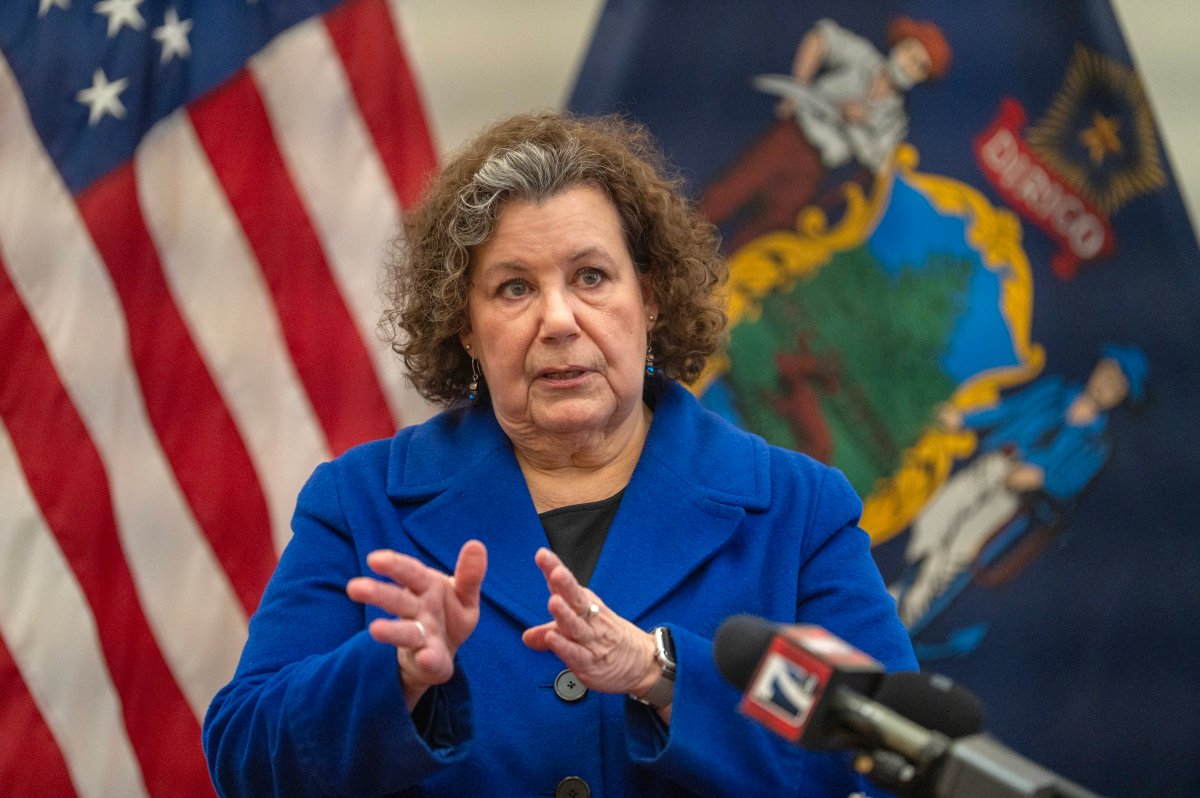
Maine’s top judge told state lawmakers on Thursday that she worries about political divisiveness and an erosion of trust and respect for the courts.
During her annual State of the Judiciary, Chief Justice Valerie Stanfill said she is surrounded by other judges who were appointed by governors from one political party and later reappointed by governors from a different party.
“Those labels you see are meaningless,” Stanfill said to a room full of state lawmakers, judges and the governor. “They must remain so.”
Stanfill’s remarks come as lawyers and legal advocates around the country have shared concerns about a growing lack of respect for the rule of law. After her speech, Stanfill told reporters that judges and lawmakers in other states have been threatened and killed, and at least one Maine judge “felt it necessary to vacate” their home this year.
“We don’t publicize these things,” Stanfill said. “We don’t want to publicize these things, but that’s how the discourse is in this country now. I don’t know how we bring it back, except to talk about what are the issues, and to remember that there are a lot of issues that unite us.”
In her speech, Stanfill also addressed technological advances in the court and the need for more staff and courthouse repairs.
Stanfill said she hopes all court records will be online by next year in Maine, where many courthouses are still using paper files that can only be viewed in person. Maine first announced that it would begin transitioning to an electronic filing system more than 10 years ago.
Androscoggin County was the first to begin putting new criminal cases online last summer. Stanfill said that region is now using the electronic filing system for all case types and that courts in Kennebec and Somerset counties began the transition on Feb. 2. York County will be next.
The courts have also launched an electronic payment site and a text notification program for criminal defendants to reduce the number of times people fail to appear for important court dates, Stanfill said.
She said the courts have been turning to technology with “unprecedented speed,” but that the judicial branch still struggles with basic infrastructure and staffing needs.
The chief justice has used previous speeches to advocate for new judge and clerk positions, after the National Center for State Courts found in 2023 that Maine needed dozens more clerks to process criminal and civil court cases. Some new positions have been created, but Stanfill said Thursday that Maine courts still run “very lean” compared to other states.
She listed several new construction and repair projects for the year ahead, as well as courthouses that had to close last year. A small courthouse that was only open two days a week in Madawaska closed in 2025. The courthouse in Newport has been closed for more than a year due to mold.
“To be clear, it is not been our intent to permanently close the Newport courthouse, but the cost involved to get a new courthouse up and running is significant,” Stanfill said.
The judicial branch has several construction projects planned for the year, after lawmakers authorized bonds in 2024 to fund the work. That includes a new courthouse in Hancock County and additions to the courthouses in Skowhegan and Lewiston.
“The reality is that most of the county facilities throughout the state are aging and aging and aging, and simply cannot support modern and safe court operations,” Stanfill said.
Staff Photographer Joe Phelan contributed to this report.
