

Early last week, Graham Platner was hoisted from a frenzied mosh pit onto a stage in Portland. As a well-known Celtic punk band played, he growled lyrics in his graveled baritone voice, and then plunged back into a sea of eager hands, which passed him around in the air.
Two days later, Gov. Janet Mills cut a ribbon for a new energy storage facility in Gorham before quietly making the rounds of several local businesses. She spoke warmly with local proprietors about personal backgrounds and policy with a small campaign team in tow.
The contrast of styles in Maine’s Democratic U.S. Senate primary could hardly be more stark. Both Mills and Platner are fighting for the right to take on five-term Republican incumbent Susan Collins this fall. And each candidate symbolizes the internal division among Democrats here and nationwide.
“I think they’re rooted in two different theories of what voters want,” said Rob Glover, an associate political science professor at the University of Maine in Orono. “Maine voters have a real choice, and it’s a choice between two very authentic candidates that are extremely different.”
The candidates — and their approach to campaigning — illustrate the soul-searching happening more broadly in the Democratic party. A growing faction wants younger leaders, while others want battle-tested candidates who are proven winners.
Platner is a 41-year-old progressive newcomer backed by Sen. Bernie Sanders of Vermont. With no political experience, he rails against “the establishment” and “the oligarchy.” He supports bold policies: Medicare for All, abolishing U.S. Immigration and Customs Enforcement and raising taxes on the wealthy. The hallmark of the combat veteran and oyster farmer’s campaign has been large town hall rallies all over the state.
Mills is a 78-year-old moderate backed by Senate Minority Leader Chuck Schumer of New York. She’s spent her professional life in public office as a state legislator, district attorney, attorney general and governor. She supports “universal health care” and believes ICE can be reined in and reformed. Her early campaign appearances have been far more controlled, and they’ve featured small and curated audiences. She mingles with business owners and residents at “candid conversation” events, only some of which the press is invited to observe.
Glover said each candidate is targeting different voters. Platner’s campaign is geared toward the young, frustrated and disaffected, while Mills is targeting those seeking experience and stability in elected leaders.
“With Platner,” Glover said, “the populist roadshow is kind of focusing on disruption, so we see the big rallies, the spectacle and the emphasis on authenticity over polish.”
With Mills, the only Democrat to win a statewide election since 2006, “I think she’s running as the steady hand,” Glover said. “She is making the argument that she can level up to D.C. and knows how to work with the machinery of government there.”
RETAIL POLITICS
On Wednesday, Mills’ “candid conversations” tour brought her to several local businesses in Gorham.
At each stop, Mills moved easily from personal chit-chat to policy proposals. At an auto shop, she discussed Congress’ failure to extend the enhanced tax credits under the Affordable Care Act, and she said she believes health care is a human right.
At a local gift shop, she pored over the products, including a pouch of “Hungover as Hell” tea, which elicited a chuckle from the governor.
It was literally retail politics.
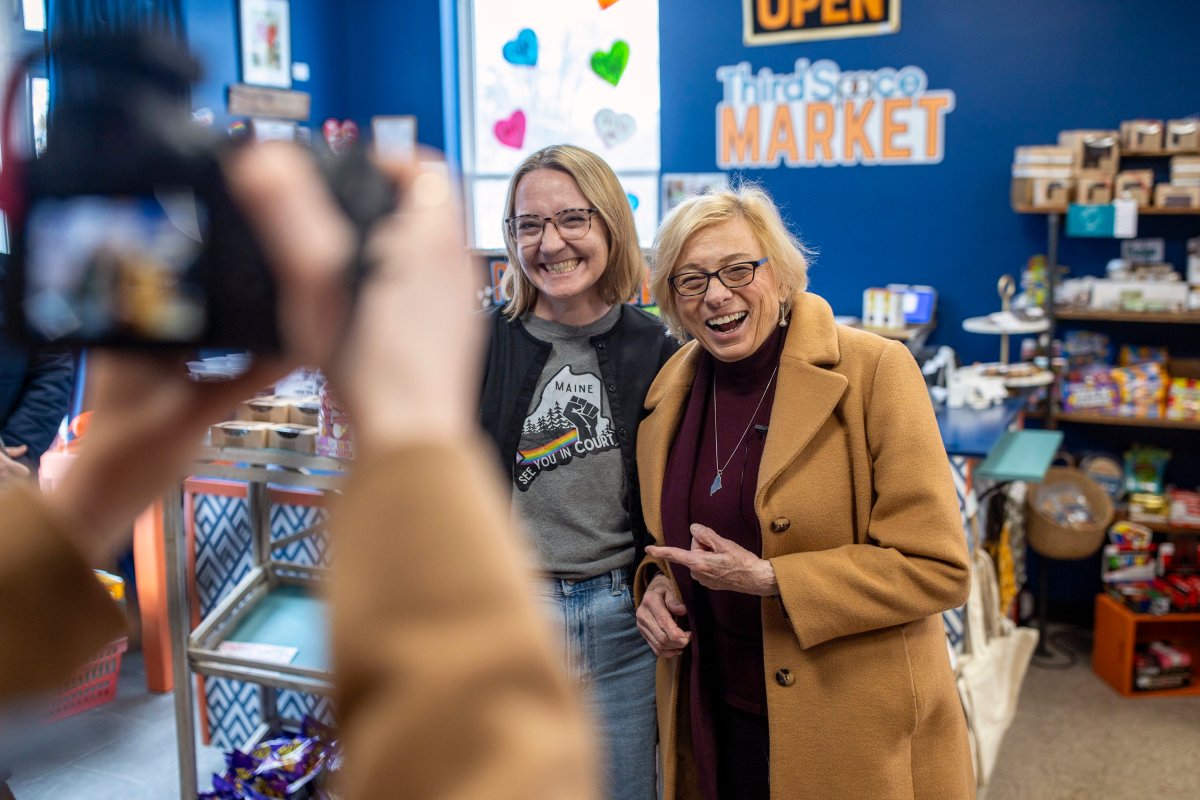
At the gift shop, Third Space Market, Mills talked about spending nine years of her childhood in Gorham. She used to have a paper route, she played in an abandoned mill by the railroad tracks and she would spend her mother’s quarters at a local movie theater that is no longer there.
Owner Michelle Littlefield told the governor that health care costs are the biggest challenge for her, along with tariffs, which are driving up costs for her local suppliers.
“Tariffs on chocolate and coffee — what is he thinking of,” Mills said, referring to President Donald Trump.
After the brief discussion, Mills browsed the shelves of the funky store, which has furniture, a big screen TV and Atari games out back. She bought four wine toppers for charcuterie, a coarse pad for soap and some stickers, including one that said, “elect more women.”
She posed for a photo with Littlefield, who was wearing a custom-made t-shirt featuring an outline of the state, a rainbow and a Black power fist along with the governor’s famous “see you in court” clapback at Trump. The line made Mills a national resistance hero months before Platner came long.
Mills smiled from ear to ear while camera shutters clicked.
CROWD SURFING
Quiet hobnobbing isn’t Platner’s cup of tea.
After announcing his candidacy in late August, he addressed over 6,000 people at a Labor Day rally featuring Sanders, who won Maine’s Democratic caucuses in 2016.
Since then, he’s held more than three dozen town hall events across the state. In more populous areas, crowds approach 1,000 people. And in rural areas, he draws hundreds. At most events, he takes questions from members of the crowd seemingly selected by the candidate at random, and doesn’t shy away from any topic. Not even his history of controversial social media posts or his now-covered Nazi tattoo.
His savvy social media team highlights crowd sizes after each event, and posts clips of exchanges that have gone viral, including one about how to speak to people who voted for Trump.
The campaign cites Platner’s thousands of volunteers as proof of the movement the candidate wants to build. And Platner regularly posts into-the-camera comments on the political news of the day, or makes personal requests for donations.
It all seems to designed to show Platner’s comparative youth, energy and, at times, anger at the status quo.
Perhaps nothing more encapsulates Platner’s energetic approach than the Dropkick Murphys concert Feb. 9 at the State Theater in Portland.

Platner, who had appeared with the Boston-based band last year, was hoisted into the air by the crowd and pulled onstage by frontman Ken Casey. The duo sang “Bury the Bones” into the same microphone. The song is an ode to the working class and the power of organizing.
“You spread your hate to divide us ’cause you want us scared and alone / But soon, you’ll fall in disgrace when you’re dragged down on high from your throne,” they scream-sung.
Platner, the populist, pointed to the crowd and looked at Casey, who gave a wave of his arms. Platner ran to the front of the stage, jumped, and flew belly-first into the crowd below.
The next day, Platner posted a video of his stage dive.
“Thanks for always standing with the working class @dropkickmurphys,” he wrote.

We invite you to add your comments. We encourage a thoughtful exchange of ideas and information on this website. By joining the conversation, you are agreeing to our commenting policy and terms of use. More information is found on our FAQs. You can update your screen name on the member's center.
Comments are managed by our staff during regular business hours Monday through Friday as well as limited hours on Saturday and Sunday. Comments held for moderation outside of those hours may take longer to approve.
Join the Conversation
Please sign into your CentralMaine.com account to participate in conversations below. If you do not have an account, you can register or subscribe. Questions? Please see our FAQs.