

The slow art of fly-fishing requires wading and waiting. As modernity speeds up around us, so does the erosion of the world in which fly-fishing exists. For anglers like Paul Guernsey and his protagonist, Vincent Mapp, one must adapt to avoid great loss.
Paul Guernsey’s fourth novel, “Rolling Back the River,” explores an eroding world with a guide who knows the last of what’s left on the map. Vincent Mapp, like Guernsey himself, is an expert angler on a mission to catch a fish native to Maine in the waters of Argentina. Along the way, he learns to adapt to adventure, loss and the whims of literature at every turn.
Guernsey uses humor, grief and field guide precision to take readers on an adventure to Argentina and through time as we roll back the river of his devising.
Vincent Mapp is an angler, like you. What got you into fly-fishing?
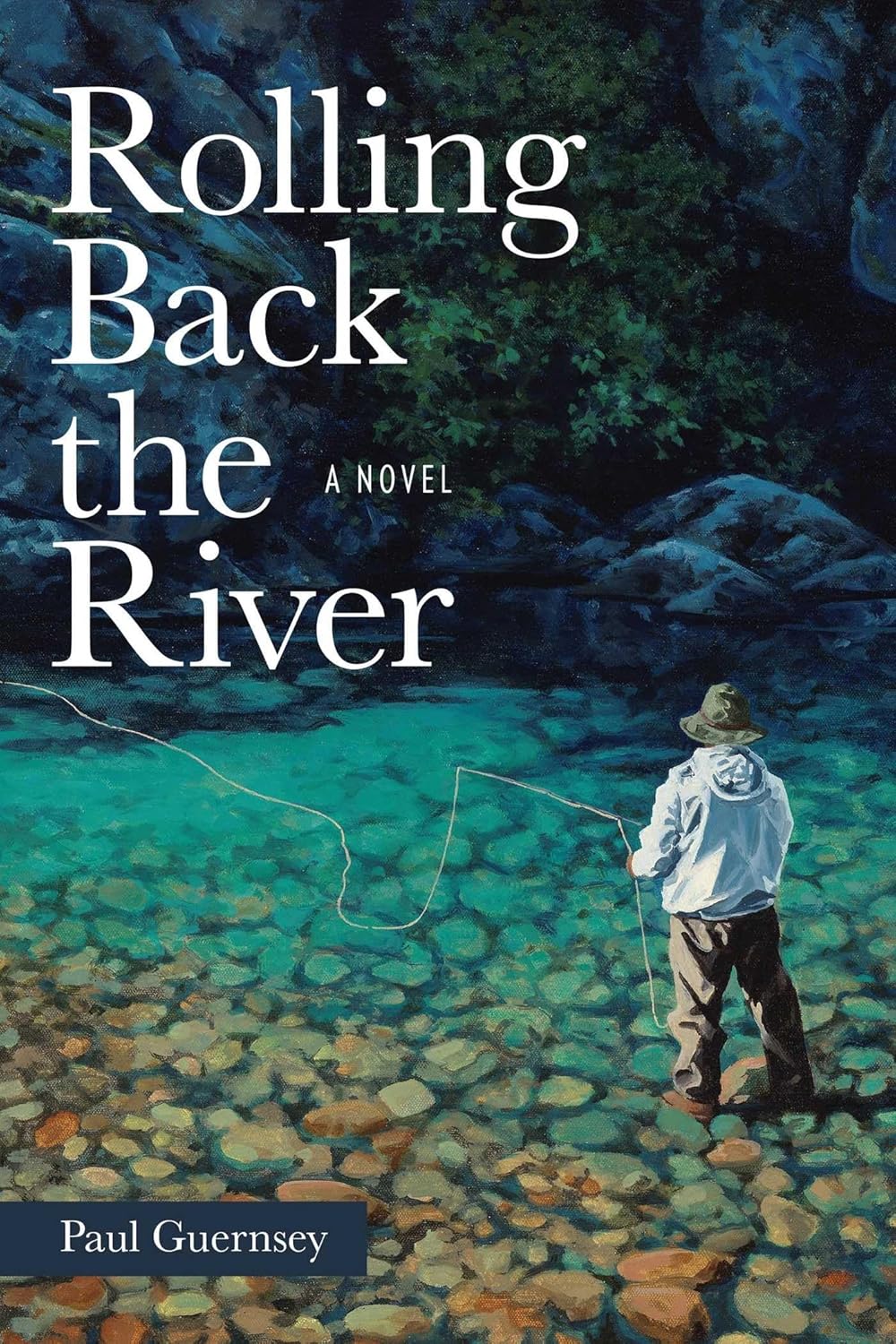
My father had me out on the little brook trout streams in Connecticut where he fished as a kid, and I got imprinted on brook trout. I knew there was such a thing as fly-fishing, but I didn’t know anybody who did it. While I was a fisherman for pretty much my entire life, I finally met somebody who fly-fished, and they let me tag along and loaned me equipment. I used to go with a group of guys into the Catskills. When I moved to Maine, that became the thing I did more than anything else, aside from writing.
Eventually, I became — actually the first — associate editor [of Fly Rod & Reel Magazine]. That opened up all kinds of opportunities for me.
I really loved the novel’s architecture. The first chapter is ‘Maps and Mazes,’ and we learn how Vincent creates his own maps for where he fishes. How did you invent that structure?
When we first meet Vincent, he’s a professor teaching at a little environmental college, so as well as being an angler, he’s also a well-read person. Everything that happens to him, he associates with something in literature. At different times, he’ll imagine himself as Don Quixote. Of course, he’s off to Argentina on this absurd grail quest to catch a salmon in Argentina that was originally transplanted from Maine. This provides the frame for the story, although it’s not mainly what the story is about.
Vincent is very concerned with what fish are native to where and how they got there. What tension do you see in that idea of conserving a kind of world?
I start off with an epigraph by Aldo Leopold — he’s attributed with being the father of American conservation — “One of the penalties of an ecological education is that one lives alone in a world of wounds.” Vincent is this person who’s living almost alone in a world of wounds. With fishing, we’ve moved around all these species that we like to catch. We’ve put them in places where they’re not native, and they change the whole ecosystem. Because it’s underwater, it’s not out in plain sight.
People who go fishing for, say, brown trout or rainbow trout in the Rocky Mountains — well, the fish that belongs there is the cutthroat trout, and it’s been largely displaced by rainbow trout and brown trout. Anybody who’s fishing for brown trout anywhere in North America is fishing for an introduced species, so it’s not a completely natural experience. We like to think of it as being a natural experience, and it is, but it’s different than it would be if we hadn’t moved all these different species around and changed the ecosystem. I don’t know what the answer is, but I think it’s important to know that changes have been made in the outdoor space where you’re conducting your recreation. You at least need an appreciation for the fact that people have intervened and changed things.
Vincent’s way of thinking about ecology and the world is eroding quickly. When he and his pal are fishing, they’re interrupted by the new bros of fishing who are pontificating about their Teslas and fancy equipment. Do you feel sad about the nature of things changing? Is there hope to restore things to an old way, or at least to have the knowledge written somewhere?
With anything from one generation to the next, attitudes are going to change, so I would not fault those new fly-fishing bros, totally. Part of it is these two older guys being grumpy old men who are angry that someone has discovered their secret trout stream, which to them is so sacred that they don’t even mention its name to each other. There is some generational change that’s natural, and it’s going to happen in any sport, any profession, any undertaking. In the end, these guys catch the bigger fish.
The sprawl of the title, ‘Rolling Back the River,’ opens the lasting question, if we can’t roll back the river, where do we go next? Where does that leave you as a writer? How does that make you feel about the world?
The river is always there, and you have to fish the part of it that you’re on. I don’t think that my character, Vincent, is particularly mournful — he’s mournful at different times, but he realizes we’re in a different place now, so we have to make the best of that. I think that that’s the only way we can go forward. We cannot return to a previous time when we thought things were better. If we sit around thinking about the good old days, we’re just wasting our time because we’re in a different spot. We have to recognize that, and we have to make the best of our short time in that place. Rolling back the river is a very familiar metaphor, but too many people spend their time trying to roll back up the river. If you’re in a rowing craft, that’s very difficult, if not impossible. You just have to step out where you can and fish that spot, make the best of that spot and then keep moving.
Lisa Hiton is a writer living in Brooklyn, N.Y. She is the author of the poetry collection “Afterfeast,” and her work has been featured or is forthcoming in the Kenyon Review, The Slowdown, NPR, New South and elsewhere.
We invite you to add your comments. We encourage a thoughtful exchange of ideas and information on this website. By joining the conversation, you are agreeing to our commenting policy and terms of use. More information is found on our FAQs. You can update your screen name on the member's center.
Comments are managed by our staff during regular business hours Monday through Friday as well as limited hours on Saturday and Sunday. Comments held for moderation outside of those hours may take longer to approve.
Join the Conversation
Please sign into your CentralMaine.com account to participate in conversations below. If you do not have an account, you can register or subscribe. Questions? Please see our FAQs.