

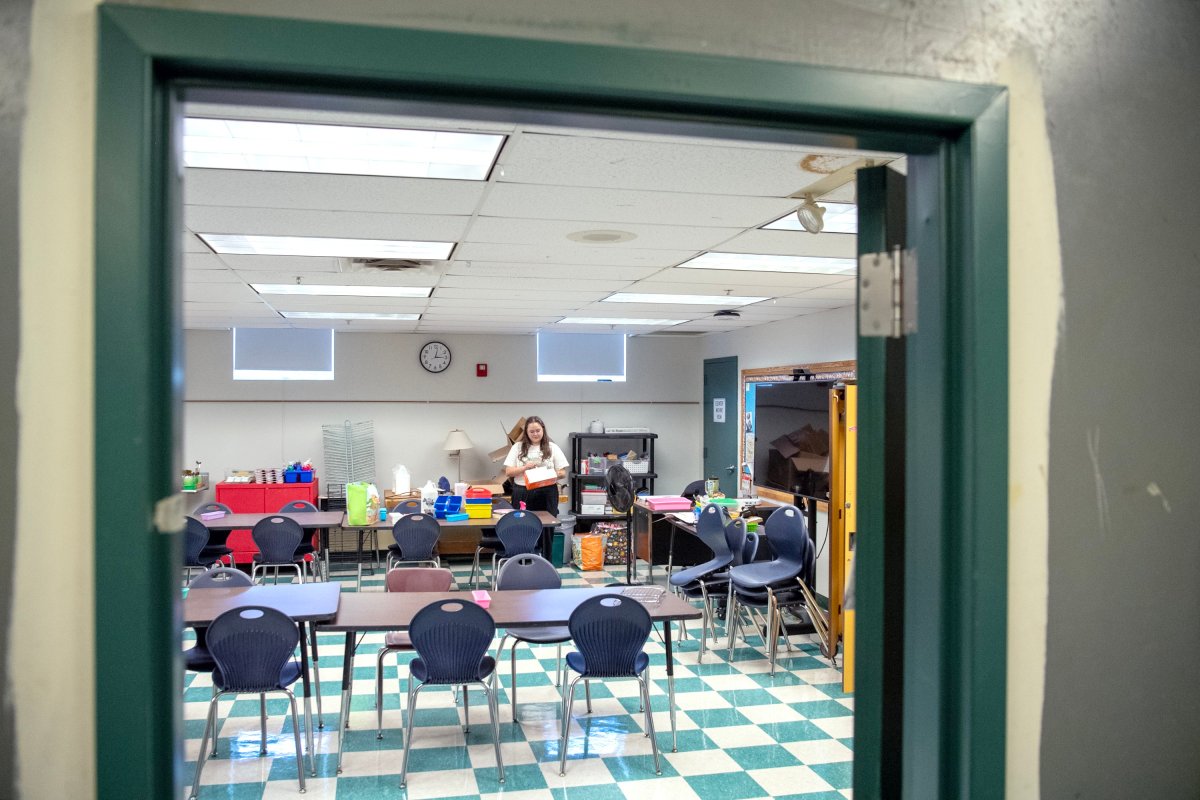
A commission charged with finding solutions to Maine’s school construction crisis has released its final report, which outlines recommendations on how to improve the state’s K-12 infrastructure by cutting costs, maximizing existing resources, increasing funding and utilizing data.
The report — publicly released Friday but dated Feb. 10 — includes more than a year of work from the Governor’s Commission on School Construction. Mills announced the commission in October 2024, and the review is the first of its kind since 1998. She said it was “time for a new look at how Maine pays for school construction.”
“The existing approach is not equipped to address the size, scope, and complexity of this statewide issue — one that involves almost 600 schools in 272 districts across hundreds of municipalities, state and local funding, and a wide array of partners and stakeholders,” the summary of the new report reads.
The group was tasked with finishing its work by April 2025, but released just an interim report at that time and continued meeting through the end of the year. The preliminary report found the scope of the problem to be vast: 500 of the state’s 600 school buildings would need to be replaced in the next 20 years, a cost conservatively estimated at $11 billion.
The final report includes formal recommendations “to reduce cost, maximize existing resources, and to stop deterioration due to deferred maintenance.”
Many districts have put off fixing infrastructure issues, which makes those projects more expensive over time. To solve this, the commission suggested rethinking how the state uses its revolving renovation fund — a program that provides no-interest loans for small projects like HVAC replacements — by raising the cap from $2 million and supplying more funding.
Other proposals include finding savings on soft costs (like architects, designs and permits) by using specialists already pre-qualified by the state or prototype design elements.
Two other recommendations address hot-button topics: the major capital construction program and school consolidation.
The current state funding process for replacing schools uses an all-or-nothing approach, where a small number of districts receive 100% state financing for their projects, and the rest receive none. In the last cycle, out of the 74 schools that applied to have their buildings replaced, only nine received funding. The commission suggested moving to a sliding-scale model to make more resources available to more districts.
It also proposes looking at school consolidation, although stops short of recommending it as a broad policy. Instead, the report says consolidation should be “part of the long-term strategy with greater attention to understanding the economic and qualitative cost-benefits” and suggests using data analytics to assess the true value of consolidation, and continuing to incentivize it on an individual project basis.
To increase funding, the commission suggests state-level bonding, raising money through additional tax or funding sources outside of property taxes (currently used in 19 other states), reexamining debt service and exploring public-private partnerships. It concludes with strategies for maximizing data analytics for better long-term planning and financial modeling.
The report proposes the creation of a quasi-governmental agency, the Intergovernmental Office of School Infrastructure, to implement the recommendations. The authors emphasize that the report is not meant to be taken as several individual recommendations, but rather as a framework meant to be executed all together.

We invite you to add your comments. We encourage a thoughtful exchange of ideas and information on this website. By joining the conversation, you are agreeing to our commenting policy and terms of use. More information is found on our FAQs. You can update your screen name on the member's center.
Comments are managed by our staff during regular business hours Monday through Friday as well as limited hours on Saturday and Sunday. Comments held for moderation outside of those hours may take longer to approve.
Join the Conversation
Please sign into your CentralMaine.com account to participate in conversations below. If you do not have an account, you can register or subscribe. Questions? Please see our FAQs.