
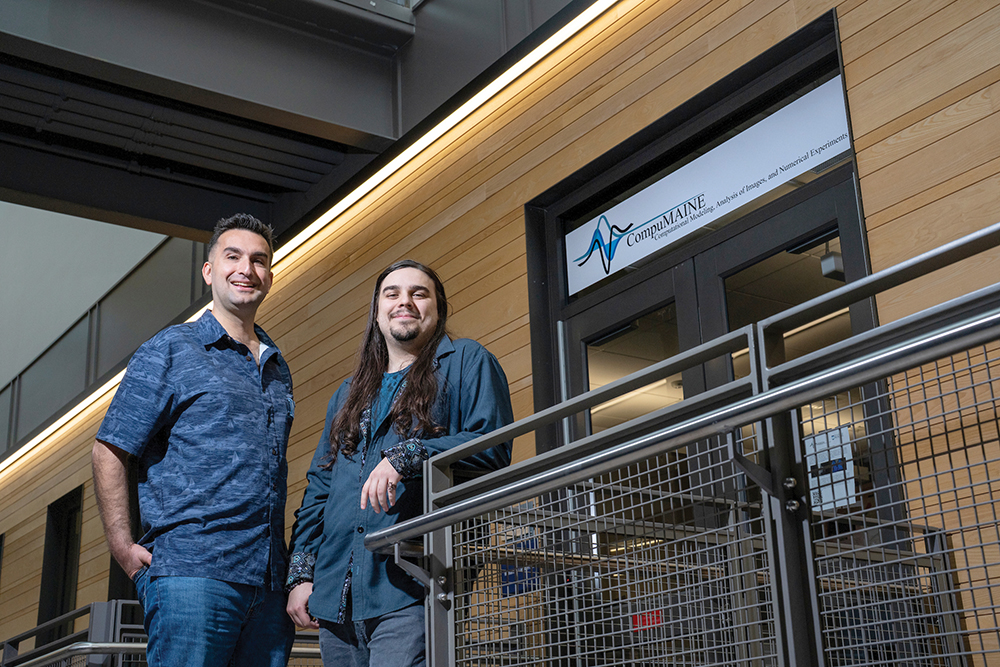
Lifesaving research is taking place at the University of Maine in Orono. A research team, led by a PhD student and recent graduate, has developed a new artificial intelligence (AI) tool to improve early detection of breast cancer. It has the potential to increase the speed and accuracy of breast cancer diagnoses. The name of the new system is Context-Guided Segmentation Network (CGS-Net).
The project was spearheaded by researchers Jeremy Juybari, a recent PhD graduate in electrical and computer engineering, and Josh Hamilton, a doctoral candidate in biomedical engineering. They said the new system is an improvement over existing AI breast cancer detection tools because it not only has the capability to detect primary breast cancers but it can also integrate information regarding tissue surrounding the tumor. That can contribute to a more accurate diagnosis.
“Prior research has shown that tissue near a tumor can differ from tissue farther away,” said Juybari. “We build on that idea by giving our model access to surrounding tissue, in addition to the local region, when making predictions.”
According to Juybari, the tool looks at surrounding tissue as context, which helps improve its predictions. If the new tool recognizes that tissue surrounding a suspected breast cancer is abnormal, that may help to confirm the presence of some type of breast cancer.
“What we know is that the model uses information from the surrounding tissue when making its prediction and that including the context improves performance,” said Juybari. “However, we can’t say it’s ‘confirming’ cancer based on a specific tissue type.”
Quicker and more accurate early detection can save lives
Breast cancer is the second most common cancer diagnosis among women in the U.S., and the second leading cause of women’s cancer-related deaths. One in every eight women (13%) will develop breast cancer at some point in their lifetime.

The American Cancer Society recently announced that the five-year survival rate for all cancers combined is now 70%. They attribute that, in part, to an increase in early detection. “You can’t treat it if you don’t know it’s there,” Hamilton said.
The standard practice for diagnosing breast cancer, until recently, has been for pathologists to examine biopsy slides under a microscope following an abnormal mammogram. That practice is being replaced by digital imaging which paves the way for the UMaine researchers’ new technology.
Their tool is trained to differentiate between breast cancer tissue and normal breast tissue. It has the capability to examine hundreds of digital breast tissue images at once to screen for breast cancer. That allows pathologists to triage patients more easily and quickly, decreasing the amount of time patients have to wait before they can begin treatment after a positive biopsy.
Hamilton’s interest in cancer research stems from his personal experience. He lost a close high school friend to osteosarcoma (bone cancer) and his stepfather to pancreatic cancer. He said that pancreatic cancer is difficult to diagnose early because it doesn’t usually exhibit symptoms until the cancer has progressed to a later stage.
The focus of the two researchers’ work is on discovering new ways to improve early detection of both breast and pancreatic cancer.
The purpose of the new AI detection tool isn’t to replace pathologists, but to make their work easier by providing them with a tool that can help triage patients with more accurate and early diagnoses.
“In many parts of the world there is a shortage of pathologists,” said Hamilton. “Two-thirds of the world’s pathologists are located in 10 countries. That shortage can lead to delays in treatment and deaths that could have been prevented.”
As cancer rates increase, humans are finding innovative ways to increase survival and improve treatment. This new tool developed in Maine has the potential to expedite the work of pathologists and save lives worldwide.