

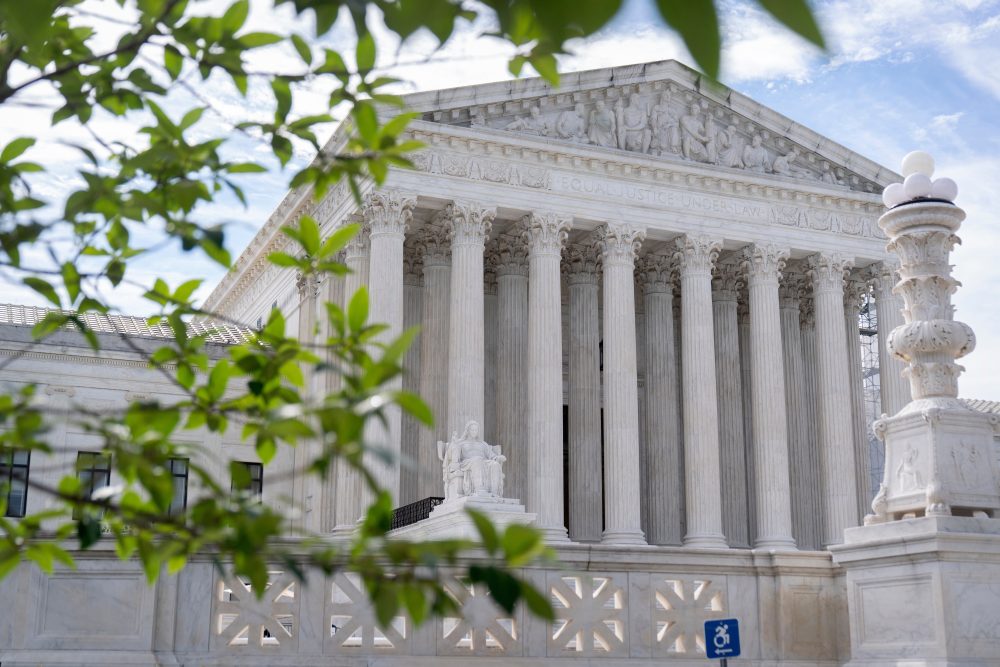
In a consequential decision for Maine, the U.S. Supreme Court has ruled that President Donald Trump cannot use the International Emergency Economic Powers Act to impose sweeping tariffs.
The 6-3 decision was announced Friday morning, with conservative Justices Samuel Alito, Brett Kavanaugh and Clarence Thomas dissenting.
The emergency tariffs had created a challenging regulatory environment for Maine’s businesses over the past year, said Patrick Woodcock, president of the Maine State Chamber of Commerce.
“It has been a roller coaster for a lot of Maine businesses,” he said Friday morning.
The chamber is generally supportive of tariffs that can level the playing field for Maine businesses in certain industries, such as those targeting softwood lumber, Woodcock said. But the sweeping and fluid nature of Trump’s emergency taxes had been difficult to plan around.
“I would hope that there’s more of a selected and targeted approach that businesses can plan around,” Woodcock said. “I do not see that this will be the end of tariffs — far from it.”
The court’s decision doesn’t stop Trump from imposing duties under other laws. While those come with more limitations, Trump projected confidence that he’d be able to keep his tariff framework in place under other authorities.
Hours after the court issued its ruling, Trump vowed to impose a 10% global tariff while his administration considers its options. Those new tariffs would be limited to 150 days.
The president called the court’s decision “incorrect” and “ridiculous.”
“But it doesn’t matter because we have very powerful alternatives,” Trump said.
MAINE OFFICIALS RESPOND
The court’s decision drew bipartisan praise from Maine’s elected officials Friday.
In an interview, Gov. Janet Mills said she agrees with the justices in the majority, noting that Mainers are contending with soaring prices across the board.
“I’m pleased that the chief justice took the bull by the horns and is reining in the powers of the chief executive under the Constitution,” Mills said. “This has not been an emergency.”
Sen. Susan Collins, R-Maine, whom Mills is challenging in the U.S. Senate race this year, said the court’s ruling “reaffirms” Congress’ authority to impose tariffs.
“The President can only do so under a clear and limited delegation of authority from Congress,” Collins said in a written statement.
Sen. Angus King, I-Maine, said the decision is a cue for Congress to assert itself as the courts have.
As news of the decision broke Friday morning, Democratic Rep. Chellie Pingree offered a brief response to reporters at her Portland district office.
“Hallelujah,” she said.
She expanded on that in a written statement later in the day, calling the decision “a win for businesses and industries that have struggled to navigate the uncertainty” brought by Trump’s trade policies.
“Trump’s tariffs have done incredible damage to our economy, to our relationships with key allies, and to the pocketbooks of millions of Americans,” Pingree said.
And Rep. Jared Golden, D-Maine, said Friday’s ruling shows that tariffs need to be passed into law by Congress, not via executive order. Golden has long championed tariffs as a way to bolster the country’s position in global trade.
“I remain committed to ensuring our country uses this tool — whether at the president’s direction or the Congress’s,” Golden said in a written statement.
TARIFFS’ FULL IMPACT UNCLEAR
Many of the products Maine imports from Canada, its largest trading partner, are exempted from Trump’s tariffs because they are covered in the United States-Mexico-Canada Agreement.
James Myall, an analyst with the left-leaning Maine Center for Economic Policy, said the exemptions, which are a part of the pact designed to alleviate trade barriers between the three nations, have softened some of the effects of Trump’s Canadian tariffs.
“The Canadian tariffs have actually not had as much impact as people worried they would,” Myall said. But “many Maine companies and businesses use goods that are imported from all kinds of other places as well.”
The total value of imports into Maine fell about 11% from 2024 to 2025, according to an analysis of trade data provided by the U.S. Census Bureau. Year-over-year values were down in nine of 12 months.
Myall said the court’s decision was “generally good news” for Mainers.
However, he called it unsurprising, given the skeptical tone of justices’ responses to oral arguments in the case last year.
THE CASE
The Constitution gives Congress the power to levy tariffs. But the Trump administration argued that a 1977 law allowing the president to regulate importation during emergencies also allows him to set tariffs. Other presidents have used the law dozens of times, often to impose sanctions, but Trump was the first president to invoke it for import taxes.
Trump set what he called “reciprocal” tariffs on most countries in April 2025 to address trade deficits that he declared a national emergency. Those came after he imposed duties on Canada, China and Mexico, ostensibly to address a drug trafficking emergency.
A series of lawsuits followed, including a case from a dozen largely Democratic-leaning states and others from small businesses selling everything from plumbing supplies to educational toys to women’s cycling apparel.
The challengers argued the emergency powers law doesn’t mention tariffs and Trump’s use of it fails several legal tests, including one that doomed then-President Joe Biden’s $500 billion student loan forgiveness program.
The economic impact of Trump’s tariffs has been estimated at some $3 trillion over the next decade, according to the Congressional Budget Office. The Treasury has collected more than $133 billion from the import taxes the president has imposed under the emergency powers law, federal data from December shows.
REFUNDS?
Many companies, including the big-box warehouse chain Costco, have already lined up in court to demand refunds.
Though Kavanaugh said the country “may be required to refund billions” in his dissent, the issue did not come up in the majority opinion.
Speaking to reporters from the White House Friday afternoon, Trump said it was “crazy” that the court’s decision did not address the refund question. He did not directly answer a question about whether he would pursue them.
“It’s not discussed. We’ll end up being in court for the next five years,” Trump said.
Woodcock, the Maine chamber leader, said he expects refunds to come up in additional court cases.
But he said “it’s a bit challenging to isolate the exact damages from something like this, that happened so rapidly.”
Wade Merritt, president of the Maine International Trade Center, said refunds remain a significant concern for the state’s businesses.
In a written statement, he advised business owners to “connect with their attorneys, customs brokers, or other qualified experts to keep up with the latest information regarding the refund process.”
Staff Writers Randy Billings and Billy Kobin contributed to this story. Material from the Associated Press was also used.

We invite you to add your comments. We encourage a thoughtful exchange of ideas and information on this website. By joining the conversation, you are agreeing to our commenting policy and terms of use. More information is found on our FAQs. You can update your screen name on the member's center.
Comments are managed by our staff during regular business hours Monday through Friday as well as limited hours on Saturday and Sunday. Comments held for moderation outside of those hours may take longer to approve.
Join the Conversation
Please sign into your CentralMaine.com account to participate in conversations below. If you do not have an account, you can register or subscribe. Questions? Please see our FAQs.