

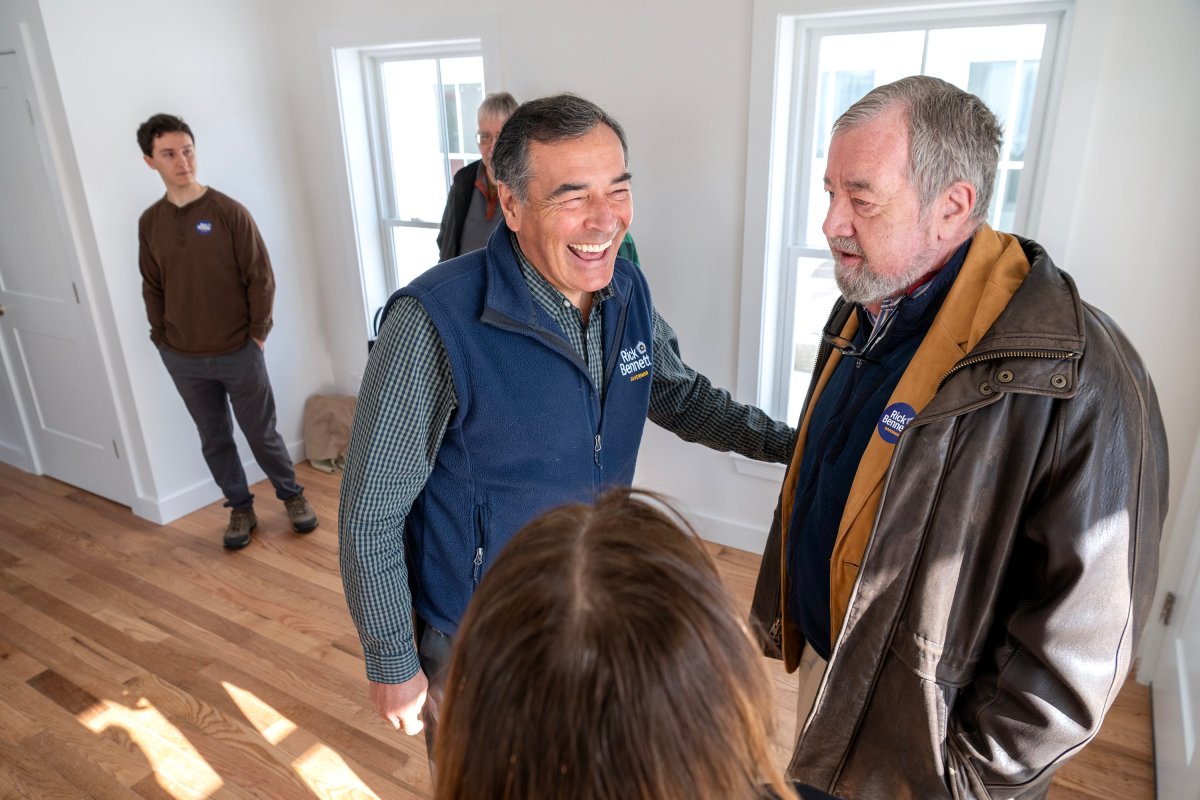
RUMFORD — On a recent spring-like morning, Rick Bennett gathered with supporters in the shiny new kitchen of the type of apartment he hopes to build more of if elected governor.
Surrounded by a small group holding up campaign signs, Bennett outlined his top ideas to address the state’s housing crisis. He offered a mix of middle-of-the-road proposals: giving homeowners state money to help with their mortgage — with the state able to recoup some of the cost as home appreciation builds — and incentivizing the construction of factory-built and modular housing.
“If we’re going to find solutions, that means some things that have become dirty words in politics: collaboration, compromise, working across the aisle,” Bennett said in an interview after the event. “People get that. So I’ve been really feeling like I’m approaching this in the right way at the right time.”
Bennett, a longtime lawmaker and businessman, is among six independents running for governor. Unlike some of his competitors who have never held elected office and are unknown to the public, he has the resume to compete with the Democratic and Republican front-runners, and he’s raised more money than some party-affiliated candidates.
Maine also has a long tradition of bucking the two-party system. About one-third of Maine voters are independents, and two of the last seven governors have been independents, including U.S. Sen. Angus King, a left-leaning legislator who served as governor twice and has been elected to the Senate three times.
But in the time of President Donald Trump, voters are more divided along partisan lines than ever. If he’s going to win, Bennett — who had been a Republican up until last year — has to hope that voters will do something they seem to do less and less frequently: listen to someone who doesn’t share their party identification.
Riley Worth, a 23-year-old University of Southern Maine student who spoke at Bennett’s event in Rumford, said he hasn’t decided whom he will vote for in the governor’s race. But as an independent, he likes the idea of an independent candidate, and thinks others will, too.
“It’d be great to have someone at the state level who’s more focused on getting the job done rather than toeing the party line,” Worth said. “There are so many great ideas Republicans have and so many great ideas Democrats have. … I like that an independent can pick and choose from each.”
WHAT KIND OF CANDIDATE IS BENNETT?
Last year, at the same moment he announced his campaign for governor, Bennett, who chaired the Maine Republican Party from 2012 to 2017, had a public breakup with the GOP.
Though he voted for President Donald Trump in 2016, he has since said he doesn’t think Trump “is the right person for the presidency.”
Bennett’s pitch to voters is that he’s a “businessperson who supports strong pro-growth economic policies.”
“I also support something which I think Mainers share, which is they don’t want politicians making decisions about the way they live and who they are,” he said.
Bennett is feeling optimistic about his chances. People have been more receptive to his candidacy as an independent than he anticipated, he said.
Maine has elected two independent governors in its 206-year history, both relatively recently. James Longley served from 1975 to 1979, choosing not to seek reelection after promising on the campaign trail to serve just one term. King, now a U.S. senator, served from 1995 to 2003. (King’s son, Angus King III, is running for governor as a Democrat.)

Before unenrolling as a Republican last year, Bennett was the only member of his party who sided with Democrats to vote against a trio of bills aimed at preventing transgender athletes from participating in girls sports. He also voted in favor of a controversial Democratic bill to limit law enforcement’s ability to work with immigration authorities.
He’s won endorsements from officials in both parties. Rep. Lydia Crafts, D-Newcastle, is among a half-dozen current and former Democratic elected officials who have endorsed Bennett.
Crafts said her support is not intended as a slight at the Democratic candidates, many of whom she says are highly qualified. But she said Bennett’s style of leadership is what Maine needs now.
“I’m impressed with his ability to put issues before the partisanship that has divided so much of our country,” she said. “I’ve heard that from my own constituents, too, that they care about being open and listening to positions that aren’t dictated by some sort of mandate by party affiliation.”
IS THE SUPPORT THERE?
Dan Shea, a professor of government at Colby College, said he doesn’t see an opening for Bennett in today’s partisan environment, where even independent voters are likely to lean more heavily toward one side or the other.
“Swing voters — truly independent voters — are a vanishing breed,” Shea said. “That makes it hard for independent candidates.”
Shea expects few Republican voters to be turned off should a “hard MAGA candidate” in the mold of Trump make the general election in the governor’s race. Bennett will need conservatives to win, and there simply aren’t enough Trump-fatigued Republicans to go around, the professor said.
Democrats, meanwhile, are likely to stand united behind whoever their nominee is, not wanting to see a repeat of 2010, when former Republican Gov. Paul LePage won with 38% of the vote, Shea said.
That race featured a strong independent candidate, Eliot Cutler, who finished second. The Democratic candidate that year, Libby Mitchell, got just 19% of the vote.
But the divided political climate could also drive voters toward someone like Bennett, who has pitched himself as a consensus-builder and who is already a well-known politician, said Jim Melcher, a professor of political science at the University of Maine at Farmington.
“I’m certainly not going to predict that he’s going to win yet,” Melcher said. “But I think there’s every reason to think that he’ll be a very strong candidate.”
Another issue that could come into play is a bill currently under consideration that would expand the use of ranked-choice voting to include the governor’s race. (Ranked-choice voting is currently only used in federal races and state-level primaries.)
Lawmakers passed the bill last year, but recalled it from the governor’s desk after learning she planned to veto it. Earlier this month, they passed a resolution asking the state’s high court to weigh in about whether the expansion would be constitutional.
Ranked-choice voting is said to benefit independents because it allows voters to cast their ballots for third-party candidates without fear that their vote will be wasted.
If the system is expanded before November, it could make a big difference for independents like Bennett.
“The pool of voters in the middle has shrunk, but that could be Bennett’s opening,” Shea said. “It would be narrow, but possible.”

We invite you to add your comments. We encourage a thoughtful exchange of ideas and information on this website. By joining the conversation, you are agreeing to our commenting policy and terms of use. More information is found on our FAQs. You can update your screen name on the member's center.
Comments are managed by our staff during regular business hours Monday through Friday as well as limited hours on Saturday and Sunday. Comments held for moderation outside of those hours may take longer to approve.
Join the Conversation
Please sign into your CentralMaine.com account to participate in conversations below. If you do not have an account, you can register or subscribe. Questions? Please see our FAQs.