
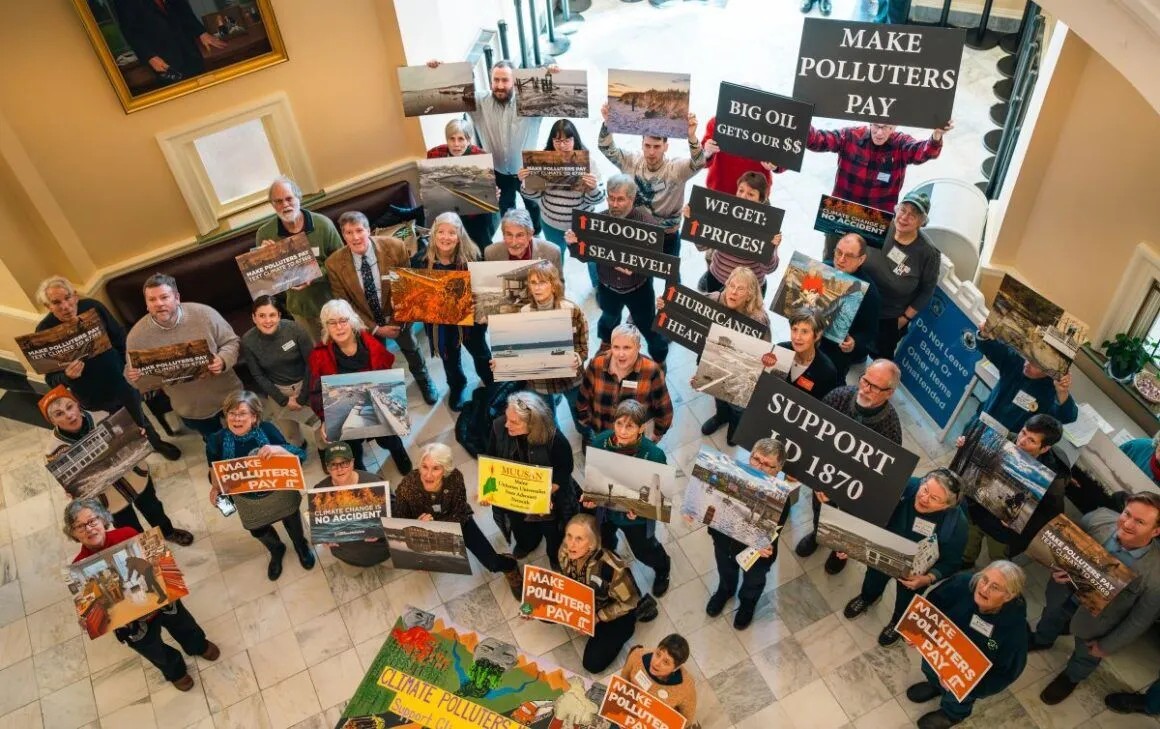
As Maine grapples with how to pay to fix roads, piers and other infrastructure damaged by severe storms that are increasing as the climate changes, lawmakers are considering a climate superfund act that would fine major fossil fuel companies for past damage.
Vermont and New York passed similar laws in 2024; Massachusetts, Connecticut and Rhode Island are each considering their own bills this year.
Maine’s climate superfund bill, L.D. 1870, which advanced out of committee last month, would impose fines on companies that contributed more than 1 billion metric tons of greenhouse gas emissions between 1995 and 2024 and put that money toward a range of climate resilience and mitigation projects across the state.
The idea is modeled after the federal Superfund program that was established in 1980 to make polluters pay to clean up toxic waste sites.
Advocates for the bill such as Jack Shapiro, climate and clean energy director at the Natural Resources Council of Maine, believe it is common sense to make fossil fuel companies pay for damages caused by their greenhouse gas emissions, from stronger storms and coastal flooding to more intense heatwaves and wildfires.
“The responsible parties contemplated by the bill in Maine and in other states are really the world’s largest polluters, and in many cases have been documented to have understood the impacts of the pollution associated with their products,” Shapiro said.
Opponents, meanwhile, have pointed to the legal challenges facing similar laws in other states.
The U.S. Chamber of Commerce and the American Petroleum Institute, which represents large fossil fuel companies, sued Vermont over its climate superfund law in December 2024. In February 2025, industry groups and a coalition of Republican-led states challenged New York’s law.
The suits, which are still playing out in the courts, argue that the laws are unconstitutional in part because federal law, not state law, governs greenhouse gas emissions. The states, in response, have argued they are not attempting to regulate the burning of fossil fuels but are instead evaluating costs caused by past emissions and then planning to use one-time fines to finance climate adaptation projects.
Last April, President Donald Trump signed an executive order that described Vermont and New York’s climate superfund laws as “state overreach” and “extortion.” The federal government then brought a series of lawsuits against New York and Vermont as well as Michigan and Hawaii in an attempt to block them from seeking damages from fossil fuel companies. Those cases are currently pending.
Sean Mahoney, the Conservation Law Foundation’s vice president for Maine, said the question at the heart of the issue is: “Do the states have the authority to seek redress from these companies for the harms associated with the products that they sold, knowing that there would be adverse consequences?”
Opponents argue that the legislation will punish companies by fining them retroactively for lawful activities, in this case the burning of fossil fuels. Whether these fines are legal is up to the courts.
While the lawsuits play out, Vermont is working to begin implementing its law. The first step is to determine what greenhouse gases emitted between 1995 and 2024 cost the state of Vermont in terms of climate-related damages, like repairing infrastructure, and adaptation investments, like climate resilience projects, said Ben Walsh, the climate and energy program director at Vermont Public Interest Research Group, who worked to pass the climate superfund act. That work involves using attribution modeling established by researchers at Dartmouth and elsewhere.
Maine’s proposed legislation would follow a similar model. After using an attribution framework like Vermont’s to quantify the cost of emissions to the state and identify companies from the world’s largest fossil fuel emitters who have certain business ties to Maine, the state would fine each company proportionately based on their emissions during the 1995-2024 period.
“ExxonMobil has gas stations in Maine. They should be accountable for the emissions that they have created,” Shapiro said. “Other ones like Saudi Aramco, the Saudi state oil company, may not have ever done business in Maine, and so they may not be accountable to us here in the state through a state policy.”
This story was originally published by The Maine Monitor, a nonprofit and nonpartisan news organization. To get regular coverage from The Monitor, sign up for a free Monitor newsletter here.
We invite you to add your comments. We encourage a thoughtful exchange of ideas and information on this website. By joining the conversation, you are agreeing to our commenting policy and terms of use. More information is found on our FAQs. You can update your screen name on the member's center.
Comments are managed by our staff during regular business hours Monday through Friday as well as limited hours on Saturday and Sunday. Comments held for moderation outside of those hours may take longer to approve.
Join the Conversation
Please sign into your CentralMaine.com account to participate in conversations below. If you do not have an account, you can register or subscribe. Questions? Please see our FAQs.