

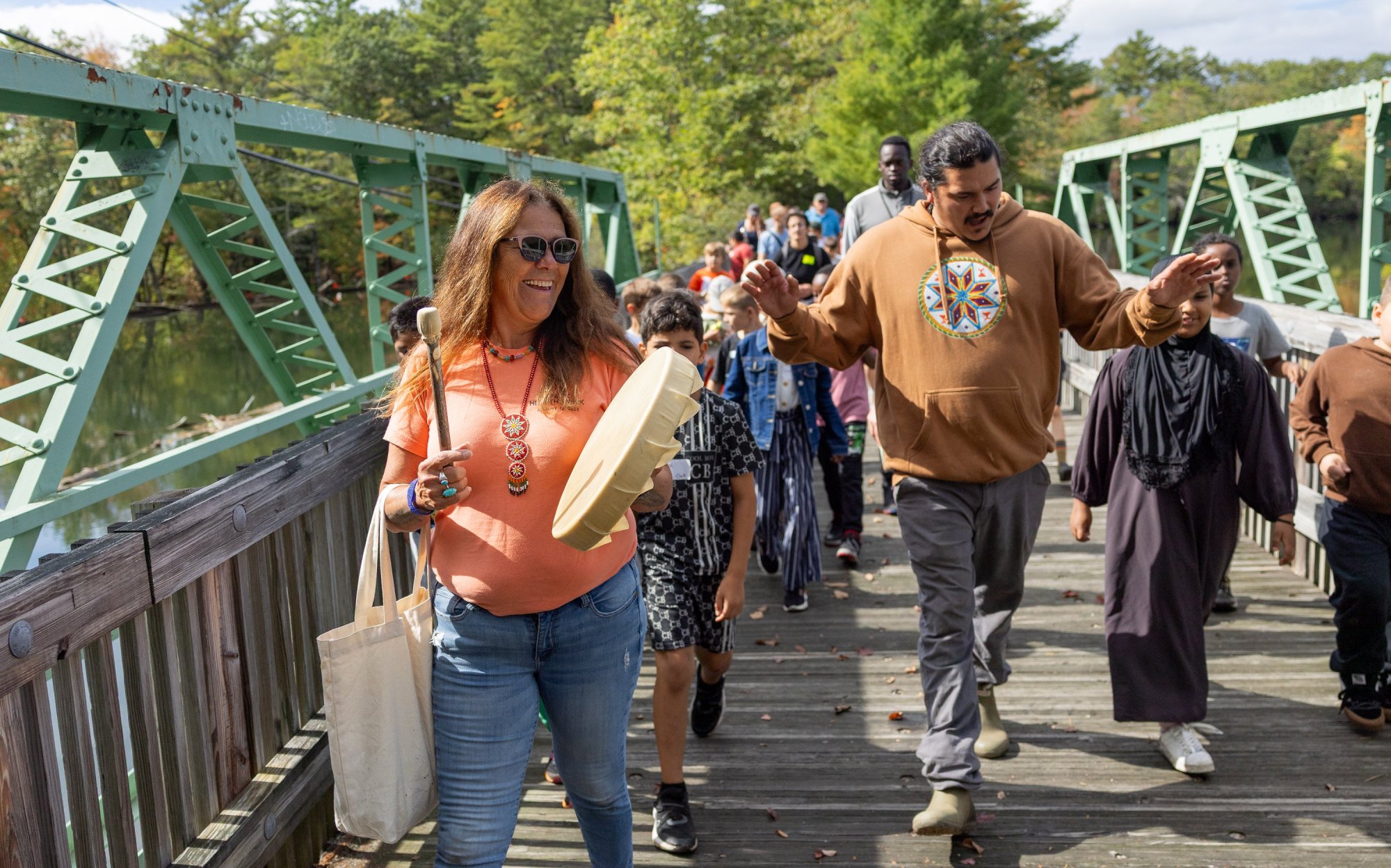
WINDHAM — In plain terms, Harley Bassett explained to a group of Portland third graders how the Presumpscot River flowing before them provided for his people. The tribe reciprocated by caring for its waters.
It was shoulder season, not quite summer, not quite autumn. Only the precocious leaves had begun their colorful turn.
“Can anyone tell me the name of the river behind me?” Bassett asked.
“Umm, Passamaquoddy River?” one student guessed.
“It is a Passamaquoddy river, but it is not named The Passamaquoddy River,” Bassett said.
It was a fair guess. Bassett had already explained that he is a member of the Passamaquoddy Tribe, one of four Wabanaki Nations in Maine. His station on that September field trip was a part of the students’ Wabanaki studies unit.
Nearly 25 years have passed since Maine lawmakers decided students should learn about Wabanaki history, culture and contemporary life. Still, not all children in Maine receive that comprehensive education.

A 2022 report that examined 10 school districts — the five largest in the state and the five closest to reservations — found most were struggling to implement the law with little support from the state.
Over the last several months, the Portland Press Herald/Maine Sunday Telegram requested teaching materials from those 10 districts, attended teacher training on Wabanaki studies, observed a field trip and spoke with various subject matter experts in order to gauge the state’s progress.
A few districts — including Portland Public Schools, Bangor School Department and Oxford Hills School District — boast robust curricula that integrate Wabanaki studies into a variety of subjects. Others are still struggling.
Now, lawmakers are considering whether to provide long-term funding for a statewide Wabanaki studies specialist — something advocates say should have been done years ago.
‘ON OUR OWN’
In the decades since the Wabanaki studies bill passed, educators across Maine’s 558 schools have felt disconnected to the law, it seems. Even when teachers are aware of it, they face its mandate empty handed.
In a room full of teachers last October, everyone nodded when Heather O’Leary, a social studies teacher at Telstar Middle School in Bethel asked, “Why wasn’t I taught? Why didn’t I hear about this?”
Instruction on the subject is supposed to align with the state’s learning results and graduation requirements. But while the mandate is more prescriptive than in other subjects, the state stops far short of telling educators exactly what to teach, much less how to do it.
The state also has no specific mechanisms for assessment or enforcement.
The result? A disparate patchwork of compliance reliant on the good faith of educators.
“It needs to be transmitted through administration that it’s a priority,” said Melissa Prescott, an art teacher at Telstar.
Prescott was among those who independently chose to attend a professional development training on Wabanaki studies led by Brianne Lolar and her daughter, Kaya Lolar, who are both Penobscot, at the Topsham Public Library in October.
“One of the biggest barriers for me … is being afraid to screw it up, and as a white person, misinterpreting (or) misrepresenting,” said Joanna Payne, a humanities teacher at Cape Elizabeth Middle School.
To address that, teachers say they need resources — teaching materials, time to learn and plan, and funding.

Administrators by and large are making good faith efforts to implement the law, public records obtained by the Press Herald show, but are often hindered by a lack of funding and support.
In Sunrise County School District, which operates schools near the Passamaquoddy Reservation at Sipayik, principals turned over an assemblage of lesson plan summaries from individual teachers, links to resources and references to past and future events in response to the Press Herald’s request for materials. The documents show an earnest but incomplete effort to comply with the law.
“The state passes the law and they tell us, ‘OK, yep, here’s the new law. Have fun,'” said MaryEllen Day, the district’s superintendent. “The state didn’t give us any money to do this. We are simply trying to do this on our own.”
Portland schools, which have integrated field trips such as the river outing in September into the curriculum over the last four years, are largely recognized as Wabanaki studies leaders in the state.
WHAT’S WORKING
Brianne and Kaya Lolar are considered somewhat of a dynamic duo in the Wabanaki Studies world.
Brianne Lolar, who spent over a decade in Old Town classrooms, was brought on almost four years ago by the Department of Education as its first Wabanaki studies specialist. She works on both the back end, coalescing the knowledge of Wabanaki elders and community members into teachable content, and the front end, leading workshops and empowering administrators and teachers.
She has also developed a series of Wabanaki studies learning modules for the Maine Online Open-Source Education platform. Many school districts now rely on those online modules, records indicate.
“I am doing all the things,” Brianne Lolar said with a grin, “and I have a hard time saying no.”
Kaya Lolar, 23, is the director of policy and Wabanaki studies at the Maine Environmental Education Association, a nonprofit dedicated to growing environmental awareness and education. There’s a hunger, she said, among school districts for what the Lolars have to offer.
All teachers in the Oxford Hills School District, for example, are taking the Wabanaki essentials micro-course offered through the association, and Brianne Lolar will follow up with an in-person professional development day. The district has already managed to work lessons on Wabanaki culture, status and history into course materials across grade levels.
But that’s one district among several hundred.
“Our one Wabanaki studies specialist can’t be everywhere at once,” Kaya Lolar said.
FUNDING FOR THE FUTURE
Sage Phillips, 25, remembers students pointing to a mural of two stereotyped Indians on the wall of Old Town High School — which formally changed its mascot to the Coyotes in 2005 — and saying to her, “Well, you don’t look like that, so are you Penobscot?”
There was a lack of understanding among students at her school, which is less than a mile from the Penobscot reservation on Indian Island, that she said might have been ameliorated by a robust Wabanaki studies curriculum.
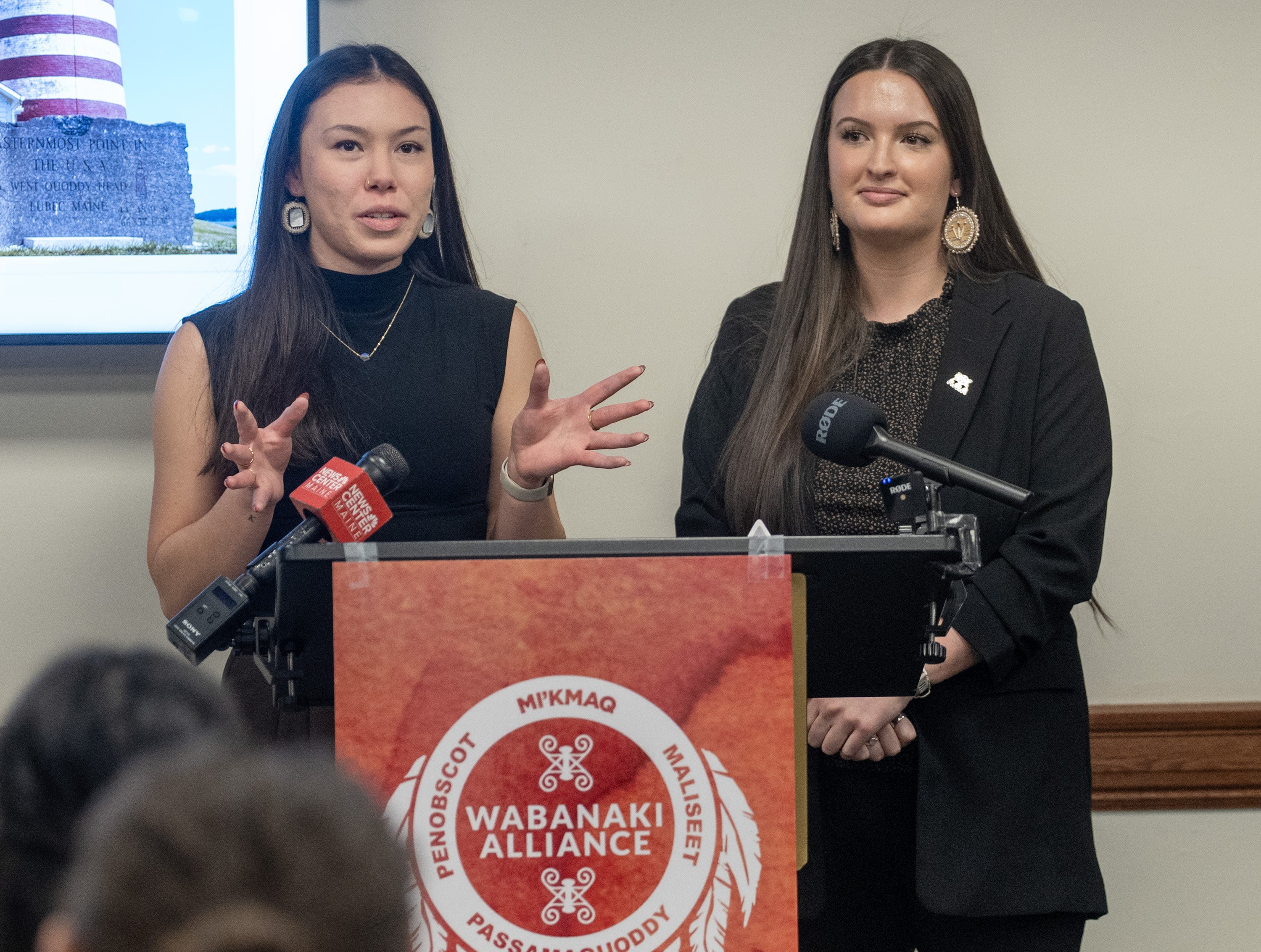
Phillips is the newly appointed communications and community engagement coordinator for the Wabanaki Alliance, and with Kaya Lolar leads a coalition of young people called the Wabanaki Policy Youth Initiative.
Phillips and the younger Lolar are now the third generation of Penobscot women pushing to ensure Maine students learn about the region’s Indigenous tribes.
For them, incorporating content about the Wabanaki Nations into students’ learning about Maine is critical to fighting prejudice and advancing equity. It also combats the false yet pervasive narrative that Native people existed only in the past.
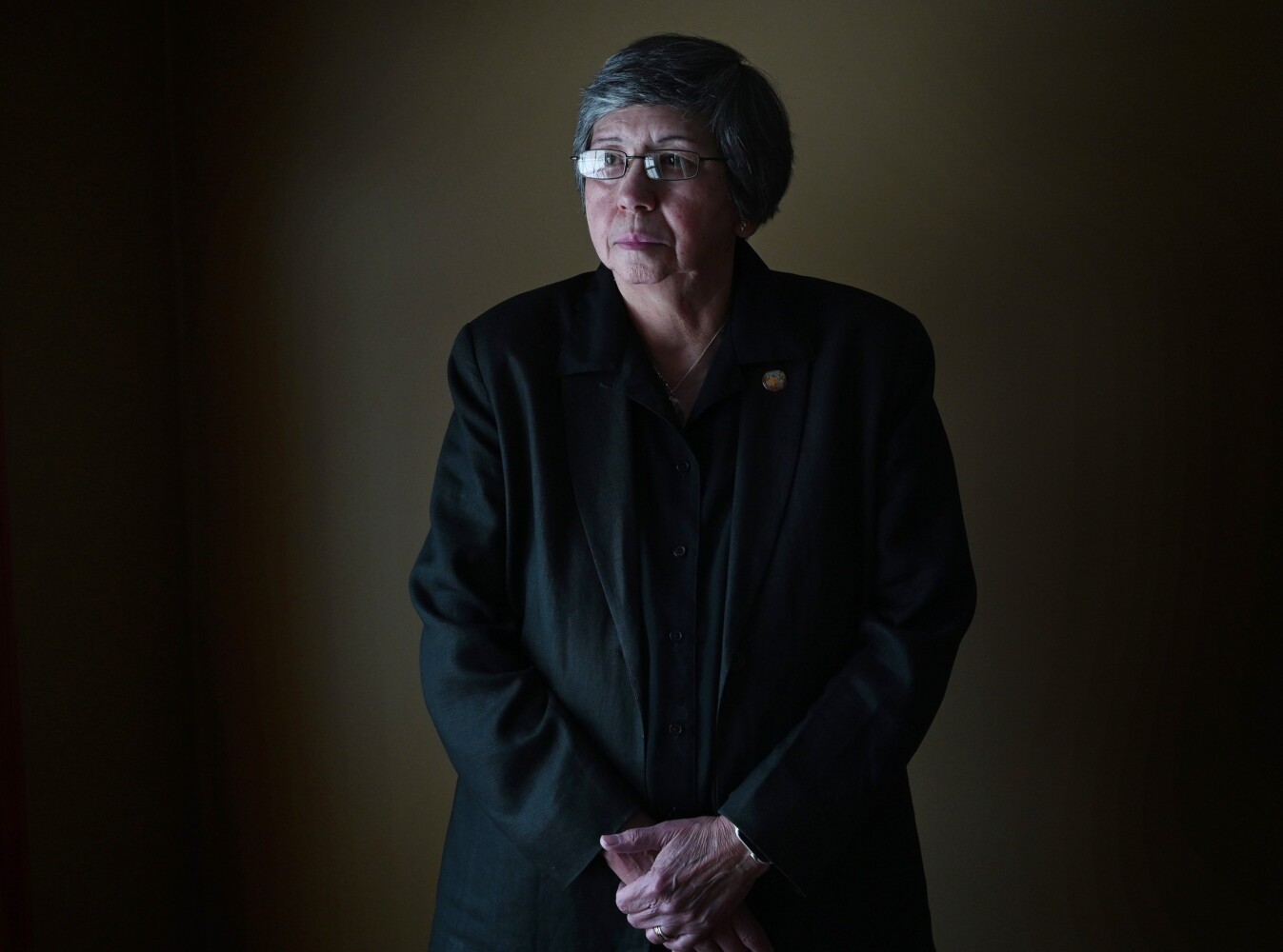
Donna Loring, a Penobscot elder, was her tribe’s non-voting representative in the Legislature in 2001 when she pushed the bill mandating Wabanaki studies through to the desk of then-Gov. Angus King.
It was a heavy lift.
“I feel like I’m swimming against the current, but then again, I’ve been swimming against the current all my life,” she wrote in her journal, which was later published, on the morning of the bill’s first work session on Feb. 21, 2001.
The bill’s passage positioned Maine as a leader nationally. Today? Experts say the state has slipped on the charts.
“We are absolutely behind,” Brianne Lolar said.
She regularly meets with her counterparts in other states including Hawaii, New York and Washington, all of which have more than seven people doing the job Lolar does alone.
The Legislature is considering a bill held over from last session that would make Lolar’s position in the Department of Education permanent.
A spokesman for Gov. Janet Mills confirmed that the supplemental budget request released this month included that funding, giving the bill a good shot at being approved.
Loring, now 77, has waited nearly a third of her life to see the effects of the Wabanaki studies law take shape and doesn’t mince her words.
“It’s time to fund that damn bill,” she said.
Reuben M. Schafir is a Report for America corps member who writes about Indigenous communities for the Portland Press Herald.

We invite you to add your comments. We encourage a thoughtful exchange of ideas and information on this website. By joining the conversation, you are agreeing to our commenting policy and terms of use. More information is found on our FAQs. You can update your screen name on the member's center.
Comments are managed by our staff during regular business hours Monday through Friday as well as limited hours on Saturday and Sunday. Comments held for moderation outside of those hours may take longer to approve.
Join the Conversation
Please sign into your CentralMaine.com account to participate in conversations below. If you do not have an account, you can register or subscribe. Questions? Please see our FAQs.