

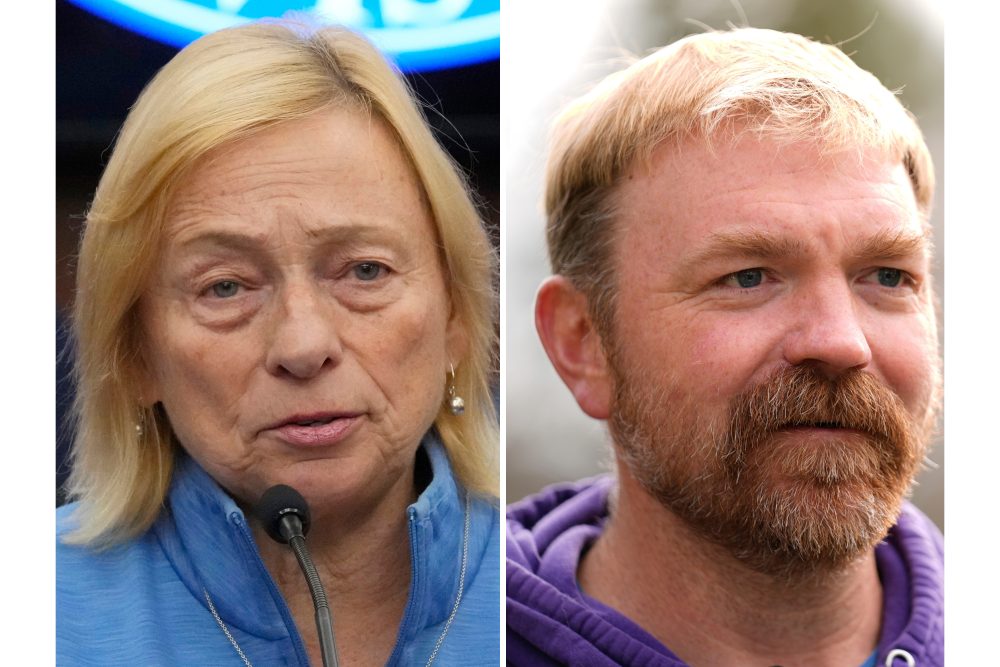
A new independent poll shows political newcomer Graham Platner holding a commanding — and growing — lead in Maine’s Democratic primary for U.S. Senate.
A University of New Hampshire poll released Tuesday found that Platner has a 38-point lead over two-term Gov. Janet Mills.
The poll also showed Democrat Nirav Shah, the former director of the Maine Center for Disease Control and Prevention, and Republican Bobby Charles, a former U.S. assistant secretary of state, leading their respective primaries for governor.
And it found a tight race in the 2nd Congressional District. That seat is held by Democratic Rep. Jared Golden, who is not seeking reelection.
Sixty-four percent of those surveyed about the Senate primary supported Platner, the 41-year-old oyster farmer from Sullivan. That’s an increase of 6 percentage points since UNH’s last survey in October. Mills, 78, has 26% support, an increase of 2 percentage points, surveyors found.
The UNH survey also showed Platner with a double-digit lead over incumbent Republican Sen. Susan Collins in a hypothetical general election matchup. Platner leads Collins 49% to 38%, driven by larger support among independents, the poll found. Mills held a slight lead over Collins, 41% to 40%.
The poll of the Democratic Senate primary included responses from 462 likely primary voters gathered from Feb. 12-16, and had a margin of error of 4.6%.
In addition to the relatively small sample size, the poll heavily sampled younger voters even though Maine is one of the oldest states in the nation. About 29% of those surveyed were aged 18-34, while about 27% were 65 or older. And about a fifth of those surveyed were self-identified socialists.
The Mills campaign projected confidence in a written statement Tuesday.
“Janet Mills is the only Democrat in this race who has actually won statewide, not once but twice, and by increasing margins,” campaign spokesperson Tommy Garcia said. “Janet Mills is going to fight for every vote, and she’s going to win both the primary and the general.”
Platner’s campaign said the polling shows the strength of the movement the candidate is building.
“Mainers want change,” campaign manager Ben Chin said in a written statement. “This poll shows not only that Graham is positioned to win the primary, but also is the strongest candidate in a head-to-head (race) against Senator Collins.”
Maine’s U.S. Senate race is expected to be one of the most closely watched in the country.
Democrats are bullish on unseating Collins, the only New England Republican in Congress, and the only incumbent Republican running in a state won by Democrats in the 2024 presidential election.
For all the attention focused on the race, which includes a competitive primary that in many ways encapsulates the Democratic Party’s broader soul-searching, there has been scant independent polling.
UNH has conducted two polls, each showing Platner with large leads. Similar surveys by Platner’s campaign, progressive allies and a national Republican pollster have shown the newcomer with leads ranging from 15 to 34 percentage points.
But UNH whiffed on its late October survey about two referendum questions on the state ballot. It showed 49% opposed a citizens initiative to adopt a strict voter ID requirement and 38% supported a red flag law.
After the votes were counted, more than 64% of voters opposed voter ID requirements and nearly 63% supported the red flag law.
A Pan Atlantic Research poll in late November showed Mills with a 10-point lead, while a Maine People’s Resource Center Poll showed a close race, with Platner up 2 percentage points over Mills.
GOVERNOR
The poll shows Charles with a sizable lead in the Republican primary for governor, with nearly a third of respondents still undecided.
Charles was the first choice of 28% of respondents, followed by former Maine Senate majority leader Garrett Mason (12%); real estate professional David Jones (7%); fitness executive Ben Midgley (6%); health care executive Jonathan Bush (5%); retail professional Robert Wessels (4%) and state Sen. James Libby (2%). David Foster and Owen McCarthy came in at 1%.
Thirty-one percent of likely Republican voters were still undecided.
On the other side, the poll found Shah leading in the Democratic primary with 25%, followed by Secretary of State Shenna Bellows (19%), former Senate President Tory Jackson (16%), former Mills administration official Hannah Pingree (10%) and renewable energy executive Angus King, III (5%).
Twenty-three percent of respondents were undecided.
CONGRESSIONAL DISTRICT 2
The survey showed a close race in the 2nd Congressional District, with Republican Paul LePage, a former two-term governor endorsed by President Donald Trump, in a virtual dead heat with each of the three leading Democrats.
UNH didn’t ask probable Democratic primary voters which candidate they preferred. Instead, it polled how the three top Democrats would fare in a general election against LePage.
LePage held a slight lead over both state Sen. Joe Baldacci, D-Bangor — 48% to 47% — and State Auditor Matthew Dunlap of Old Town — 47% to 46%.
LePage held a 4 percentage point lead, 48% to 44%, over Jordan Wood, who had been running for U.S. Senate before seeking the CD2 seat.

We invite you to add your comments. We encourage a thoughtful exchange of ideas and information on this website. By joining the conversation, you are agreeing to our commenting policy and terms of use. More information is found on our FAQs. You can update your screen name on the member's center.
Comments are managed by our staff during regular business hours Monday through Friday as well as limited hours on Saturday and Sunday. Comments held for moderation outside of those hours may take longer to approve.
Join the Conversation
Please sign into your CentralMaine.com account to participate in conversations below. If you do not have an account, you can register or subscribe. Questions? Please see our FAQs.