

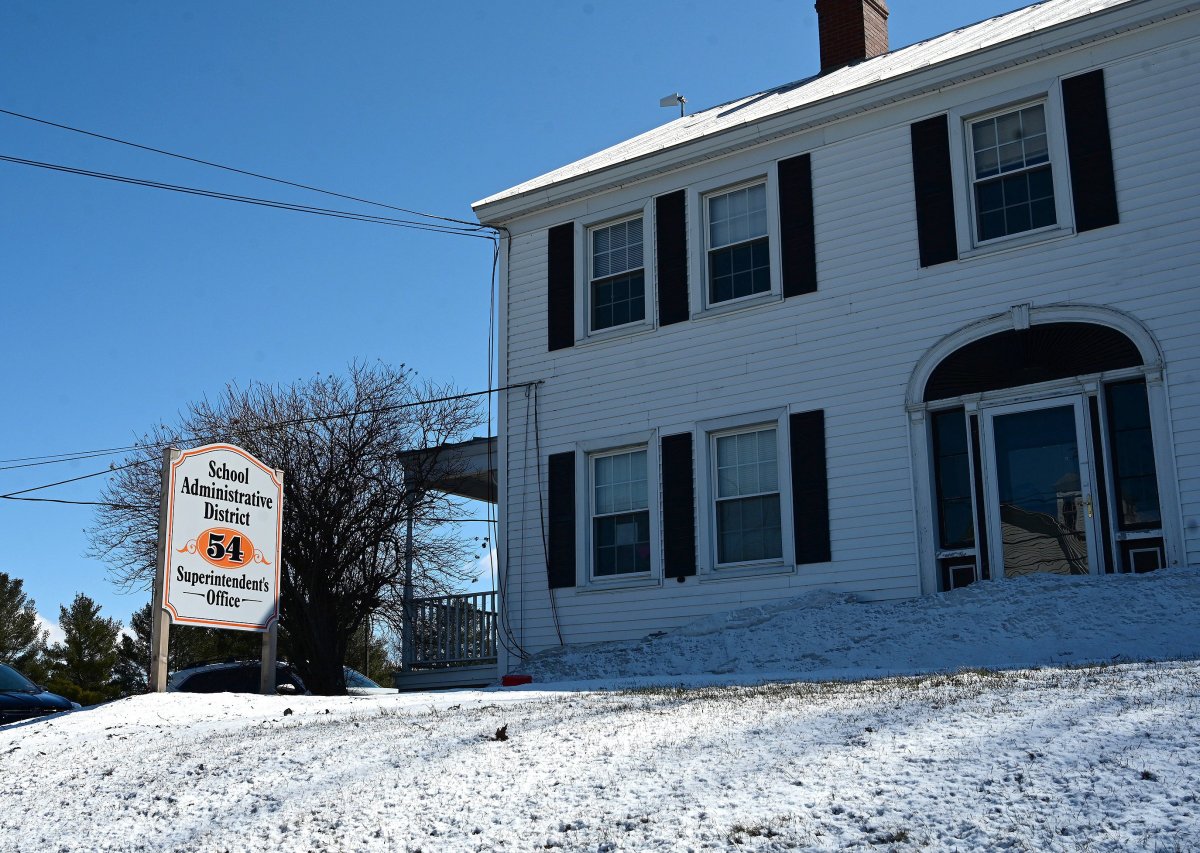
Smithfield voters will not decide whether the town should withdraw from the Skowhegan-area Maine School Administrative District 54, after a petition that circulated in recent months was withdrawn.
It’s unclear why the proposal, which would have resulted in the question being posed to Smithfield voters in March, was withdrawn.
But the decision came after MSAD 54 Superintendent of Schools Jonathan Moody called out inaccurate information town officials had circulated. Moody shared figures showing that switching to another area school district would have resulted in a bigger hit to Smithfield property taxpayers.
The petition, submitted to the town Jan. 7 with 62 verified and valid signatures, requested the Board of Selectmen to initiate the process to withdraw from MSAD 54. State law outlines a 22-step process for municipalities to withdraw from school districts. A petition signed by at least 10% of the voters in the municipality who voted in the last gubernatorial election is the first step.
First Selectman Rebecca Bright requested the petition papers, Town Clerk Meredyth Tuttle said. In an email, Bright confirmed the petition was withdrawn Feb. 18.
Bright otherwise declined to answer questions. Second Selectman Danielle Keay did not return a phone call. Third Selectman Justin Furbush declined to answer any questions and abruptly hung up the phone.
A brief document posted on the town’s website pitched withdrawing from MSAD 54 as a cost-saving measure for property taxpayers, who have taken a disproportionate hit in recent school budgets due to increases in the town’s state valuation.
“Smithfield pays more than double per student compared to the lowest-contributing town” in the district, the document said of the petition’s main reason.
The document suggested possibly switching to Oakland-based Regional School Unit 18. The nearby towns in that district also have a significant amount of waterfront property, which has been a key driver in the increase in Smithfield’s state valuation in recent years. It also suggested that RSU 18’s locally funded portion of its budget was lower than MSAD 54.
MSAD 54 Facts About Smithfield Withdrawal by Maine Trust For Local News
Moody, in materials given to the Smithfield Board of Selectmen and families, highlighted what he saw as several inaccurate statements in the Smithfield document. School administrators felt compelled to share accurate information after concerned parents contacted the district, Moody wrote.
Among the issues in Smithfield’s materials, he noted the total local funds in RSU 18’s budget were nearly triple that of MSAD 54.
Moody also wrote that, despite suggestions from some people, Smithfield did not need to execute the petition to begin exploring withdrawal, and the district administration would have helped provide financial figures upon request.
And, according to an independent study conducted by the district’s lawyers at Drummond Woodsum, a switch to RSU 18 in the current fiscal year would have resulted in a significant increase for Smithfield taxpayers.
A state-determined portion within Smithfield’s locally funded allocation would have stayed the same in any district at $1.08 million. The other portion of Smithfield’s allocation, referred to as “additional local funds,” would have increased from $265,000 to $420,000, the law firm found.
Dan Frey, one of Smithfield’s two representatives on the 23-member MSAD 54 board of directors, said he was not involved in the recent petition effort but understood both sides of the issue.
“I think, ultimately, everything stemmed from people wanting to see if there was a possibility out there and what it would look like,” Frey said Tuesday.
The problem for Smithfield that seems to have sparked the petition effort ultimately comes down to the role of state property valuation in the district’s budget formula.
Like most districts in Maine, the six MSAD 54 towns — Canaan, Cornville, Mercer, Norridgewock, Skowhegan and Smithfield — divide up their responsibilities for the locally funded portion of the school budget based on their respective share of their valuation compared to the total state valuation for the six towns. The locally funded portion of the school budget in the current fiscal year totals approximately $16.48 million out of an overall budget of $51.44 million.
In the last seven years, MSAD 54 has averaged a modest increase of about 2.17% to the portion property taxpayers fund, according to calculations from Moody, the superintendent.
In the current year’s budget, a 2.35% overall increase to the amount funded by local taxation was not distributed evenly. Canaan, Mercer and Norridgewock saw increases to their allocations of about 5%. The share for Skowhegan, by far the district’s largest town by both student count and property valuation, went up less than 1%; Cornville’s went up 1.62%.
Smithfield’s portion, meanwhile, went up 7.44%.
A similar story played out in the prior year’s budget, with Smithfield being hit with nearly a 10% increase to its locally funded share, while Skowhegan only experienced an increase of 2.69%.
The driving force is the change in state valuation: Between fiscal years 2025 and 2026, for example, the six towns’ valuations overall went up about 10%, while Smithfield’s increase far outpaced the other five at 15%.
Smithfield is not alone in considering withdrawing from a district as a solution to this problem. In Embden, which like Smithfield has a significant amount of high-valued waterfront property but sends relatively few students to public schools, voters last year rejected a proposal to explore withdrawing from Regional School Unit 74.
Voters in all six MSAD 54 towns will be asked this June to consider changing the formula to factor in student count from each town, in an effort to level the budget impacts on property taxes across the towns.
The proposal, developed through a committee process outlined in state law, would phase in student count as a factor in the locally contributed portion of the district budget. If approved, the first two years would change cost sharing among the towns to 90% valuation and 10% student count, with the split going to 80-20 in the third and following years.
Within the current budget, as an example, the change would result in decreases for some towns and increases for others. Smithfield’s “additional local funds” would drop about $21,000 in the 80-20 formula, budget figures show.

We invite you to add your comments. We encourage a thoughtful exchange of ideas and information on this website. By joining the conversation, you are agreeing to our commenting policy and terms of use. More information is found on our FAQs. You can update your screen name on the member's center.
Comments are managed by our staff during regular business hours Monday through Friday as well as limited hours on Saturday and Sunday. Comments held for moderation outside of those hours may take longer to approve.
Join the Conversation
Please sign into your CentralMaine.com account to participate in conversations below. If you do not have an account, you can register or subscribe. Questions? Please see our FAQs.