

Spring may be around the corner, but in the meantime, we could still use more light, color and joy to get us through winter’s frigid home stretch. Two shows provide those things in varying degrees. One also represents a kind of homecoming, while the other explores home in the context of the memories we associate with it.
LIGHT SHOW
“Drawn in Light: Charlie Hewitt” at Lewiston’s Maine Mill museum (through May) delivers on all three winter balms. Everybody needs this exhibition. It is eminently accessible to people of all ages, and it’s filled with humor, fun and — above all — light. Hewitt is a Lewiston native son, arguably best known in Maine for his “Hopeful” marquee signs, which grace buildings not only in many of our own state’s cities, but locations in many states up and down the Eastern Seaboard.
It’s not truly accurate to call this show a homecoming because Hewitt has, in effect, been coming home for years, both physically and psychically. A large “Hopeful” sign hangs on one of the city’s many mills. On the site where he grew up (now a parking lot) stands a light sculpture he made of a rose to honor, he has said, “all the French beauties who were in my life as a child” (his mother’s family was French Canadian, hence the phrase “Beauté Française” that graces it). And due to his and local architect Tom Platz’s efforts, the town also now boasts the largest statue — 10 feet tall — of Muhammad Ali. It commemorates a 1965 rematch with Sonny Liston that took place here.

As you’ve probably gathered, Hewitt is a versatile artist who oscillates among printmaking, drawing, painting, sculpture and light art. He also ricochets between high and low art with a refreshing insouciance. Having been a figure in the New York City art scene for decades starting in the 1960s until his move back to Maine shortly after the 9/11 attacks, he’s seen it all and, at almost 80, is determined to do what he wants, no matter what the highfalutin art cognoscenti might think.
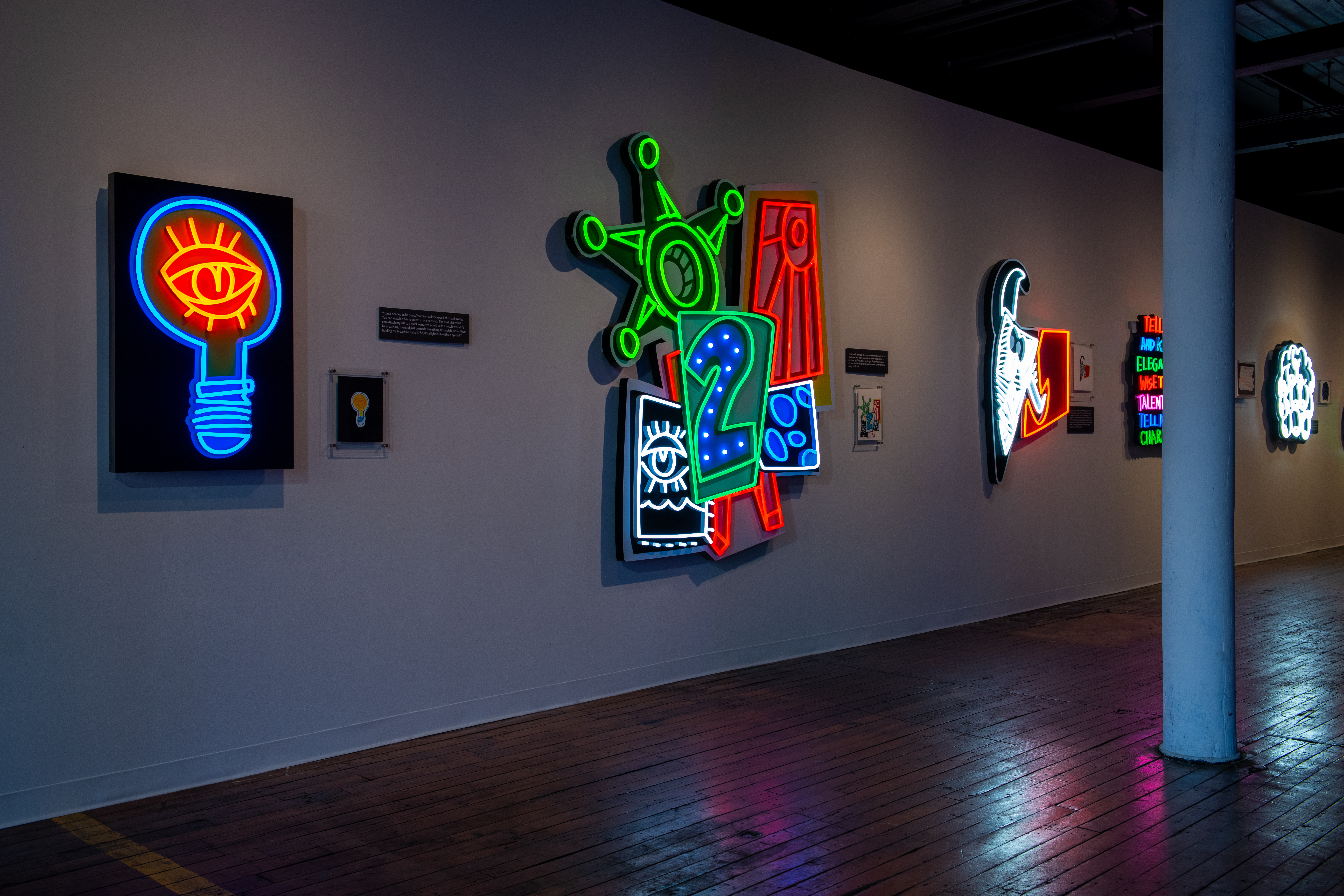
To wit: This exhibition presents Hewitt’s colorful Sharpie doodles translated into wall-hung light sculptures. Merriam-Webster defines “doodle” as “an aimless or casual scribble, design, or sketch.” By its very nature, then, this is not so-called “high” art. It’s blissfully free of abstract theories and heady conceptual gravitas. Yet the work here gives physical and visual form to a continual, relentless activity—doodling—that expresses Hewitt’s nonstop impulse of creative restlessness. This exhibition makes clear that he is helpless to curb it.
Each sculpture hangs adjacent to the sketch that inspired it. Especially engaging are the wall labels, which are in Hewitt’s own words. One typical label, this one accompanying an image of a horned animal skull, reads: “The skull is a play on a Picasso kind of imagery, but not in an important way, you know? I’m not trying to discover how he made it. I just stole that kind of triangular image, and I thought it was cool. And then I put the red next to it because I’m an artist and because it had to be balanced out. So this is me calming me, keeping me fresh, keeping me young, keeping me, me. So I’m poking my own self first. If I’m poking the establishment with it, I love that.”
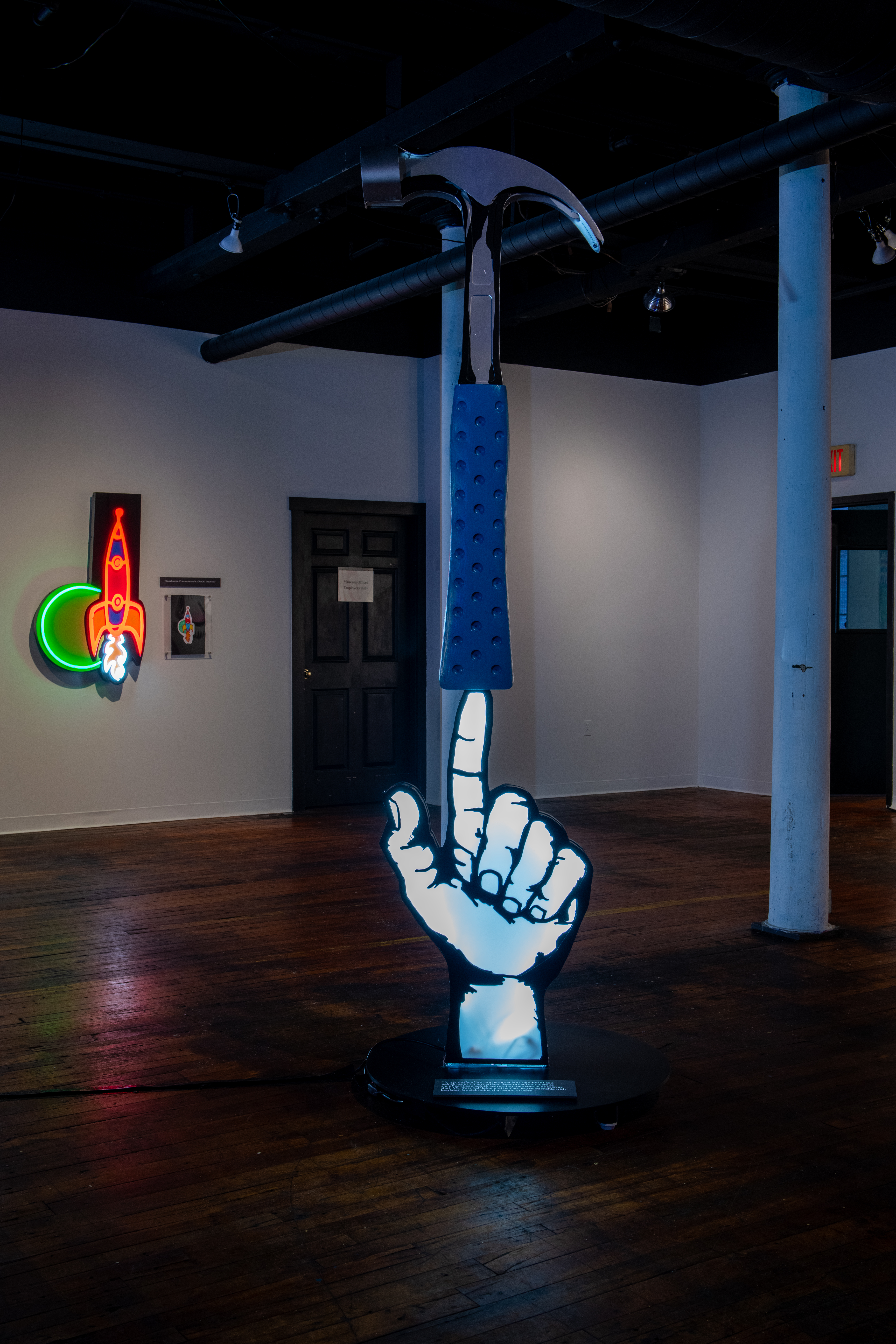
Simple, sans pretension, mischievous, self-deprecating and fun. How can anyone not like — nay, admire — those qualities, even when you mightn’t be enamored of the image itself? Other pieces contain poignant messages embedded within odd or comical circumstances. A light work of a utilitarian safety pin arose from a visit to Italy during which Hewitt ripped his pants and, finding it impossible to communicate with language, drew a safety pin for the woman in the laundry room of his hotel, who then found him what he needed. Drawing here becomes another vehicle through which humans communicate, suggesting the many ways we can connect with each beyond the verbal. But it’s coupled with a humorous situation.
A car spewing red flames recalls a visit to the Berlin Wall the night before it was demolished. On a late-night stroll, Hewitt observed a tiny little car that pulled up to the wall and trained its lights on this symbolic boundary between ideologies. Then “four of the oldest people I’ve ever seen in my life” emerged and fiercely attacked the wall with hammers. “I put the fire because it’s a dangerous time. I didn’t now at the time if we were going to annihilate each other at any moment over it.” Here we experience joy and pathos side by side and, again, an incongruously eccentric encounter with the memorialization of a momentous historical event rippling with deeper meaning.
Another stroke of brilliance here: a series of framed desk calendars along the window wall of the gallery. The reason it is wonderful is that these comprise evidence of how constant and pervasive Hewitt’s doodling is. We see some of the images we find on the walls and understand their genesis. And we also discover many others that Hewitt has transformed into digital art. One of those digital art pieces also hangs in the gallery, thus further solidifying for us Hewitt’s facility with multiple media.
The show synopsis puts it best: “There’s nothing to decode here. The image is the message.” The exhibition will be up until the museum relocates to the new building being constructed a few blocks away in May (where Hewitt, will, of course, have an enormous light sculpture displayed in the entry).
HOME SWEET HOME
“Nick Benfey: Neighborhood” at Moss Galleries in Falmouth (through April 11) is this young painter’s second show with the gallery. His first was a hallucinatory tour de force of memory paintings.
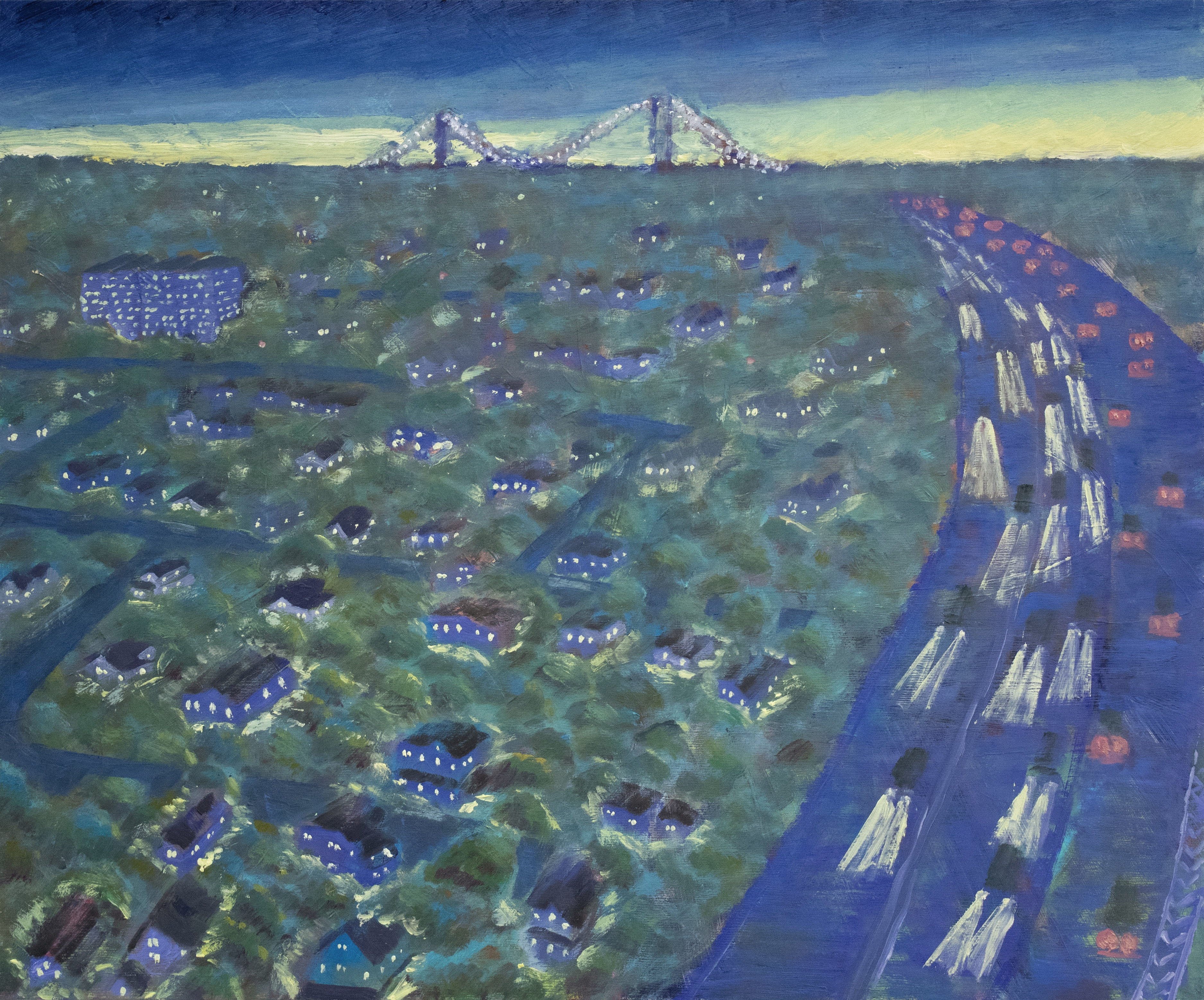
In my review of that show, I quoted the philosopher Gaston Bachelard’s book The Poetics of Space to describe something essential about the felt sense of memory in his paintings. It is worth citing again, since many of Benfey’s concerns then persist in his new work, and some feel like literal embodiments of this passage: “We comfort ourselves by reliving memories of protection. Something closed must retain our memories, while leaving them their original value as images. Memories of the outside world will never have the same tonality as those of home and, by recalling these memories, we add to our store of dreams.”
Benfey, in his own artist statement for this show, relates his childhood experience of walking home and standing outside observing his family inside. “I’d stand there in the dirt next to the garage for a while, looking at the orange windows, breathing and not talking, a feeling of peace overtaking me…Eventually I’d go inside and things would resume, the feeling wouldn’t last, I’d have to talk, I’d feel insecure and embarrassed again.”
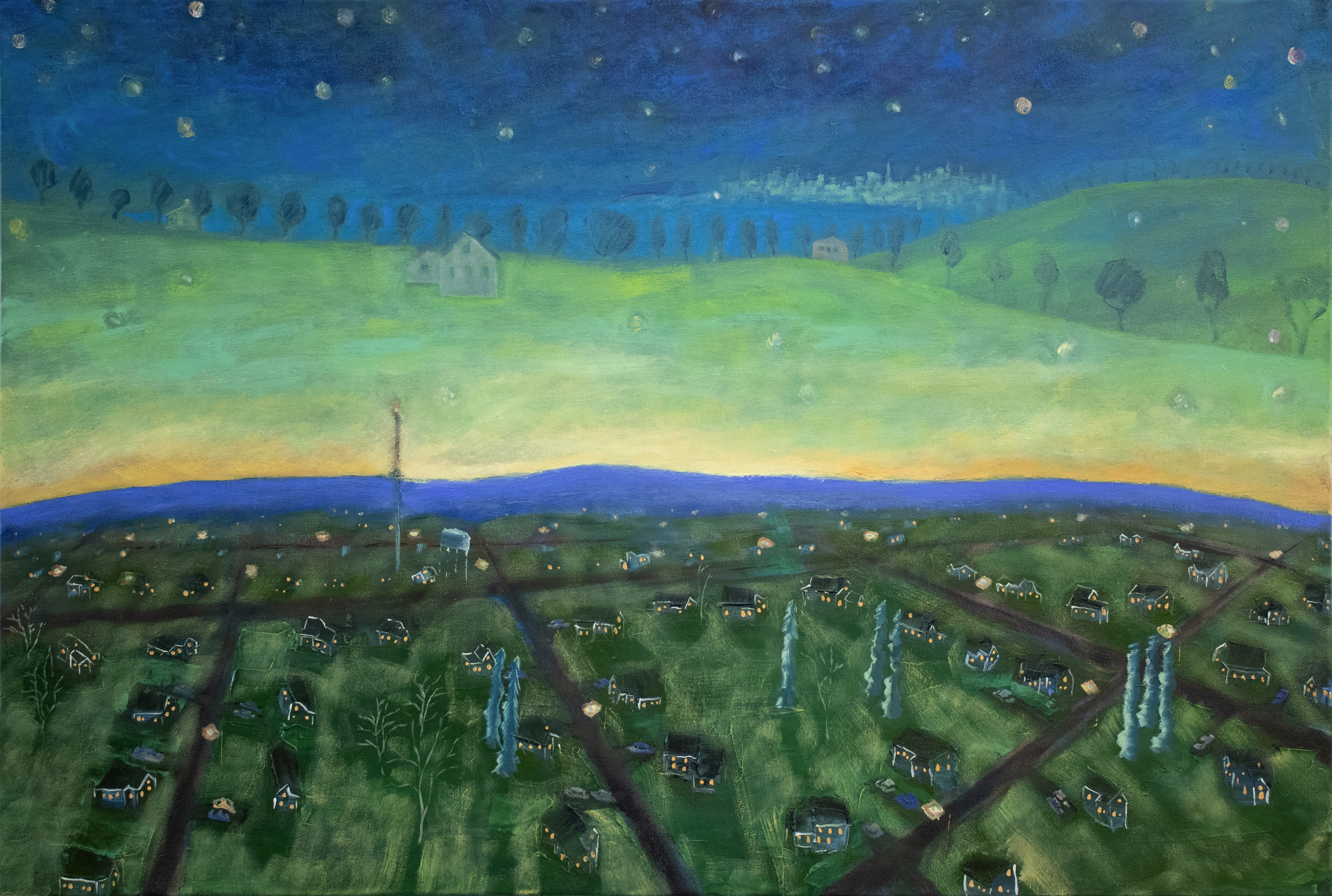
This voyeuristic perspective pervades the work in the exhibition. We see everything from the exterior but never any people, their presence only intimated by the lambent light emanating from windows. This is Benfey’s comfort zone, the vantage point from which his fondest memories take form in their purest state, before he must interact with the world and corrupt them. Many of our memories, in fact, require this sort of insularity. In the solitariness of our personal experience, they are devoid of others’ interpretation and intrusion. Unadulterated memories are necessarily experienced alone.
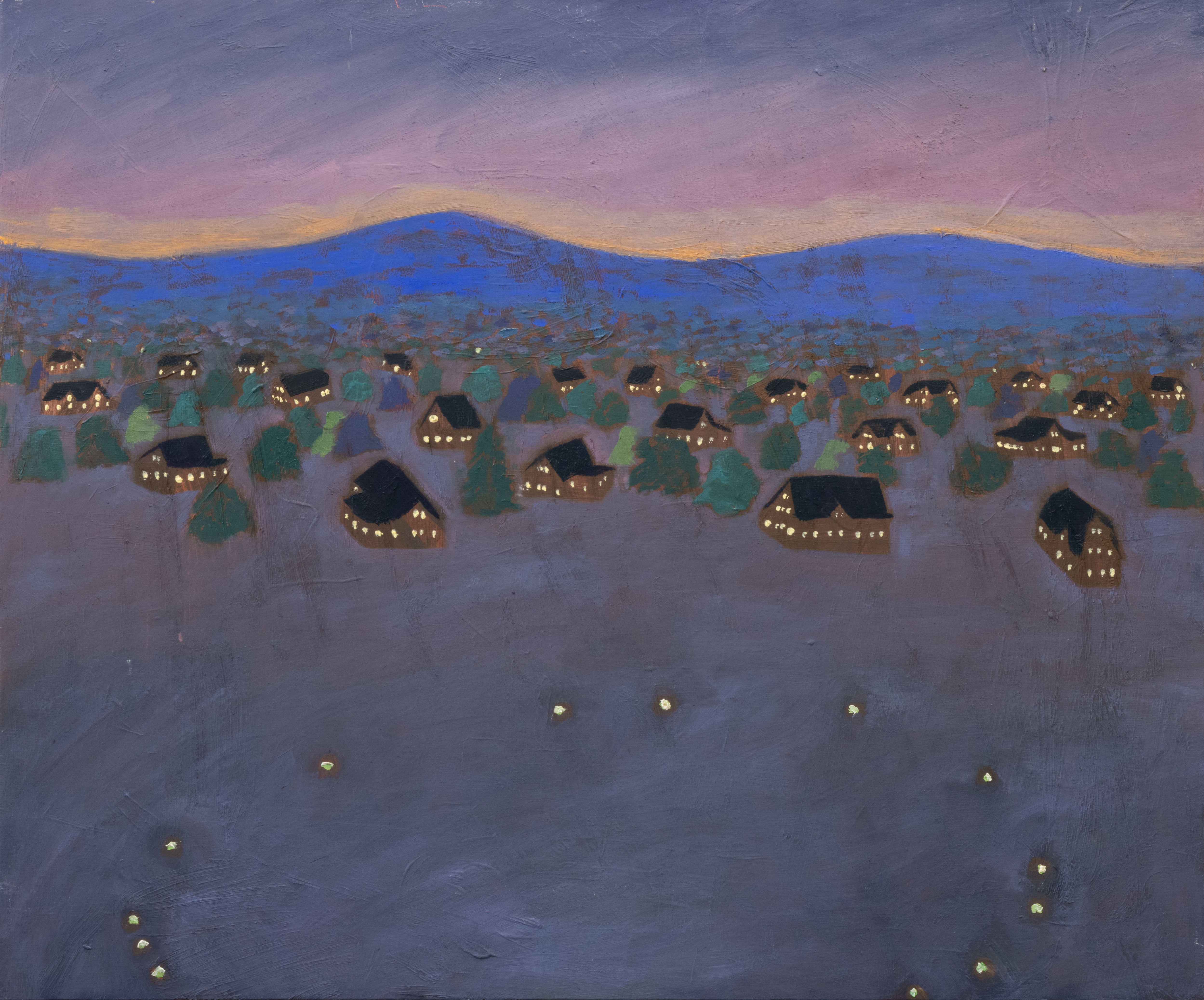
Bachelard’s assertion that “something closed” retains those memories is apparent in walls and fences of many paintings, or in the way a memory floats apart from the terrestrial reality of the neighborhoods Benfey depicts. The walls resemble the tall concrete barriers that run alongside highways, isolating and insulating suburban life from the rushing to and fro of commuters, commerce and travelers. Inside the wall life stands still. “Neighborhood, Edge of the Visible,” “House, Edge of the Visible,” “Winter Candle House” and “Purple Neighborhood with Decoration” all have this sense of boundary that forms the container of memory.
In some works, interior scenes might appear as ghostly apparitions. “Flying Around,” for instance, presents us with a mirage of what we assume is Benfey’s childhood bedroom, which levitates amid the stars above the houses and yards. A wall surrounds this vision too, while above it, instead of a moon, we find a snow globe containing a house in a forest clearing — yet another symbol of hermetic insularity.
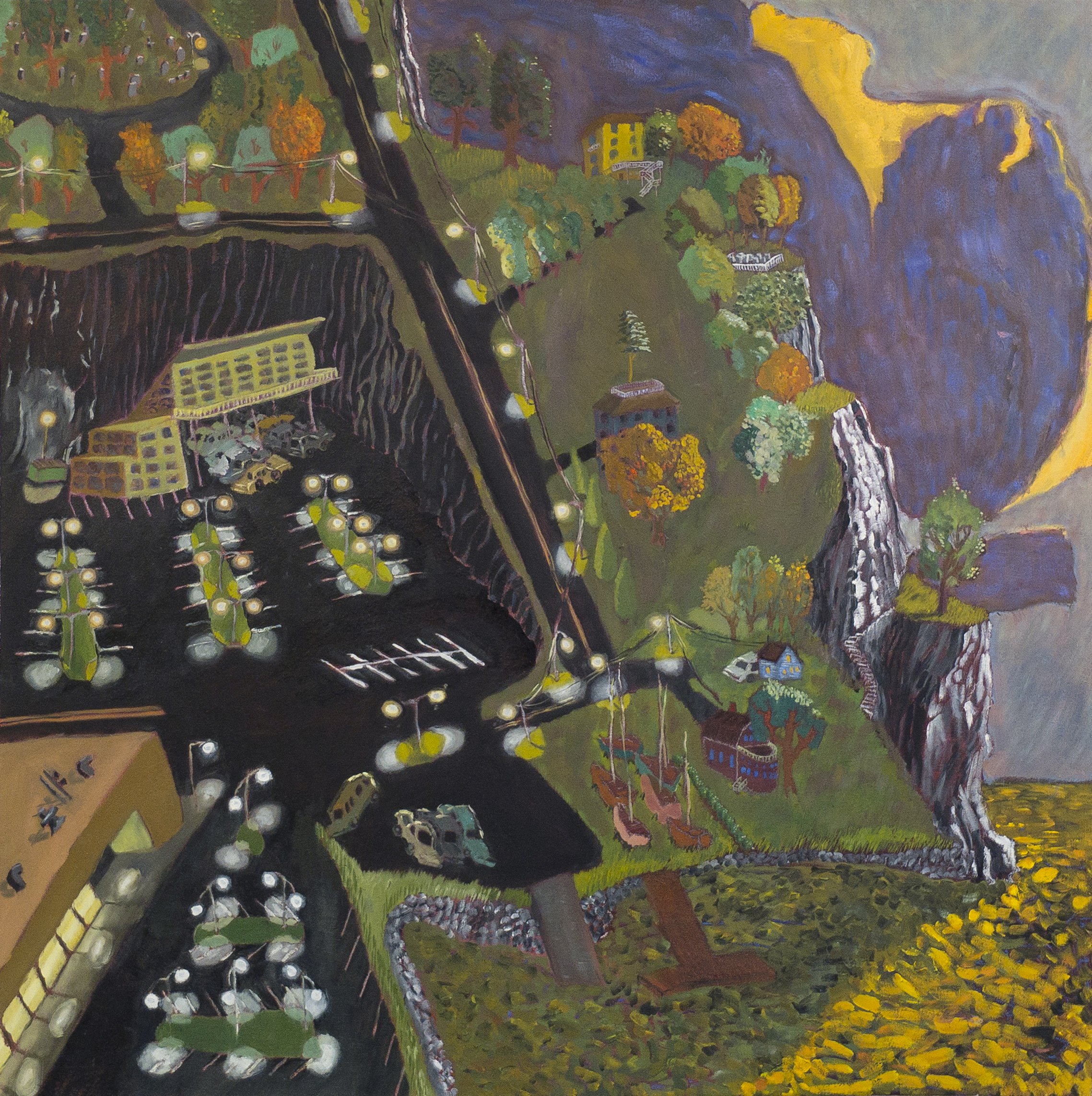
Within the boughs of a tree in “Measure in the Boughs” we glimpse a pointillist colonnade of arches, suggesting that memory lives amidst the quotidian (here a car parked outside a yellow building). Some memories feel corrupted or confused, or as though several memories are colliding. This happens most especially in “Inner Landscape,” which appears as adjacent rooms of a house, one accommodating a bed, the other a sofa. But leading from it are Escher-like stairways descending, ascending, inverted. The rooms are also open to various exterior spaces. What is happening here? Are we inside or outside? What is forefront and what is background? We can’t be sure.
Benfey’s paintings, for all their nostalgic qualities, also have an eeriness to them. Part of that is due to how they hover in twilight, a kind of magical hour for some, but an augur of the unsettling nocturnal unknown for others. “No Man’s Land” and “No Man’s Land 2” both depict parking lots that are mostly or completely empty. They are also cut into hillsides, bounded by rockface, giving them an aura of urban ennui, unsafe places where people are robbed or mugged or worse.
IF YOU GO
“Drawn in Light: Charlie Hewitt” through May. Maine Mill, 35 Canal St., Lewiston, 10 a.m.-4 p.m. Wednesday through Saturday. Admission $5 for adults, $4 for seniors (65+), free for children under 6 and active-duty military veterans with ID. 207-333-3881 or mainemill.org
“Nick Benfey: Neighborhood” through April 11. Moss Galleries Falmouth, 251 Route 1, Falmouth, 10 a.m. to 5 p.m. Tuesday through Saturday. Admission free. 207-781-2620 or elizabethmossgalleries.com
Jorge S. Arango has written about art, design and architecture for over 35 years. He lives in Portland and can be reached at [email protected]. This column is supported by The Dorothea and Leo Rabkin Foundation.
We invite you to add your comments. We encourage a thoughtful exchange of ideas and information on this website. By joining the conversation, you are agreeing to our commenting policy and terms of use. More information is found on our FAQs. You can update your screen name on the member's center.
Comments are managed by our staff during regular business hours Monday through Friday as well as limited hours on Saturday and Sunday. Comments held for moderation outside of those hours may take longer to approve.
Join the Conversation
Please sign into your CentralMaine.com account to participate in conversations below. If you do not have an account, you can register or subscribe. Questions? Please see our FAQs.