
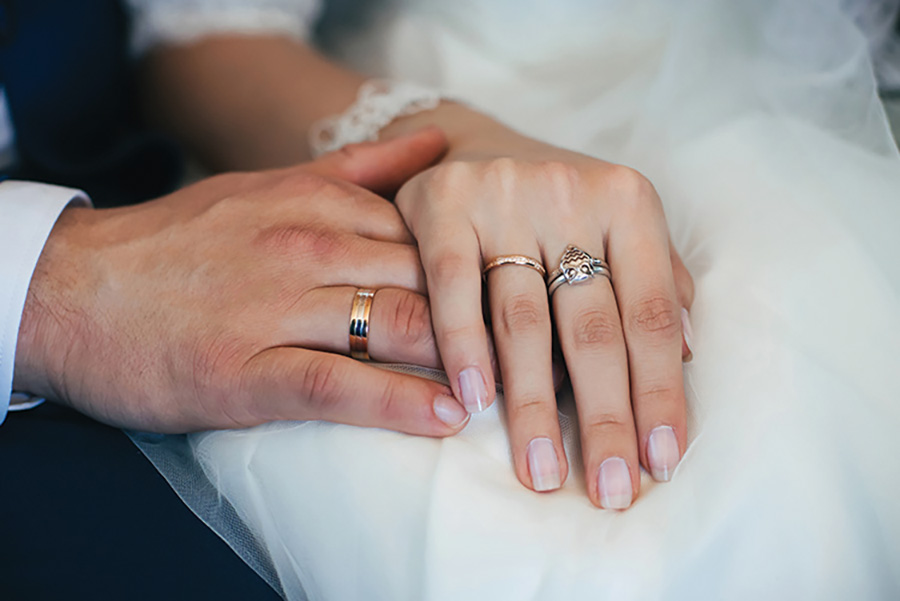
Wedding rings have long signified a couple’s commitment to one another for life. Some of the earliest reported to have worn wedding rings were the Egyptians, according to the Gemological Institute of America. Thousands of years ago, they exchanged wedding rings, and engagement rings, made from organic materials such as reeds and hemp, the unbroken circle of the band symbolizing eternity. Both the Egyptians and Romans wore engagement rings on the fourth finger of the left hand, because of the belief that a vein on that finger led directly to the heart.
Those materials weren’t very durable and were eventually replaced with leather, bone, ivory, and gold. Romans, men and women, wore gold or iron wedding and engagement rings, sometimes engraved, signifying ownership.
While the prices for gold and natural diamonds have been steadily increasing in recent years, their post-World War II accessibility has made the style a near must have for U.S. couples.
President of the American Jewelry Research Institute, Kenneth Gassman, has reported that around 75% of U.S. brides now wear diamond engagement rings. However, other gemstones are also gaining popularity and couples are also collaborating with local jewelers to design their own, creating expressions of themselves rather than in keeping with tradition.
As you look for first-time, upgraded or bonus rings, you might wonder why gold and diamonds have come to be standard bearers of “forever.” Here’s a brief history of how a diamond solitaire and solid band came to dominate U.S. and global markets.
The origin of the solitaire engagement ring
During the 15th century, diamonds became the gemstone used most often for engagement rings. The first recorded diamond engagement ring was given to Mary of Burgundy by Archduke Maximilian of Austria in 1477. It is currently held at the Museum of the Profane in Vienna.
Gold and diamonds became steadily accessible to couples from a wider range of social strata when gold mines were discovered in South Africa in the mid-to-late 19th century. The abundance of material – and exploitative labor – brought prices down in other markets. Today, lab-grown diamonds, estate jewelry and industry standards have generally made the industries safer for workers and empowered consumers to responsibly source this meaningful investment.
Why are diamonds forever?
Not surprisingly, diamond sales plummeted in the U.S. during the Great Depression and following war. According to the Voice of America program “American Mosaic,” De Beers, a British company founded in the 19th century South African diamond rush, was responsible for re-energizing and expanding the market.
They hired the American advertising agency N.W. Ayer & Son which created a campaign emphatically connecting diamonds with romance, and suggesting any man who loved his fiancée should buy her a diamond. “A diamond is forever” was a key slogan, likely inspiring the James Bond title “Diamonds Are Forever”
Men’s trends in wedding bands
During World War II, many more American and European men began wearing wedding bands as a reminder of their loved ones back at home and their commitment to them. According to research from the Victoria and Albert Museum in London, this was a seismic shift to the cultural norm today.
The majority of today’s wedding bands for all genders are gold for practical purposes as well. It is highly resistant to corrosion and not easily scratched. It’s also malleable which makes it easy to design and resize as you age. Men’s rings today are made not only of gold or silver but also materials like tungsten and titanium. Some grooms choose to have wood inlays, engravings, or gemstones, such as black diamonds.
Comments are not available on this story. Read more about why we allow commenting on some stories and not on others.
We believe it's important to offer commenting on certain stories as a benefit to our readers. At its best, our comments sections can be a productive platform for readers to engage with our journalism, offer thoughts on coverage and issues, and drive conversation in a respectful, solutions-based way. It's a form of open discourse that can be useful to our community, public officials, journalists and others.
We do not enable comments on everything — exceptions include most crime stories, and coverage involving personal tragedy or sensitive issues that invite personal attacks instead of thoughtful discussion.
You can read more here about our commenting policy and terms of use. More information is also found on our FAQs.
Show less