

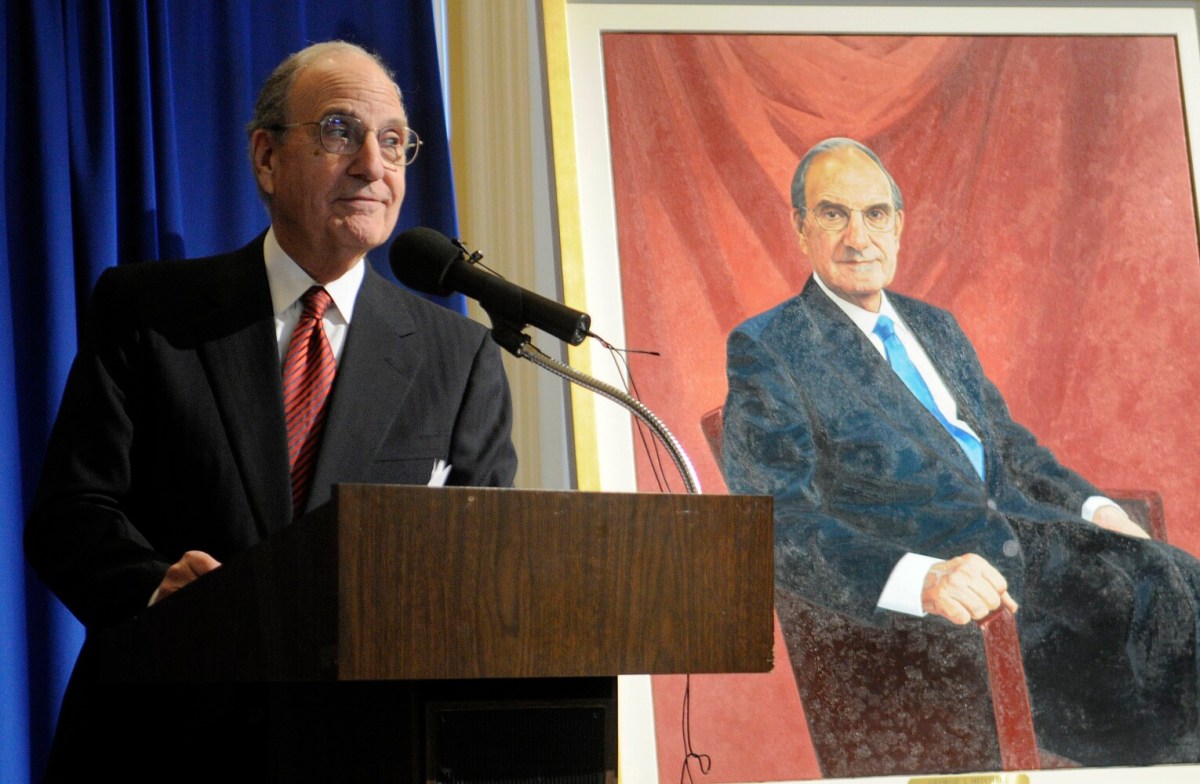
A portrait of former U.S. Senate Majority Leader George Mitchell was removed Friday from a wall of the Maine State House, officials said, the latest fallout from Mitchell’s alleged ties to disgraced financier Jeffrey Epstein.
The Democrat who represented Maine in the U.S. Senate from 1980 to 1995 and later helped broker peace between Ireland and Northern Ireland has been under increased scrutiny in recent months as new details about his connections to Epstein have emerged.
Mitchell is referenced hundreds of times in the millions of documents the U.S. Department of Justice has released related to its investigation into Epstein, a Press Herald analysis found.
A spokesperson for the former senator did not return messages seeking comment.
The Legislature’s presiding officers — Speaker of the House Ryan Fecteau, D-Biddeford, and Senate President Mattie Daughtry, D-Brunswick — had gotten several inquiries “regarding the appropriateness of the portrait,” said Suzanne Gresser, the Legislature’s executive director.
They decided around the middle of this month to ask the Maine State Museum to remove the portrait and replace it with one of Gail Laughlin, the first woman to practice law in Maine, Gresser said. Spokespeople for Daughtry and Fecteau reiterated that account Friday afternoon.
“It was a good time to make that change,” said Victoria Foley, a spokesperson for Fecteau. She said the presiding officers made the call “together.”
A spokesperson for Gov. Janet Mills noted that the portraits are under the Legislature’s purview but said she “supports the decision.”
Bernard Fishman, the museum’s director, said removing the portrait should serve as a reminder that “a high standard of behavior” needs to be the basis of public service, as well as an acknowledgement of the imperfections inherent even in those with strong legacies in other parts of their life.
“Obviously, moving the Mitchell portrait is a matter of public interest at this point. … Under the circumstances, it’s justified,” Fishman said. “It’s an occasion for reflection. It’s an occasion to encourage us to meet this high standard.”
Mitchell’s portrait had been displayed in the Hall of Flags since it was hung in 2014.
NEW PORTRAIT
Seeking to increase women’s representation on the walls, the Legislative Council accepted Laughlin’s portrait into the State House in late February 2020, Gresser said. But a global pandemic was declared shortly afterward, and a spot for the portrait wasn’t selected until this month.
“Because the council had already approved hanging this portrait, this was the portrait that the museum hung in (Mitchell’s) place,” Gresser said.
Laughlin was the first woman from Maine to practice law, having received a degree from Cornell University, according to the Legislative Council. She was elected to the state Legislature in the late 1920s and served six terms between the both the House and Senate, according to the Maine State Museum.
Her portrait was painted in 1919, after Laughlin was elected president of the National Federation of Business and Professional Women, according to the legislative council.
It’s not clear whether the portrait had been hung by the end of Friday, but Fishman said it would be up soon, if not.
He said Laughlin’s portrait will remain in place until after the legislative session, at which point it will swap places with a portrait of former Vice President Hannibal Hamlin. Hamlin’s portrait is currently in the Senate chamber, Fishman said.
“We thought this was an opportunity to show a portrait of a female legislator. There aren’t very many in our collection,” he said. “We thought it would be an appropriate way to let the public know we had that portrait.”
Daughtry has been “a huge advocate” of placing more portraits of women inside the State House, according to her spokesperson, Mary Catus.
ONGOING EPSTEIN FALLOUT
Mitchell has for years denied allegations that he was connected to or aware of Epstein’s wrongdoing.
In 2016, Virginia Roberts Giuffre named Mitchell as one of several powerful men to whom she was offered by Epstein for erotic massages and sex. Mitchell flatly denied that claim in 2019. Giuffre, who was one of Epstein’s most prominent accusers, died last year. Epstein died in jail in 2019.
The U.S.-Ireland Alliance removed Mitchell’s name from its scholarship program early this month. His name was associated with the scholarship because of his work in the ’90s to bring an end to decades of civil conflict to Ireland. The group’s board cited “new information that has come to light” in the Justice Department’s releases.
Days later, he resigned from his namesake nonprofit, the Mitchell Institute. At the time, that organization’s leadership said they were considering changing its name.
And the University of Maine also has created a task force to “review and make recommendations related to institutional naming within our system, including that associated with the former senator,” a spokesperson said this month.
UMaine has two programs named for him: the Senator George J. Mitchell Center for Sustainability Solutions — a collaborative effort of faculty, students and partners focused on “improving the well-being of people and protecting the environment” — and the George J. Mitchell Peace Scholarship, which supports UMaine students who spend a year at an Irish university.
Staff Writer Billy Kobin contributed reporting to this story.

We invite you to add your comments. We encourage a thoughtful exchange of ideas and information on this website. By joining the conversation, you are agreeing to our commenting policy and terms of use. More information is found on our FAQs. You can update your screen name on the member's center.
Comments are managed by our staff during regular business hours Monday through Friday as well as limited hours on Saturday and Sunday. Comments held for moderation outside of those hours may take longer to approve.
Join the Conversation
Please sign into your CentralMaine.com account to participate in conversations below. If you do not have an account, you can register or subscribe. Questions? Please see our FAQs.