


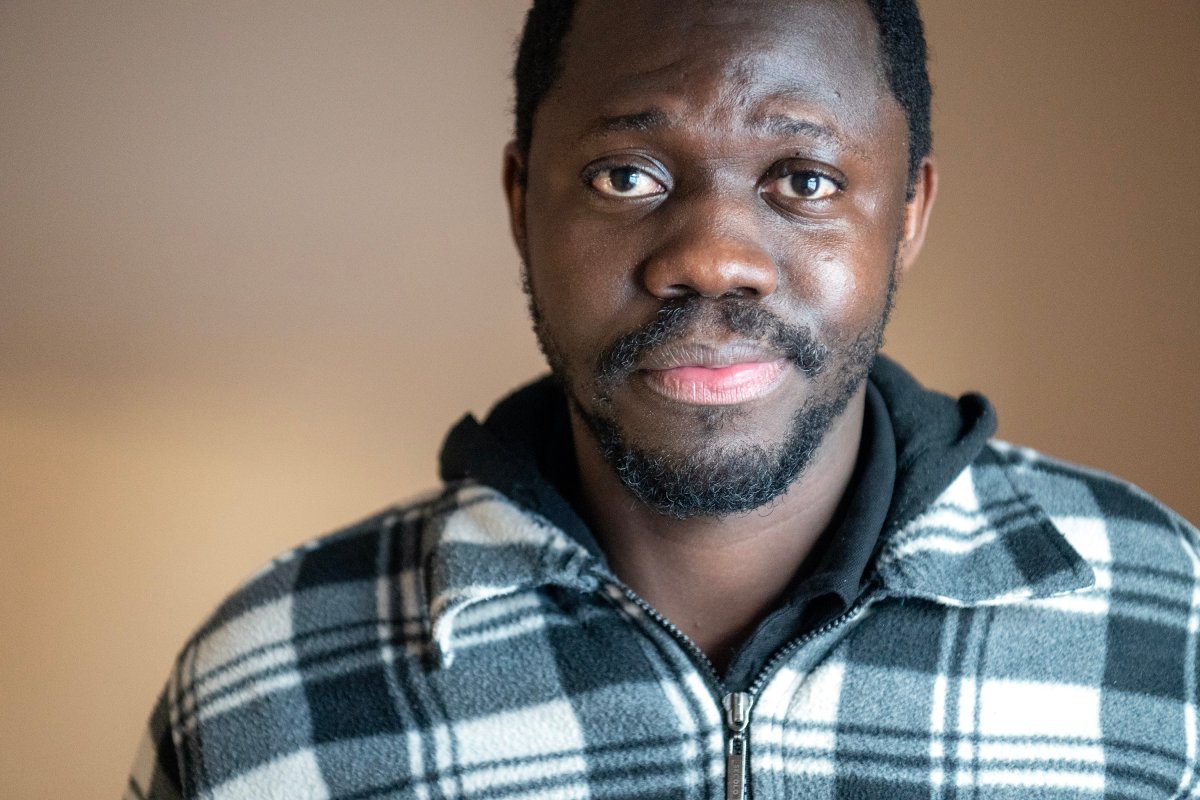
On a Thursday morning, Evaristo Kalonji left his home in South Portland for work. It’s one of the four places the 26-year-old can be found on any given day: At home, at work, at church, or at English classes.
It was Jan. 22, a few days into a surge that U.S. Immigration and Customs Enforcement dubbed “Operation Catch of the Day.” They rolled into town that week with Fox News sitting shotgun, saying ICE had “approximately 1,400 targets” in Maine who had charges or convictions for a range of crimes such as assault and drug trafficking.
Kalonji’s name was on ICE’s target list even though the agency knew he had no criminal record, according to some of the notes the government submitted in court. He said he had left his native Angola, completed an ardous journey up through the Americas and arrived in California a few years ago. He presented himself at the border, he said, then applied for asylum, so the Department of Homeland Security knew he was here.
Kalonji’s nature is to stay calm, smile generously and trust God. When agents stopped his car, he resigned himself to the situation. They knew he had a work permit and an asylum claim pending, but in his mind, it didn’t make sense to try to talk them down. Still, he was surprised.
“I knew that I’m not a bad man,” he said in an interview at the Westbrook church where he helps set up and play music for weekend services.
They took him into custody, and for more than an hour, Kalonji said he sat in the back of a car as they drove around. He watched agents type license plate numbers into what looked like a database. They pulled over more people, and, with a full car, later headed south to Massachusetts where he would spend his first nights in custody.
The Trump administration’s unusual decision to target asylum-seekers without criminal records has led to dozens of petitions challenging the constitutionality of their confinement. And in many of those cases, the government has lost. Many other petitions are still pending.
In all, the administration heralded making 206 arrests in Maine. A month after the enforcement operation, judges have ordered that dozens of them be released, finding they pose no danger to their communities.
Instead of being deported, they spent days or weeks in custody and thousands of dollars to secure their freedom (Kalonji’s bond was $3,000), and now have the chance to resume their asylum cases or pursue other avenues to legally stay in the U.S.
“People were held in detention facilities for weeks for an immigration judge to essentially find that they were not a danger or a flight risk and should be released,” said Jenny Beverly, an immigration attorney in Portland and a former immigration judge. “That tells me that the arrests were needless to begin with.”
The Department of Homeland Security has not responded to several interview requests or a list of emailed questions, though the Trump administration’s push for arrests is in line with its other actions to try to substantially scale back asylum in the U.S.
Being in detention meant Kalonji and others missed paychecks. Some lost their jobs. Their families and friends scrambled to raise money to continue to pay their bills, to pay bond, while waiting anxiously for news.
It’s also given immigrants who thought they were doing everything right a gnawing fear.

“I’m very paranoid,” said Delfino Nsuka, who was arrested by ICE in Lewiston on Jan. 22 while driving home from work. He spent 15 days in federal custody. “I say that because I just came back to the same city where they arrested me. I kind of feel some type of way about that, you know?”
DETENTION ARGUMENTS NOT HOLDING UP IN COURT
The Press Herald has verified the release of nearly 35 people who were detained in the surge and challenged the constitutionality of it in federal court.
Shaan Chatterjee, an immigration attorney in Massachusetts, represented four Maine clients who were detained during the operation, all of whom he said have since been returned to their families.
They include a man who is deaf and would have needed a Nicaraguan Sign Language interpreter for court proceedings. Chatterjee said ICE agreed to release him before a federal judge could rule on the man’s case, and Chatterjee speculated it’s because a translator would have been hard to find.
None of his clients have criminal histories, Chatterjee said.
Kalonji’s immigration attorney Enxhi Qirici, also in Massachusetts, said ICE agents may have been trying to catch people with criminal backgrounds but couldn’t reach “quotas” set by the administration. “So now they’re trying to get anyone they can,” she said.
White House Deputy Chief of Staff Stephen Miller said last year that ICE should detain a minimum of 3,000 people per day.
In cases like Kalonji’s and Nsuka’s all around the country, federal judges are debating the constitutionality of which immigrants can be detained and what rights they have. The dozens of releases ordered by judges in New England show the government’s arguments often aren’t standing up in court.
This was happening even before the January enforcement surge: In hundreds of cases over the last year, judges have found that the federal government has violated the rights of certain immigrants in their custody by not offering them bond hearings and conducting arrests without warrants.
“If for some reason an individual who is here legally is improperly detained, there should be accessible recourse through the legal system,” Republican U.S. Sen. Susan Collins said in a statement. “That is what we have seen with immigration judges ordering the release of certain individuals detained by ICE.”
THOUSANDS OF DOLLARS TO FIGHT FOR RELEASE
Nsuka spent more than two weeks in ICE custody. The first three days he wore the same FedEx uniform he was wearing at the time of his arrest.
He described cramped conditions, abbreviated phone calls with loved ones, a lack of privacy and overwhelming confusion and fear about what would happen to him.
Nsuka and his wife, Jaylee Shropshire-Nsuka, are still confused. Back home in Maine, Nsuka said he does not drive to and from work without someone else in the car. He went back to driving for FedEx but even that now feels unsafe after hearing that someone else had been picked up by ICE while driving for another business that does deliveries.
“We didn’t see this happening, to begin with,” Shropshire-Nsuka said. “It just feels like you’re looking over your shoulder. Am I safe?”
Robin Nice, an immigration attorney based in Massachusetts, said she still receives emails from one Maine client who was held at the Burlington, Massachusetts, processing center. Nice said the woman described feelings of hopelessness. Another client who was held there for three weeks in a solitary setting was fed food through a hole in the door, she said, and went days without human contact.
“It profoundly affects them,” said Nice, who has six clients who were arrested through ICE’s Maine operation. All of them are asylum seekers, and all but one have been released. One has returned with an ankle monitor.
Qirici said her firm, Macedo Law, has represented 30 clients who were detained in Maine in January. More than half, including Kalonji, have been released.
“For most clients, they take it very personally,” she said. “There are a lot of grown men who call us crying, asking what they did wrong.”
There are also tangible setbacks. Several people who have been released, including both Kalonji and Nsuka, still have not received all of their personal belongings from ICE, including identification and work papers. To be safe, Kalonji said he went a week without driving until he was able to get a new driver’s license.
Immigrants, their families and advocacy organizations have spent thousands of dollars to secure their release, and to continue fighting for legal status in immigration court.
“It takes time, and it takes a lot of money,” said Nsuka.
The Maine Solidarity Fund, which fundraises for legal defense and emergency assistance, said as of last week, it had helped 27 people make bond payments and the fund is still getting new applications. The group has spent nearly $475,000 on bond payments and legal fees combined, according to Crystal Cron, executive director of Presente! Maine, which administers the money.
The bond amounts ordered by judges range from $1,500 to $20,000, she said, not including attorneys fees.
Most often, Cron said, those being returned are coming from detention centers close by in New Hampshire and Massachusetts. ICE said it moves people out of New England because of a lack of capacity, but attorneys and families say it makes it harder to locate detainees, communicate about legal proceedings and make timely filings.
TRUMP’S CAMPAIGN TO LIMIT ASYLUM
Immigrant advocacy groups have said the majority of the people detained in the ICE operation in Maine were asylum seekers: “people who have already endured persecution, detention, torture, and more, and came here seeking safety,” Melissa Brennan of the Immigrant Legal Advocacy Project, Maine’s only statewide immigrant legal services provider, said in a statement Friday.
In an effort to prevent their release, ICE has argued in court that the asylum-seekers they detained are flight risks, but in the case of Francoise Makuiza, for example, U.S. District Court Judge Lance Walker, a Trump appointee, wrote, “Clearly, Petitioner is not ‘in the wind’ and has an established place of residence in Maine, where she lives with her husband and son.”
Federal law does not offer special protections to prevent asylum seekers without criminal records from being detained, yet many immigration attorneys said that the kinds of arrests pursued by the Trump administration were not common practice before he took office last year.
The administration has said the asylum process allows too many people to live in the country, since it takes years to adjudicate an asylum claim and more than two million people have their applications pending, during which time they’re often allowed to work legally.
“The asylum system has become a huge loophole in our migration laws,” Deputy Secretary of State Christopher Landau said at the United Nations in September.
Trump has tried to limit how thoroughly immigration judges can consider asylum claims. He’s also trying to force people to apply for asylum in a third country instead of in the U.S.
Landau alleged that there are hundreds of thousands of “fake asylum seekers.”
Despite the Trump administration’s efforts to detain asylum seekers in Maine, some of the people being released, like Kalonji, essentially will be able to pick up their asylum cases where they left off. For others, the Trump administration has successfully made their cases more difficult.
And those who have won release still face an uphill battle to remain in the country permanently, immigration attorneys warn.
“It’s not like, ‘Game over, you win, you’re here forever,’” said American Civil Liberties Union of Maine attorney Max Brooks.
The government is deciding asylum cases at a higher rate, and denying them more frequently than under previous administrations, according to data from the Transactional Records Access Clearinghouse, a data collection nonprofit affiliated with Syracuse University.
Immigration judges only granted asylum in about 19% of the cases that were considered in August 2025, down from almost 40% in August 2024.
DETERMINED TO STAY
Chatterjee, the immigration attorney, speculated another part of the Trump administration’s strategy in detaining people on questionable legal grounds is to encourage them to drop their quests to stay in the U.S.
“They often put people in horrific conditions to pressure people into signing off on their own deportation,” he said.
For Kalonji, it’s not working. Despite the challenges, he’s among the people returning to Maine who still consider it to be home.
He said he couldn’t talk about the specific reasons he left Angola; as he started to choke up, he said it was too painful. Being in detention reminded him of that time.
On the night Kalonji was released, Pastor Carlos Nzolameso drove down to meet him in Massachusetts. Nzolameso had helped pay Kalonji’s bond and worried about him every day he was in detention. On the phone from the car, Nzolameso sounded joyous to be reunited with the man he considers a son.
“Being a father is not easy,” Nzolameso said later with a knowing laugh.
Kalonji quickly went back to work at the chain restaurant where he’s worked for almost two years, he said. He noted that his English teacher in Westbrook was excited to see him back last week.
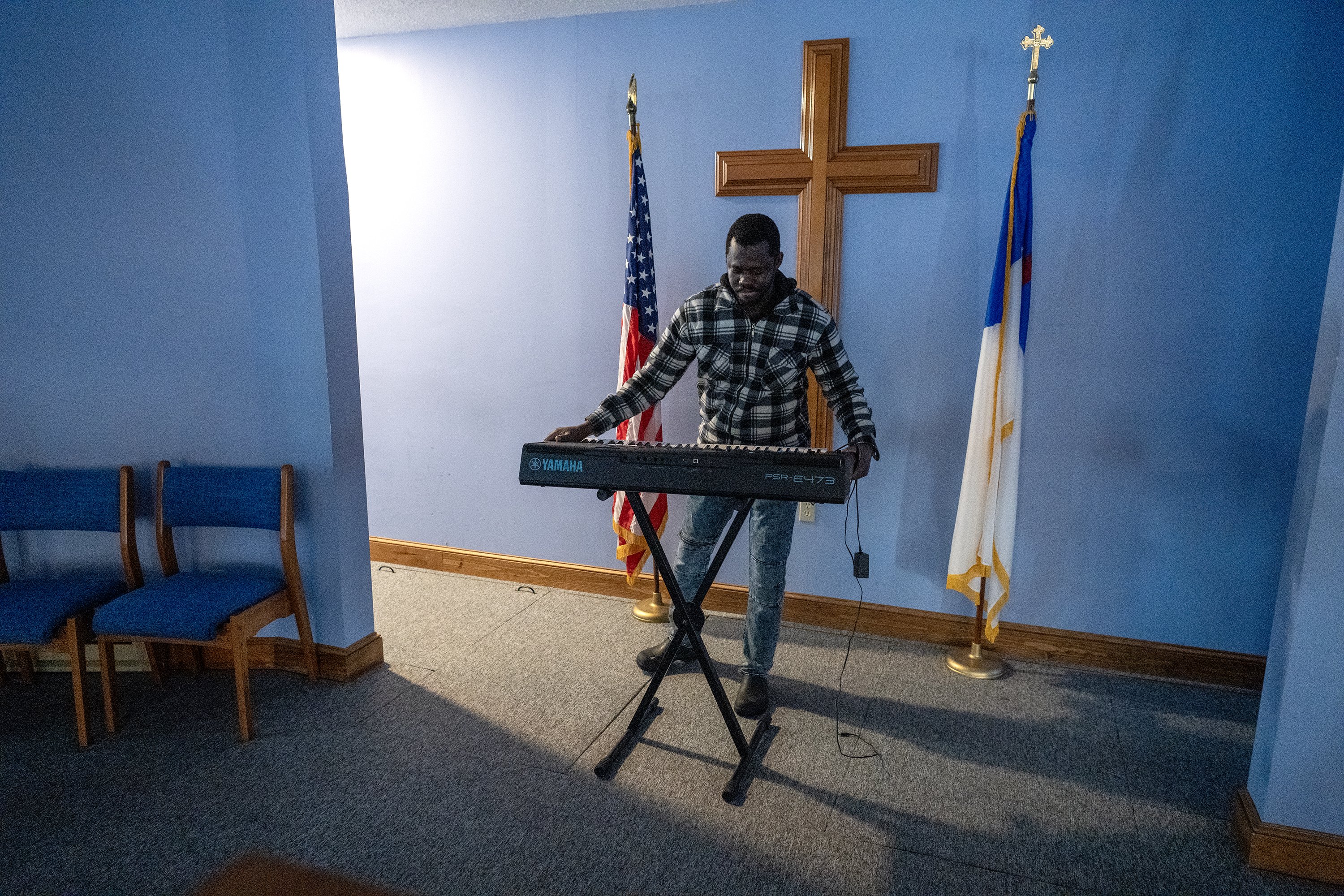
Standing in the familiar grounds of the church, he appeared calm despite a persistent anxiety he’s felt ever since he got back. He has resumed his schedule at church four days a week. This weekend he’ll play the keyboard on the altar, standing near the American flag, and sing about surrendering everything to God.
“I know one day everything is going to be good, because we have God. I’m going to smile again,” he said.
His long term plans have not changed: He wants to continue learning English and apply to college here.


Comments are not available on this story. Read more about why we allow commenting on some stories and not on others.
We believe it's important to offer commenting on certain stories as a benefit to our readers. At its best, our comments sections can be a productive platform for readers to engage with our journalism, offer thoughts on coverage and issues, and drive conversation in a respectful, solutions-based way. It's a form of open discourse that can be useful to our community, public officials, journalists and others.
We do not enable comments on everything — exceptions include most crime stories, and coverage involving personal tragedy or sensitive issues that invite personal attacks instead of thoughtful discussion.
You can read more here about our commenting policy and terms of use. More information is also found on our FAQs.
Show less