
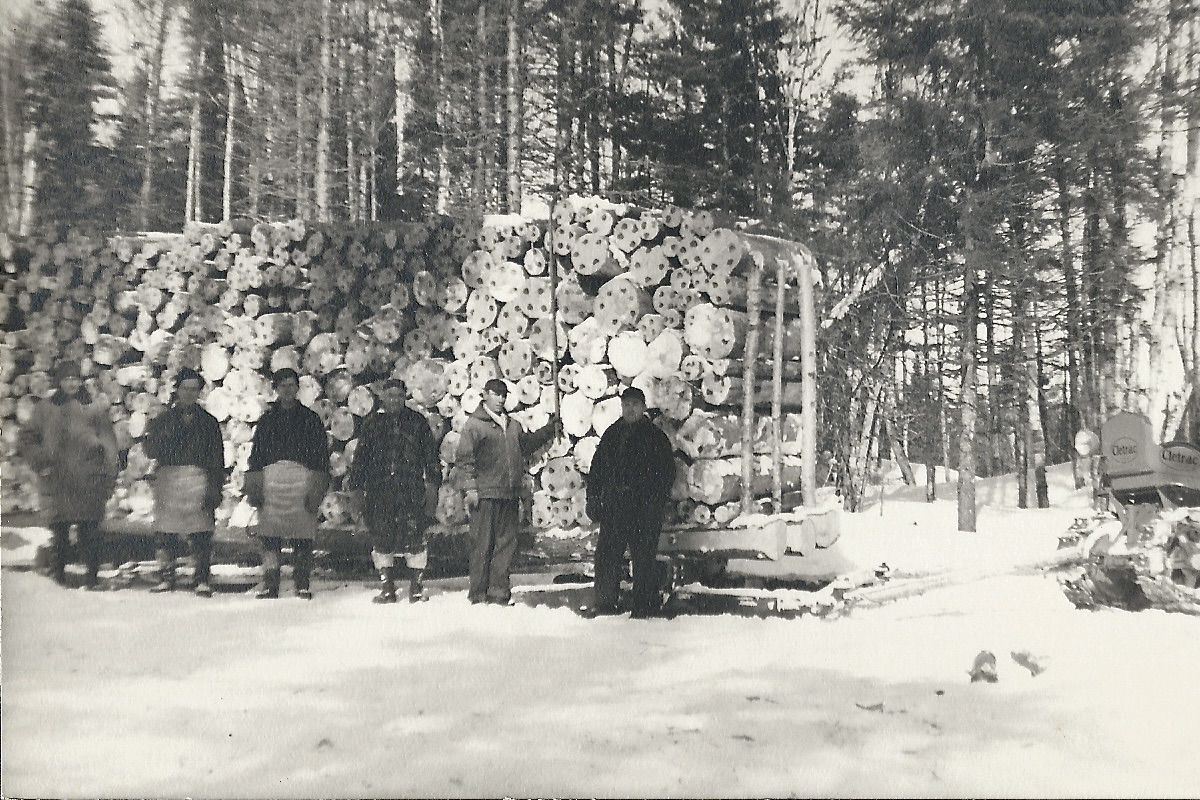
On March 8, 1945, 16-year-old Dean Yeaton began his day by filling two pails of water from a hole in the ice at his father’s remote logging camp at Spencer Lake in Hobbstown, about a dozen miles south of Jackman. As he reached shore, a pack of frightened, semi-wild pigs dashed past — signaling one of Maine’s largest manhunts was underway.
The pigs had been spooked by law enforcement agents combing the woods with bloodhounds in search of three German prisoners who escaped from a prisoner-of-war camp a mile from Yeaton’s camp. The Germans had disappeared from an ice-harvesting job the previous day. When the prisoners were missing at evening roll call, Major William Marshall, the POW camp commander, urgently requested state and federal assistance. The following morning, 30 officers from the Maine State Police, Somerset County Sheriff’s Office, Maine Warden Service, and FBI arrived at the POW camp and Yeaton’s logging camp.
In 1944, at the height of World War II, Maine Congresswoman Margaret Chase Smith and Senator Owen Brewster urged the federal government to send captured Germans to Maine to alleviate an acute labor shortage. Potato farmers and paper mills, Maine’s largest employers, had been hit hard by an exodus of young men enlisting or leaving the state for lucrative defense industry jobs in Massachusetts and Connecticut. At the time, Maine was the nation’s top producer of potatoes and paper, both vital to the war effort.
Acquiescing to Smith and Brewster’s requests, the government sent 4,000 German soldiers to several POW camps in Maine, including one near Spencer Lake. Hollingsworth & Whitney Co. — a beneficiary of conscript labor — constructed a 22-building Spencer Lake POW Camp in Hobbstown to house 250 prisoners.
The facility opened on July 10, 1944, amid considerable public outcry. At 3 a.m. that day, a rowdy crowd in Bingham met the passenger train carrying 250 POWs. The shades of the Pullman cars were drawn and armed guards stood at the end of each car.
Not all observers, though, were unsympathetic to the POWs’ arrival. Roland Tozier watched prisoners file out and board military trucks for the 50-mile ride to Spencer Lake.
“Seeing those frightened, young German boys headed to the Spencer POW camp softened me,” he said in an interview in the late 1960s. “I thought of my own two sons fighting in Europe and wondered if some German father was staring at my sons being carted off to a POW camp in Germany. I left the train station with a heavy heart.”
Many Spencer Lake POWs had served as members of General Rommel’s elite Afrika Korps. Captured in mid-May of 1943, when the Allies defeated the Germans in Tunisia and Morocco, they were among thousands of POWs shipped to Boston, New York, and Norfolk. Screened on arrival, hardcore Nazi POWs were sent to a high security camp in Oklahoma. Most of the POWs shipped to Maine, had picked cotton in Louisiana the year before.
There were no escape attempts at Spencer Lake during the camp’s first eight months. That changed when 18-year-old Franz Keller, 19-year-old Horst Schlueter, and 20-year-old Antone Geib woke up on March 7, 1945, hid some rations and sugar in pouches beneath their clothes, and then stole away into the snowy Maine woods.
The trio made simple snowshoes and harnesses using short boards, discarded leather belts, and stovepipe wire. Armed with homemade knives, they absconded with axes from their work site and a stolen map.
The nearest public road was 19 miles through the woods.
The escape prompted officials to interrogate members of the ice-cutting prisoner crew. The guard assigned to them, the prisoners confessed, had fallen asleep on a horsehair blanket beneath a balsam fir.
Months earlier, visiting military officers had voiced concerns about lax security at Spencer Lake’s wood harvesting sites. No need to worry, Major Marshall assured them: Maine’s remote forests would be a deterrent. Many Germans had seen enough movies to believe that the woods were swarming with bears, wolves, and bizarrely, hostile Indians.
But Keller, Schlueter, and Geib were unfazed by such tales. They traveled at night and hid during the day. For two days, three surveillance planes flew above Spencer Lake while law enforcement officers searched for clues on the ground. On the third day, help came from an unexpected source: an eccentric, cantankerous hermit named Bill Hall.
Hall lived in a squat, one-room trapper’s cabin halfway between the Yeaton’s camp and the POW compound. Law enforcement officials were informed of the hermit’s prickly nature, but Hall knew the woods better than anyone, and as the trail grew colder, officers reluctantly deputized him.
“Hall knew the woods like the back of his hand,” Dean Yeaton later recalled. “His first contribution was unconventional. He killed a deer with a high-powered rifle, within earshot of the interned German prisoners. Hall placed the deer’s organs in a grain bag and carried the sack over his shoulder to the POW fence. There, as Germans gathered behind barbed wire, he dumped the bloody contents onto the snow and said through an interpreter, ‘This is all that remains of one escapee.’”
The dramatic gesture backfired. Hall punctuated his point with a German phrase he had learned the previous day. “Binden sie ihre schuhe,” he growled through the fence. What Hall thought he had said was, “Let this be a lesson to you,” but his interpreter corrected him. The hermit instead had said, “Tie your shoes.”
But Hall made no further mistakes. He advised game wardens to search the woods in the town of West Forks. The hermit assured them that, after the young Germans realized they couldn’t cross the open water of Spencer Stream or the wide, swift Dead River, they would head in that direction.
As Hall predicted, on March 12, 1945 — five days after their escape — the Germans were apprehended at gunpoint in a makeshift lean-to. The wardens relieved them of their axes and knives and took them to a nearby country store, where the Army retrieved them. According to Yeaton, “Hall never received the credit he deserved because he shunned publicity.”
It wasn’t mistreatment that motivated the three young Germans’ flight from Spencer Lake. In fact, the impetus to escape was one many Mainers can relate to: “We did not want to endure another summer with biting mosquitos, blackflies, and no-see-ums,” one of the runaways later confessed.
After the POWs capture, the Red Cross visited Spencer Lake to ensure that guards weren’t retaliating against fellow prisoners. As the Red Cross finished its inspection, a German soldier representing the POWs voiced a complaint — the prisoners were sick of American white bread. The official relayed the grievance to Major Marshall, who provided the Germans with what they most craved: a Dutch oven and ingredients for Schwarzbrot (black bread). Today, the Dutch oven is all that remains of the POW camp.
Ron Joseph of Sidney is author of Bald Eagles, Bear Cubs, and Hermit Bill: Memories of a Maine Wildlife Biologist, published by Islandport Press
We invite you to add your comments. We encourage a thoughtful exchange of ideas and information on this website. By joining the conversation, you are agreeing to our commenting policy and terms of use. More information is found on our FAQs. You can update your screen name on the member's center.
Comments are managed by our staff during regular business hours Monday through Friday as well as limited hours on Saturday and Sunday. Comments held for moderation outside of those hours may take longer to approve.
Join the Conversation
Please sign into your CentralMaine.com account to participate in conversations below. If you do not have an account, you can register or subscribe. Questions? Please see our FAQs.