

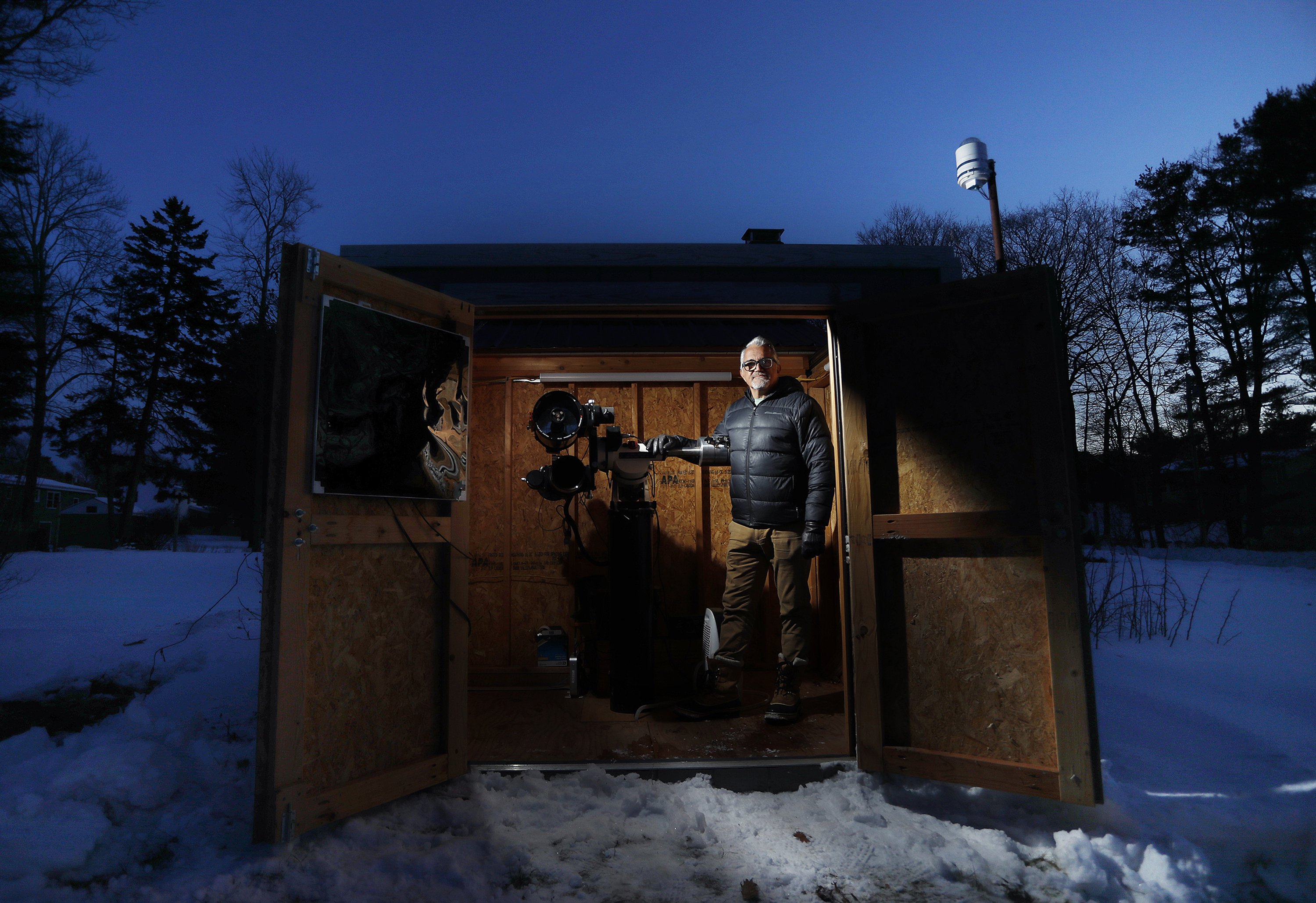
CAPE ELIZABETH — Ara Jerahian opens up the doors to the gray shed in his front yard.
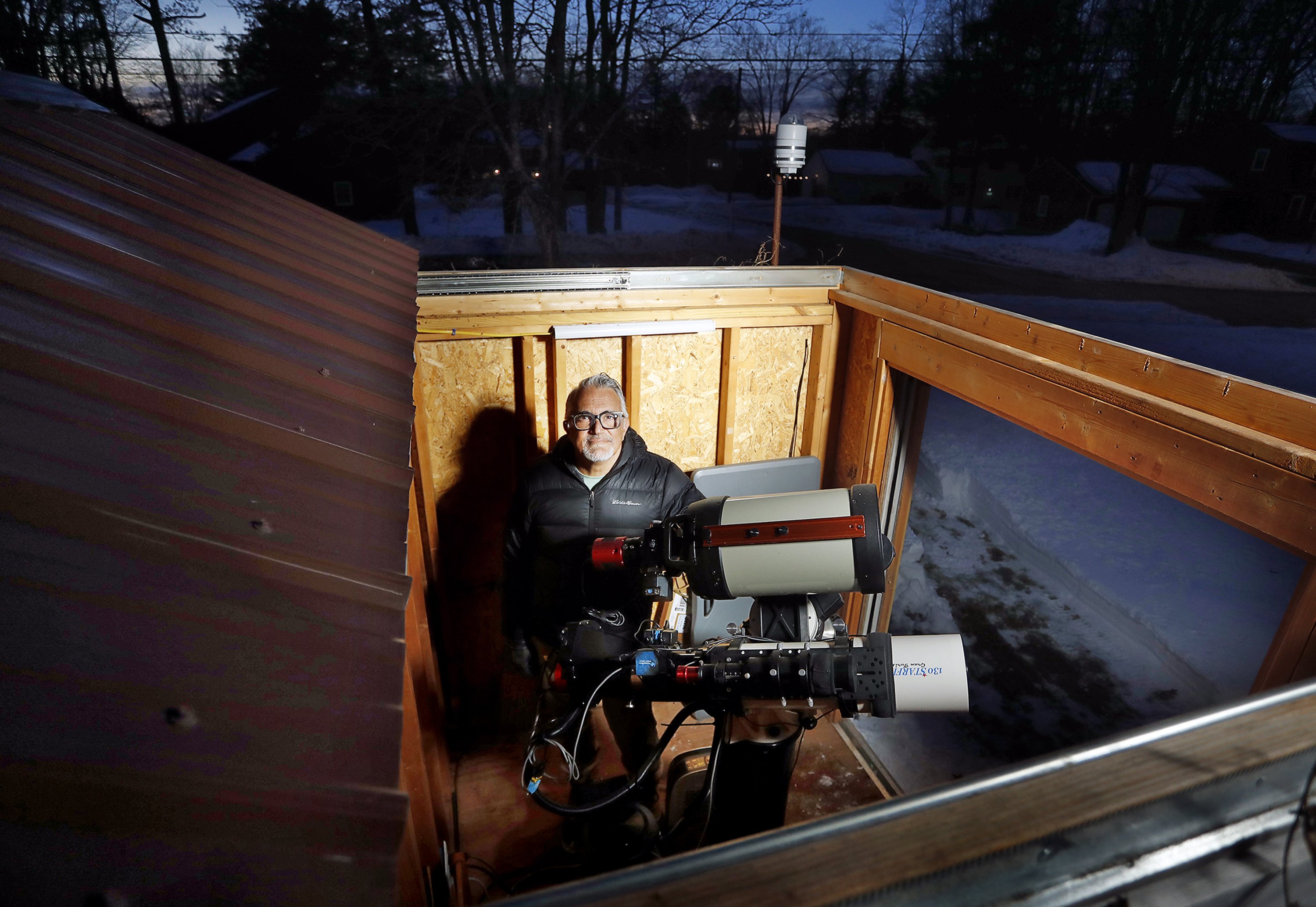
Where other people would store gardening tools or a lawnmower, Jerahian instead keeps his “ara ad astra,” or “altar to the stars:” two large white telescopes mounted on a concrete pier.
On clear nights, Jerahian rolls the roof off his 8-by-6-foot observatory to get an unrestricted view of the night sky and capture images of deep space.
Between his five telescopes, three mounts and 200 pieces of photography equipment, Jerahian said he has invested roughly $75,000 in astrophotography — “I just kind of went hog wild.”
Fanatical Mainers all over the state have taken their interest in astrophotography to the next level, investing thousands to build their own observatories and rigs, and agreeing that Maine is a special place to look at the night sky.
Because of its low population density and large forested areas, the state has some of the darkest skies east of the Mississippi, according to Shawn Laatsch, the director of the University of Maine’s Versant Power Astronomy Center. Katahdin Woods and Waters National Monument is an International Dark Sky Sanctuary, known for its clear skies.
And the state is roughly halfway between the equator and the North Pole, offering a pretty view of the northern sky, Laatsch said.
A new state law taking effect in October will require publicly funded outdoor lighting across the state to be dimmed at night to protect wildlife and dark skies.
FINDING DARK SKIES
Even with increasing light pollution, most people in Maine can drive less than an hour to see dark skies, Laatsch said. For Portland residents, he recommends heading northwest, past Gorham.
Nothing beats rural skies, Laatsch said. Charlie Sawyer, the founder of the Down East Amateur Astronomers, certainly thinks so.
He’s been entranced by the night sky ever since his family moved to Pembroke when he was 8. Fifty years later, he’s still stargazing and was part of a Maine-based team that co-discovered four supernovas in 2013 and 2014.
Sawyer owns seven telescopes, three of which he uses for imaging, and rotates through his collection, depending on his target. Comets are his favorite, because they can come from any direction.
Since 2019, he’s operated the Sawyer Observatory: a white, 6-foot-wide fiberglass dome that sits on his front deck. He built a concrete pier inside for his telescopes, so they won’t be impacted by vibrations. His equipment is hooked up to the internet, so he can control it from inside his house.
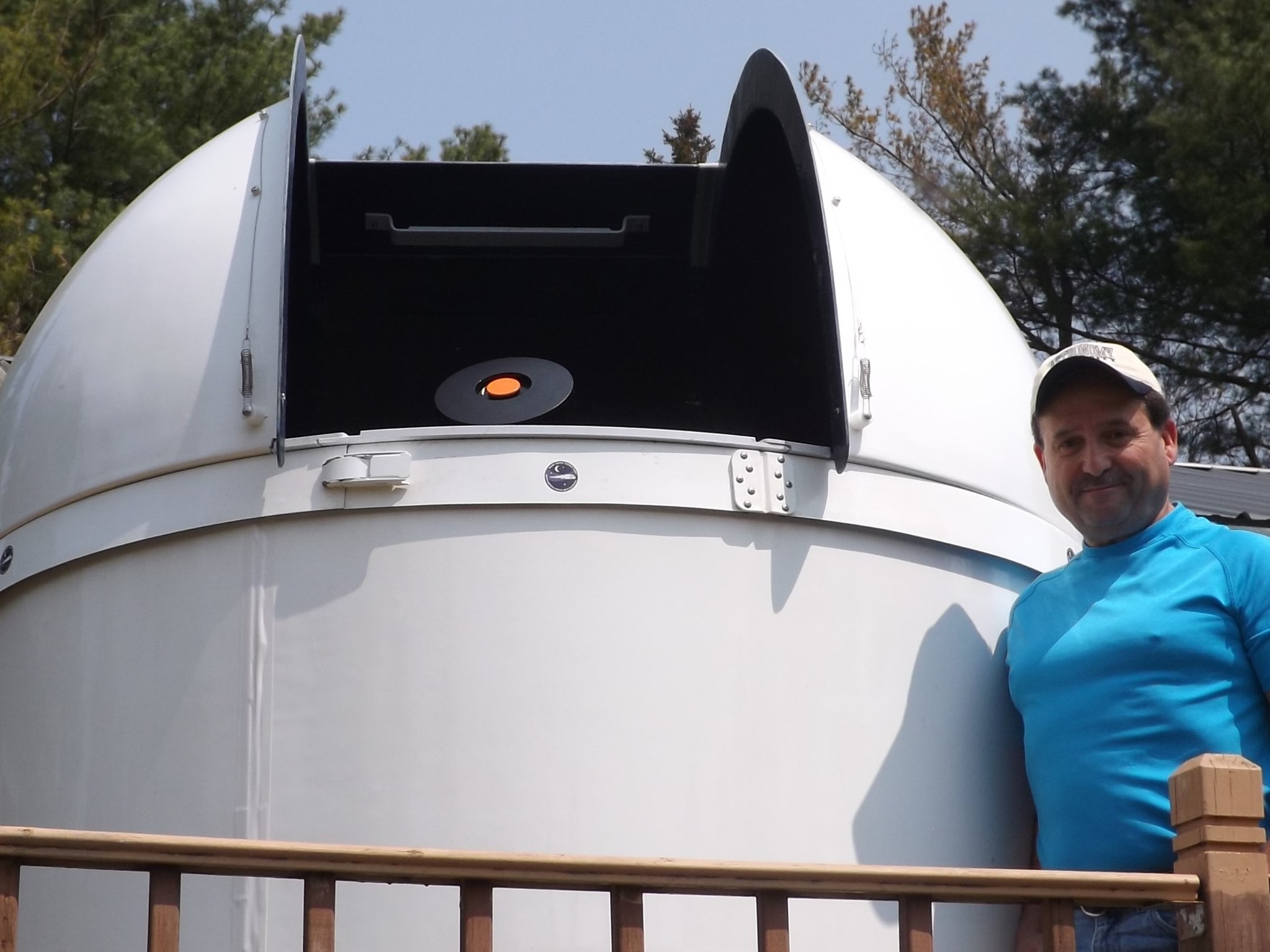
Sawyer said he is excited for spring, not just because his observatory will no longer be frozen shut but because it will also be galaxy season in the Northern Hemisphere, a favorable time to view farther objects because the sky is pointed away from the Milky Way.
He’s recently retired, and determined to do more astrophotography and outreach.
“I’ve got more free time, so staying up late isn’t going to be an issue,” Sawyer said.
He regularly hosts public viewings at his home observatory for schools, Scouts and families.
He used to host Down East Amateur Astronomers club meetings from his 12-by-12-foot roll-off roof observatory, before the shed was destroyed in a massive snowstorm in 2014. He also teaches an introductory astronomy course on Saturdays at the Pembroke library.
STARS IN THE CITY
Astrophotography is possible anywhere in Maine, even in cities.
Mark Hamilton, 38, wheels his telescope rig onto his driveway in Portland whenever there isn’t a chance of rain, snow or a full moon. Between the telescopes and his custom-built tripod, his operation weighs hundreds of pounds.
Aside from his neighbors’ houses limiting his field of vision and the occasional blur of light pollution, the night sky is his. In some of his images, he captures billions of stars.
He has two telescopes: one with a 100mm aperture for wide-field shots and one with an 11-inch aperture to zoom into dim and distant targets. He switches his camera and accessories between the telescopes a couple of times a year, depending on what he’s looking for.
Hamilton didn’t plan to become an astrophotographer. For years, he said he was excited to just look at the stars. Maine’s skies were astronomically clearer than the haze of the Dallas-Fort Worth area where he grew up.
At a night sky festival near Acadia National Park about 10 years ago, he saw a veiled nebula through a telescope for the first time.
“At that moment I was like ‘Oh man, this is nuts,’” he said. “You can just see this with your eyes?!”
Inspired, he purchased a manual Orion telescope for about $300 and hauled it around Portland for a few years. One night, he witnessed a conjunction: Jupiter and Saturn were close enough to be in the same frame, as were their moons.
“I wish I could have taken a photo of that,” he thought. That feeling wouldn’t go away.
He started with a DSLR camera and slapped an adapter onto his telescope, but quickly realized that wasn’t going to cut it. “The Earth rotates weirdly,” he said. He needed something that could follow the celestial bodies through sky.
Hamilton started building his hardware collection in earnest during the COVID-19 lockdown. Now, he has thousands of dollars worth of equipment to help him capture the stars.
Photography is much more fruitful than simply stargazing, he’s decided.
“Our eyes are not good at looking at dim things in the dark,” Hamilton said.
HOW A STAR BECOMES A PICTURE
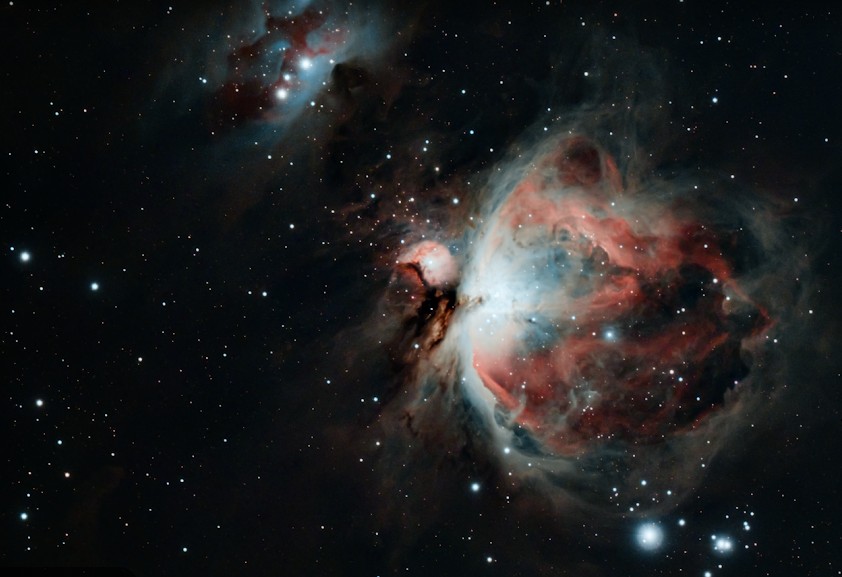
A lot of space objects look gray to the naked eye. The minutes-long exposure times of cameras can capture the minutia.
Sometimes, it takes hundreds of exposures before an image of an object in space becomes a masterpiece.
Jerahian’s camera tacked to the bottom of his telescope captured about 600 snapshots of a deep space cloud over four consecutive clear nights in June 2020. Each exposure lasted 90 seconds, an eon compared with the fraction-of-a-second burst for a traditional camera.
“In isolation, each exposure was nothing special,” Jerahian said. A few dots. Some fuzzy blurs. But when he processed and stacked all the images on top of each other, he realized he had something amazing.
It was LDN 1251, a dark nebula. But to him, it looked more like a humpback angler fish.
Jerahian played with the colors, pulling out the swirly reds caused by hydrogen, the blues made by oxygen and the rare sulphuric green.
Like many hopeful astrophotographers around the world, he submitted his image to the National Aeronautics and Space Administration for its Astronomy Photo of the Day competition. His image was chosen a few days later.
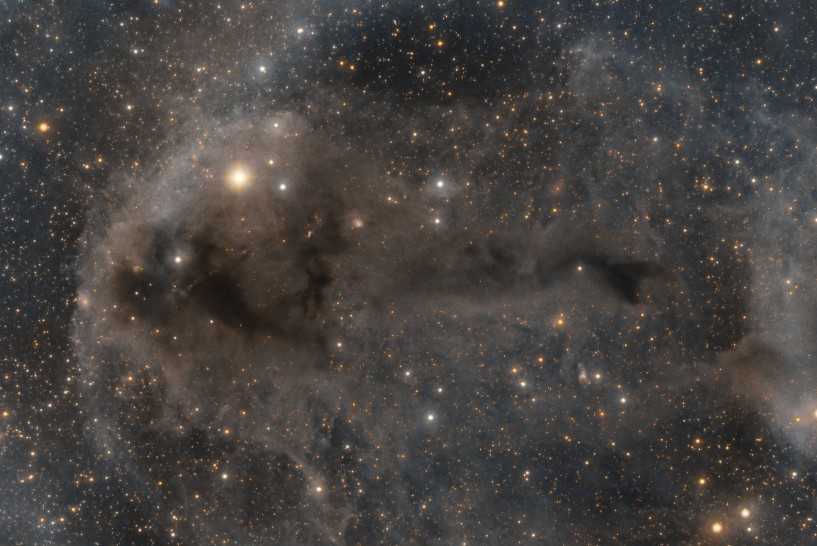
It wasn’t the first time he’d sent something to NASA: Jerahian mailed in his school report about the solar system in elementary school and received pictures of Jupiter and galaxies in return.
THE GEAR TO USE
John Meader, an astronomy educator and photographer based in Waterville, started taking pictures of the stars in the 1980s, capturing the Milky Way on his Kodachrome.
“You sent it off to Kodak and hoped for the best,” he said.
Longer exposures were risky, because an airplane flying overhead at the wrong time could ruin the shot.
“When half the images are bad, you still have to pay for them,” he said. Now, he can shoot thousands of frames on one memory card with his digital camera. A lifelong astrophotographer, Meader has had his work featured in National Geographic’s “Stargazer’s Atlas.”
Unlike other astrophotographers, he doesn’t use a telescope.
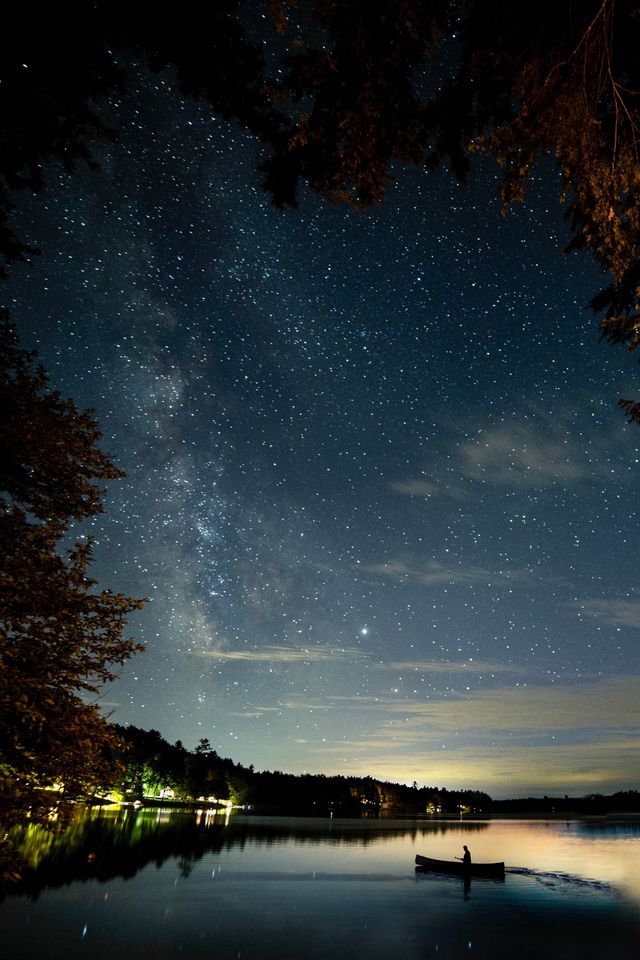
He mounts his DSLR camera on a tripod and attaches a 400mm lens and doubler, a device used to increase the focal length, to it. “It kind of becomes a telescope,” he said. The whole setup cost about $5,000.
Astrophotographers know their hobby can be expensive and all-consuming.
But it doesn’t have to be.
“You crawl before you walk and you walk before you run,” Meader said. An inexpensive tripod and an adapter for your phone is a crawl. A decent pair of binoculars is a walk. A telescope is a run, he said.
“You can take some nice images with just simple cameras and small, wide-field telescopes,” Sawyer said.
For those specifically interested in space photography, Hamilton recommends smart telescopes that can track, which range from about $300 to $1,000.
“There’s a wide spectrum of the backyard stargazer or the amateur astronomer,” Sawyer said. “You could be this person that just goes out in a comfortable lawn chair with a pair of binoculars and enjoy the nighttime sky, or you can have an observatory and thousands of dollars’ worth of equipment to do all of this serious imaging.”

We invite you to add your comments. We encourage a thoughtful exchange of ideas and information on this website. By joining the conversation, you are agreeing to our commenting policy and terms of use. More information is found on our FAQs. You can update your screen name on the member's center.
Comments are managed by our staff during regular business hours Monday through Friday as well as limited hours on Saturday and Sunday. Comments held for moderation outside of those hours may take longer to approve.
Join the Conversation
Please sign into your CentralMaine.com account to participate in conversations below. If you do not have an account, you can register or subscribe. Questions? Please see our FAQs.