


AROOSTOOK COUNTY — In a snowy field under a waxing moon, 84 dogs waited to run.
They settled their haunches on beds of hay, but their ears stayed alert. The only sounds were the snap of the wind, the clank of ladles in metal bowls, the occasional yip or howl.
An orange sign at the entrance of the field warned: “Quiet Please. Dogs Are Resting.”
These dogs were 65 miles into a 250-mile journey at the Can-Am Crown International Sled Dog Races. Half of the teams reached this checkpoint on the edge of Portage Lake as the sun set; the rest would cross the ice by the light of their headlamps.
They would break here for four hours, maybe five, then set out again into the darkness.
This event is the longest sled dog race in the eastern United States, a qualifier for Alaska’s famed Iditarod and a test of will. Of the 12 teams that started the 250-miler on a sunny Saturday morning, nine would ultimately cross the finish line, the last arriving early Tuesday.
Another 35 teams attempted 30- or 100-mile stretches, shorter but still grueling. Some didn’t finish.
“I don’t know what the pull exactly is,” Amy Dionne, who lives in Madawaska and competed in the 250-miler, said in the days before the race. “I don’t know exactly what keeps us going, wanting to go longer and longer.”

‘AND YOU’RE OFF’
The starting line was loud.
There was the sound of the announcer, introducing each musher and their lead dogs over the speaker system, the cheering of the crowd and the exuberant barking of hundreds of dogs.
“They’re ready, folks,” the announcer shouted into the microphone on Saturday. “They’re jumping.”
The night before, public works employees and local college students worked to build a quarter-mile path of snow along Main Street in Fort Kent. Lance Morin, wearing a blue-and-yellow vest that read “Main Street Chief,” said he toiled until 2 a.m. and barely slept before coming back in the morning.
He grinned as he gave directions into his headset.
“It just takes a whole community effort,” Morin said. “It’s the Valley as a whole.”
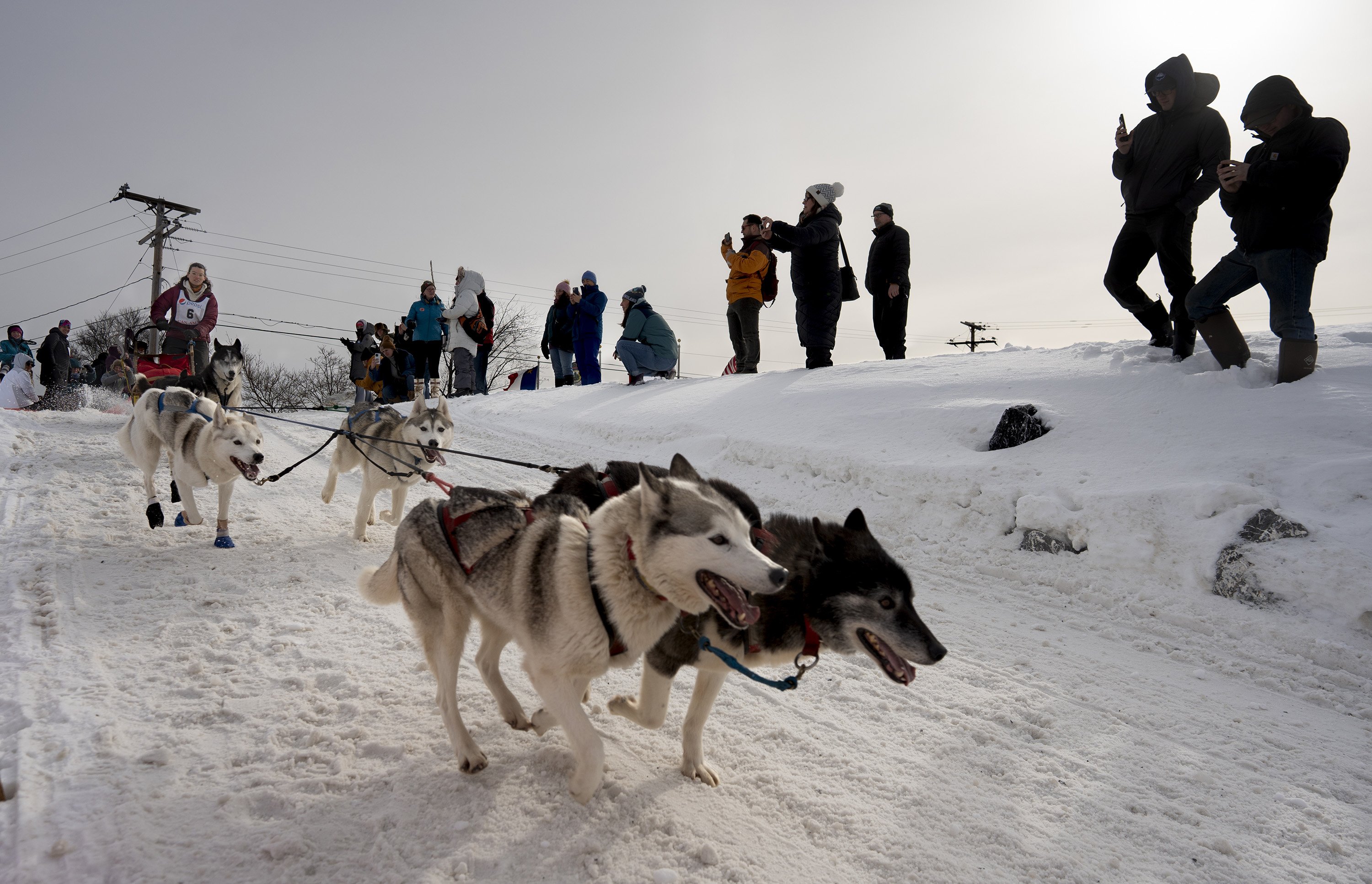
As each team approached the starting line, handlers had to hook the sleds to ATVs to prevent the dogs from bolting down the track. They leapt in the air and pulled the ropes taut. The mushers checked harnesses and spoke to their dogs in low voices that couldn’t be heard over the noise of the crowd.
“Four, three, two, one,” the announcer counted down. “And you’re off! Good luck to ya!”
The handlers let go. The mushers let off the brakes.
The dogs began to run.

OYSTER’S FIRST RACE
The teams launched every couple of minutes — 100-mile racers first, then 30-milers, then the 250.
Mushers waited by dog trailers that lined the side streets and parking lots of downtown Fort Kent. A volunteer carrying a clipboard and a list of required emergency gear went from team to team.
“Snowshoes?” she asked, checking off each item as the musher produced it. “Sleeping bag?”
Alex Gurka rubbed the ears of each dog on her young team. She knelt on the ground next to Turkey Tail, who licked her face.
“Four of them have never done the 100-mile,” said Gurka, a scientist who lives on her blueberry farm in Winn. “This is Oyster’s first race.”
The day was surprisingly warm, nearly 40 degrees. The temperatures softened the trails and slowed the teams. Mushers kept dogs hydrated by mixing their food with water, feeding them meat soups and adding electrolytes to their snacks. The heat kept some from finishing.
At the halfway point, Gurka decided to drop two dogs who seemed hot and continue with the remaining eight. The team was banging against their harnesses and yipping to run, so she kept going. When Moose got tired in the front, Gurka swapped Oyster into the lead.
“He kept looking back at me,” she later said. “That is where you see that relationship shine. You realize they want to work with you and love you.”
After 90 miles, Gurka decided her dogs were done. The volunteers who staffed the last safety station celebrated the dogs with belly rubs. Gurka said she felt proud of their season, even if they didn’t finish the race.
“I don’t want to ruin that trust that I have with my dogs of knowing what decision is best for them,” she said. “The dogs loved getting all the attention for them at the end. We had our own little finish line.”

A FAMILY TRADITION
Minutes before noon on Saturday, Alex Therriault, of Oxford, crossed the finish line of the 30-miler in a T-shirt.
Compared with the longer races, this was more of a sprint. There are no checkpoints.
In the warmest part of the day, Therriault’s dogs ate mouthfuls of snow on the trail. He stripped off his jacket for the last 7 miles as they ran up the final hills. Most teams in the 30-miler were back in Fort Kent within three or four hours.
At the finish, 3-year-old Reed was with his parents and his 1-year-old sister to cheer for Therriault. Reed had been enamored with Therriault since the race last year, when the toddler stuck his hand out at the starting line and caught a high-five from the musher.
They finally got to meet this year at Lonesome Pine Trails, the town’s small ski mountain that hosted the finish line. Therriault introduced Reed to Hero, his lead dog who loves to be carried like a baby. He said the experience was just as meaningful to him as his fourth-place finish.
“His mom said I was his Tom Brady,” Therriault said, beaming. “I don’t think I’ve ever had anybody say something so cool to me in my entire life.”
Once Hero and the rest of the team were fed, Therriault got dinner for himself and closed his eyes in his truck. It wasn’t time for bed just yet, though.
His dad was still on the trail for the 100-miler. Therriault set an alarm for 10:30 p.m. to get back to the finish line.

‘ONLY YOU AND YOUR TEAM’
The Portage Lake Town Office smelled like spaghetti sauce.
As dusk approached on Saturday, volunteers stirred pots and filled baskets with savory rolls for the 250-milers who would soon arrive. The teams in that race have to rest a total of 17 hours across four checkpoints. Portage Lake is the first.
The sun was low in the overcast sky when the siren at the fire station announced to the whole town that the first team had reached the frozen lake. A runway of red blinking lights marked their path.
Easy to spot in her coyote fur hat, Sarah Brooks has been running the Portage checkpoint for at least 15 years. She greeted each musher by name as they completed the 4-mile stretch across the ice.
“Good job, Amy!” she shouted as Dionne arrived. “She’s from Maine, guys, give her a hand!”
A knot of volunteers and spectators cheered. Two little girls clutched stuffed animals — one husky, one fox — purchased earlier that day on Main Street.
Handlers gripped the ropes to help the teams make their way to the field for their break. Otherwise, the Can-Am rules say the mushers must be self-sufficient, similar to longer races in Alaska.
“In the lower 48, it’s the race that is as close as it gets to running the Iditarod,” said Rémy Leduc, a New Brunswick musher who has run the 250-miler many times.
“It’s only you and your team.”

FROM HANDLER TO FIANCÉ
As the 250-mile teams bedded down in Portage Lake, a couple dozen spectators gathered at the base of Fort Kent’s small ski mountain. They trained their eyes on the pitch-black woods, where a flicker of light would signal the approach of the first finisher in the 100-mile race.
A headlamp on the hill drew fans from their seats at the bar in the lodge. Mélodie Beauchemin finished at 9:40 p.m., followed within 15 minutes by two more mushers. All three traveled to the race from Quebec.
Inside, the lodge was broadcasting the high school state championship basketball game at the Augusta Civic Center, where Fort Kent was holding on to a slim lead over Maranacook as the clock dwindled. The crowd cheered, as mushers kept crossing the finish line and the boys team won their first-ever title.
Fayth Weed rounded the last corner and crossed the finish line at 11:02 p.m.
She was confused when the race marshal asked her to step away from her sled — until she saw Nate Priebe on one knee.
Her partner had given her uncharacteristic advice at the halfway checkpoint: “You can’t scratch.” Only when he proposed did she understand why he needed her to get to the finish line.
She said yes.
“He got promoted from handler to fiancé,” said Weed, a flight nurse and veterinary technician from Manchester, New Hampshire.

‘HOLD ON’
On Sunday, Dionne — a paramedic from Madawaska — and fellow mushers in the 250-miler were still between remote checkpoints, accessible only by snowmobile trails or bumpy logging roads.
That morning, teams from the two shorter races were at an awards breakfast, where Weed was exhausted and jubilant.
There’s an important tradition in sled dog racing. The final musher receives a red lantern — a symbol that all teams have safely returned. Weed received the ceremonial trophy at an awards breakfast at Lonesome Pine Trails for the two shorter races.
“Which is more important?” race marshal John Pelletier asked, as she wound her way through clapping friends. “This?” He held up the red lantern. “Or that?” He pointed to her sparkling engagement ring.
Weed laughed and put a finger to her lips.
The 30-mile and 100-mile races finished Saturday, but the 250-mile was not over until Tuesday morning. Dionne finished at 1:21 p.m. Monday, coming in fifth.
Weed also leads the medical team. Instead of going home, she set out to visit checkpoints, cheer for friends and eat French-Acadian flatbreads, called “ployes,” made by volunteers. She has been running sled dogs since she was in middle school. A woman who groomed her family’s collie also had a pack of Siberian huskies.
She put Weed on a sled and said: “Hold on.”
She never let go.

We invite you to add your comments. We encourage a thoughtful exchange of ideas and information on this website. By joining the conversation, you are agreeing to our commenting policy and terms of use. More information is found on our FAQs. You can update your screen name on the member's center.
Comments are managed by our staff during regular business hours Monday through Friday as well as limited hours on Saturday and Sunday. Comments held for moderation outside of those hours may take longer to approve.
Join the Conversation
Please sign into your CentralMaine.com account to participate in conversations below. If you do not have an account, you can register or subscribe. Questions? Please see our FAQs.