

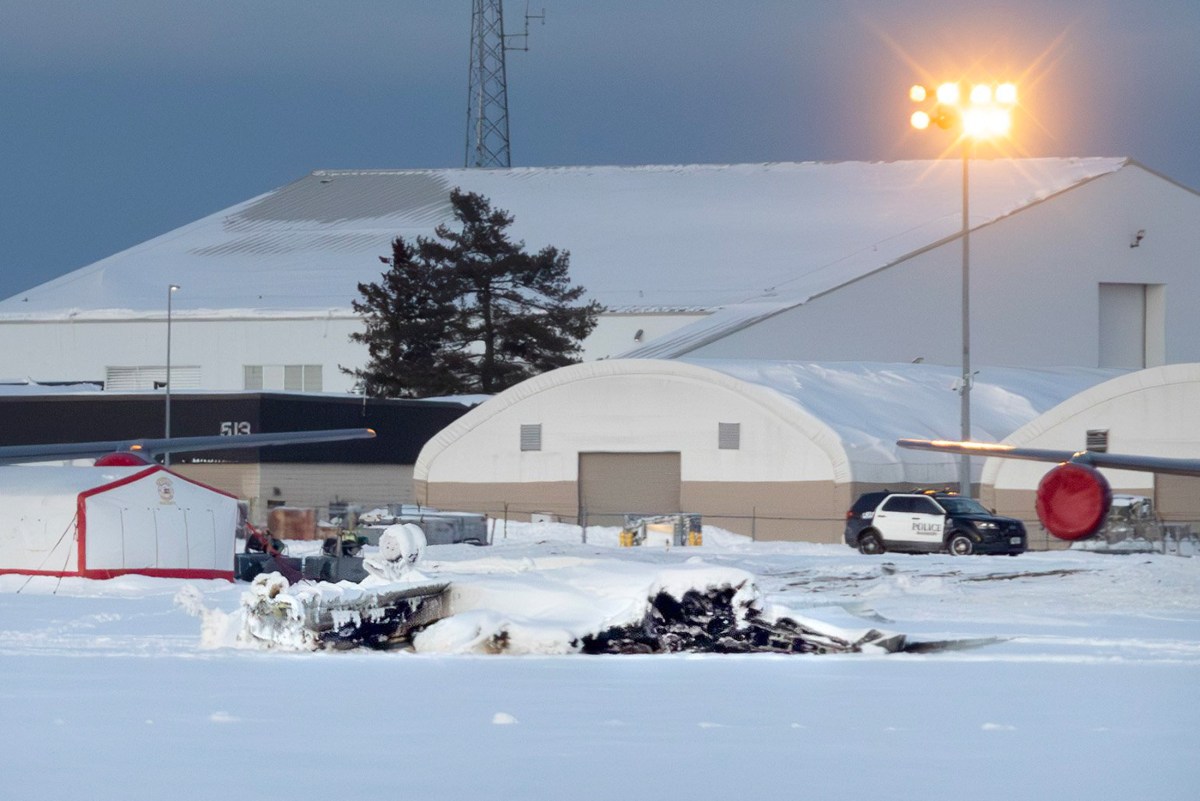
A plane that crashed in Bangor in January sat for longer than the recommended time between deicing and attempting takeoff, federal investigators said Friday.
The plane, on its way to France from the Bangor International Airport, exploded several times as it struck the ground, investigators with the National Transportation Safety Board said in their preliminary report into the crash.
The accident occurred as a major snowstorm swept over New England the evening of Jan. 25. All six onboard were killed, marking Maine’s deadliest passenger plane crash since 1985.
At seven pages in length, the NTSB’s initial report includes factual details, including a timeline of the minutes leading up to the crash, but it does not point to any probable cause. That will come in the final report, which could take as long as two years to produce, the board has said.
The plane was a Bombardier CL-600-2B16 with the tail number N10KJ.
In the days following the crash, aviation safety experts said that this model of aircraft has a history of issues with ice buildup on its wings — which has factored into previous crashes.
THE MINUTES BEFORE IMPACT
Crews began to deice the airplane just before 7:20 p.m., applying two types of deicing fluid.
The second and final round of deicing began at 7:27 p.m., marking the start of what’s known as “holdover time” — an estimation of how long deicing fluids will remain effective, depending on weather conditions. Deicing concluded just before 7:31 p.m., according to Friday’s report.
The plane then sat for 4 minutes and 51 seconds before taxiing from the deicing pad to the runway just before 7:36 p.m. At that point, more than eight minutes had elapsed since the start of the second round of deicing.
At about 7:40 p.m., a tower controller asked the plane’s crew whether they were ready to take off. The copilot gave an affirmative answer two minutes later, and was cleared for takeoff shortly afterward, the NTSB said.
In wintry conditions like the ones pilots were experiencing that night, the Federal Aviation Administration recommends that no more than nine minutes pass between the start of deicing and attempting to takeoff, according to the NTSB report.
Flight data indicate that the plane’s wheels lifted off just after 7:44 p.m. By then, it had been about 17 minutes since the final round of deicing began, the NTSB said. That’s nearly twice the FAA’s recommendation.
As it attempted takeoff, the plane rolled until its wings were nearly perpendicular with the runway, according to Friday’s report. It appeared to hit an altitude of less than 40 feet before returning to the ground.
Multiple closed-circuit TV cameras recorded the takeoff, the NTSB said.
“Several of these cameras showed the airplane impact the ground followed by multiple explosions as the impact sequence progressed,” investigators wrote.
There was no evidence that flight controls malfunctioned or failed before the crash, the NTSB said.
THOSE ON BOARD
The Bangor Police Department last month identified those on board.
Four were from Texas: Tara Arnold, 46, Jacob Hosmer, 47, Jorden Reidel, 33, and Shawna Collins, 53. The two others — 34-year-old Shelby Kuyawa and 43-year-old Nick Mastrascusa — were both from Hawaii, police said.
Reidel and Hosmer were identified as the crew, but it is not clear who was pilot and who was copilot. Friday’s report did not name any of those on the flight.
As the airplane taxied to the runway, the two crewmembers discussed holdover times, according to cockpit voice recordings reviewed by the NTSB.
The pilot said it was “standard” to have between 14 and 18 minutes, and he suggested that the plane would need another round of deicing if they waited for more than 30 minutes.
“The copilot concurred,” investigators wrote.

Comments are not available on this story. Read more about why we allow commenting on some stories and not on others.
We believe it's important to offer commenting on certain stories as a benefit to our readers. At its best, our comments sections can be a productive platform for readers to engage with our journalism, offer thoughts on coverage and issues, and drive conversation in a respectful, solutions-based way. It's a form of open discourse that can be useful to our community, public officials, journalists and others.
We do not enable comments on everything — exceptions include most crime stories, and coverage involving personal tragedy or sensitive issues that invite personal attacks instead of thoughtful discussion.
You can read more here about our commenting policy and terms of use. More information is also found on our FAQs.
Show less