

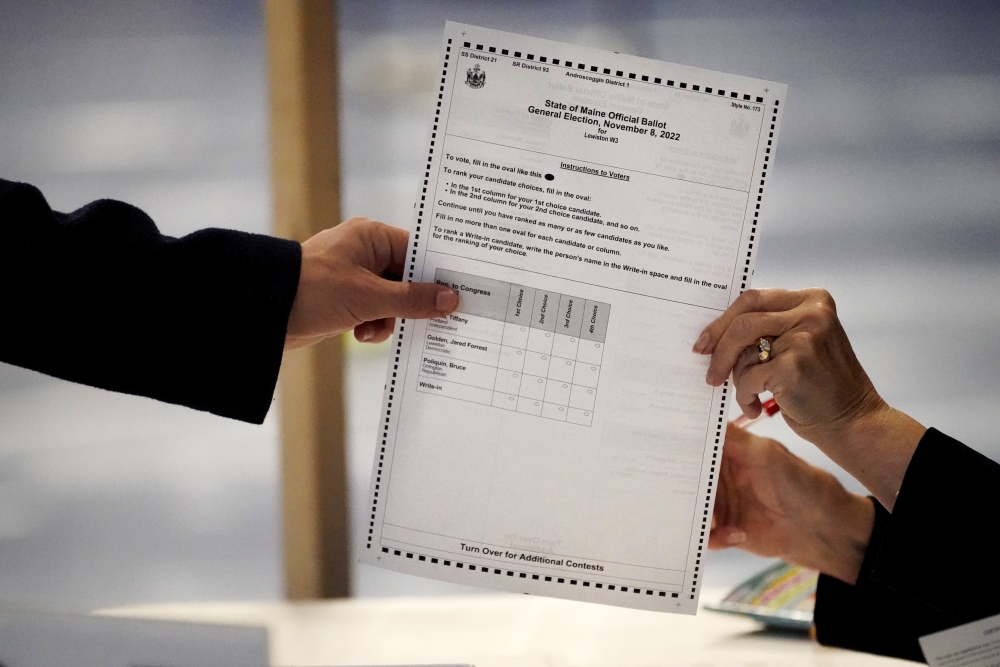
Will Maine expand ranked-choice voting to this November’s gubernatorial and state legislative races, or is that an unconstitutional change?
The Maine Supreme Judicial Court could settle that debate as soon as next month when it hears arguments tied to a proposal before the Democratic-controlled Legislature to allow ranked-choice voting in the fall races that will determine the balance of power in Augusta.
Various interested parties, including the state’s top legal official, Attorney General Aaron Frey, filed about a dozen briefs last week with the court either in support of or opposed to changes to the system that Maine voters first approved in a 2016 referendum. The state’s high court is scheduled to hear oral arguments April 1.
In a ranked-choice election, voters are allowed to rank the candidates in order of preference. If no one gets more than 50% after a first tabulation, the last-place finisher is eliminated, that person’s second-choice votes are reallocated to the remaining candidates, and the results are retabulated. This process continues — with candidates eliminated from the bottom up and their votes reallocated — until one accumulates more than 50% of the vote and is declared the winner.
If justices indicate approval for the ranked-choice changes, lawmakers will have to move swiftly to pass a proposal to expand the system to this fall’s gubernatorial and legislative races before the Legislature’s mid-April adjournment target. The House already gave the bill an initial OK.
Here’s what you need to know about ranked-choice voting, and how it could change later this year.
When did Maine first create ranked-choice voting?
Maine became the first state in the country to approve ranked-choice voting, or RCV, for state and federal elections when voters passed a 2016 referendum by a 52% to 48% margin. Lawmakers had toyed with ranked-choice voting proposals since the early 2000s, while the state’s largest city of Portland began using it at the local level in 2011.
The 2010 governor’s race, in which Republican Paul LePage narrowly beat independent Eliot Cutler by receiving 38% of the vote, motivated RCV supporters who felt “spoiler” candidates were affecting races.
The 2016 referendum was hardly the last word on the system. The Supreme Judicial Court issued a unanimous opinion in 2017 that said RCV would conflict with the Maine Constitution’s provision that says the candidate that wins a plurality, or the largest number of votes, is the winner in a statewide race.
A bipartisan mix of state lawmakers backed an RCV repeal proposal that eventually morphed into a measure that promised to delay the start of the new system until 2021 — and then repeal it unless a constitutional amendment fixed the issue.
But RCV supporters, led by former Sen. Dick Woodbury, an independent from Yarmouth, nixed that measure in a 2018 people’s veto, paving the way for the ranked-choice voting system to be used in Maine’s elections that year.
Has RCV ever swung an election in Maine?
U.S. Rep. Jared Golden, D-Maine, won election to Maine’s 2nd District thanks to a 2018 runoff that also served as the country’s first congressional race to use ranked-choice voting.
Golden and the two-term Republican incumbent at the time, U.S. Rep. Bruce Poliquin, were tied at about 46% of the vote in the initial round of that November’s general election — though Poliquin led by roughly 2,600 votes — while independents Tiffany Bond and William Hoar received a combined 8%.
The instant runoff later that month only took a few minutes, eliminating the independents and reallocating their supporters’ ranked choices to ultimately give Golden about 50.5% of the vote compared to Poliquin’s 49.5%, or a roughly 5,500-vote difference.
Poliquin sued to try to reverse his defeat, but a federal judge in Bangor and a Boston-based appeals court rejected the challenge. Poliquin did not ask the U.S. Supreme Court to hear his case. Maine Republicans have largely opposed RCV and point in particular to Poliquin’s defeat.
What is the latest proposal to expand ranked-choice voting in Maine?
Although it has been in use for state-level primaries with more than two candidates, Maine’s RCV system has remained limited to federal races during general elections. (In 2020, Maine also first started using the system for presidential elections.)
Sen. Cameron Reny, D-Bristol, put forward a proposal to expand the system to general elections for governor and state legislators by changing definitions in current law to define the winner of a ranked-choice contest as also the plurality winner. Notably, this proposal would not need the required two-thirds approval from lawmakers to change the Maine Constitution.
Though most Democratic lawmakers approved the bill last year, members recalled the measure from Gov. Janet Mills’ desk after hearing the Democrat, who is termed out and running for the U.S. Senate this year, planned to veto it. Last month, lawmakers asked the Supreme Judicial Court to weigh in.
Who supports Maine’s ranked-choice voting expansion? Who opposes it?
The most notable figure to submit a brief to the Supreme Judicial Court last week was Frey, the Democratic attorney general who came out against Reny’s proposal by saying it makes “entirely cosmetic changes” to the existing law.
“For the Legislature to go forward with such a plan without the blessing of the Justices would cause chaos in an election cycle already facing unprecedented threats of federal interference,” Frey added, while alluding to President Donald Trump’s call to “nationalize” elections.
Nothing has changed since the Supreme Judicial Court’s 2017 anti-RCV opinion, Frey argued, and he said a 2022 Alaska Supreme Court ruling in support of RCV should not factor into the Maine case. Frey is aligned with the Republican National Committee, which submitted a brief to argue Reny’s bill would violate the Maine Constitution’s existing plurality requirement.
The Legislature’s top two Democrats, Senate President Mattie Daughtry of Brunswick and House Speaker Ryan Fecteau of Biddeford, want the expansion to happen. Their attorneys submitted a brief Friday to argue Golden’s 2nd District race in 2018 “identified the will of the people by counting all the votes to determine their preferences using ranked choice voting.”
Other supporters, such as the Maine Women’s Lobby and League of Women Voters, pushed back on Frey’s assertion that the Alaska high court decision from 2022 does not matter. After Alaska voters in 2020 approved ranked-choice voting for general elections, the state’s supreme court upheld the system and said Maine made a mistake by treating each ranking and runoff tally as separate elections.
“The People of Maine—both by direct initiative and through their elected representatives—have repeatedly expressed an overwhelming desire to use ranked-choice voting to elect their leaders,” attorneys for the League of Women Voters of Maine wrote in their brief.
When does Maine need to print November election ballots?
The office of Secretary of State Shenna Bellows, a Democrat, took no official position in its brief to the Supreme Judicial Court. Deputy Secretary of State Julie Flynn, who has administered Maine elections since 1995, wrote that Maine has the necessary election infrastructure in place to conduct a ranked-choice tabulation for any general election.
To print ballots in time for the Nov. 3 general election, Flynn said the office needs a final court decision by Aug. 25.

We invite you to add your comments. We encourage a thoughtful exchange of ideas and information on this website. By joining the conversation, you are agreeing to our commenting policy and terms of use. More information is found on our FAQs. You can update your screen name on the member's center.
Comments are managed by our staff during regular business hours Monday through Friday as well as limited hours on Saturday and Sunday. Comments held for moderation outside of those hours may take longer to approve.
Join the Conversation
Please sign into your CentralMaine.com account to participate in conversations below. If you do not have an account, you can register or subscribe. Questions? Please see our FAQs.