

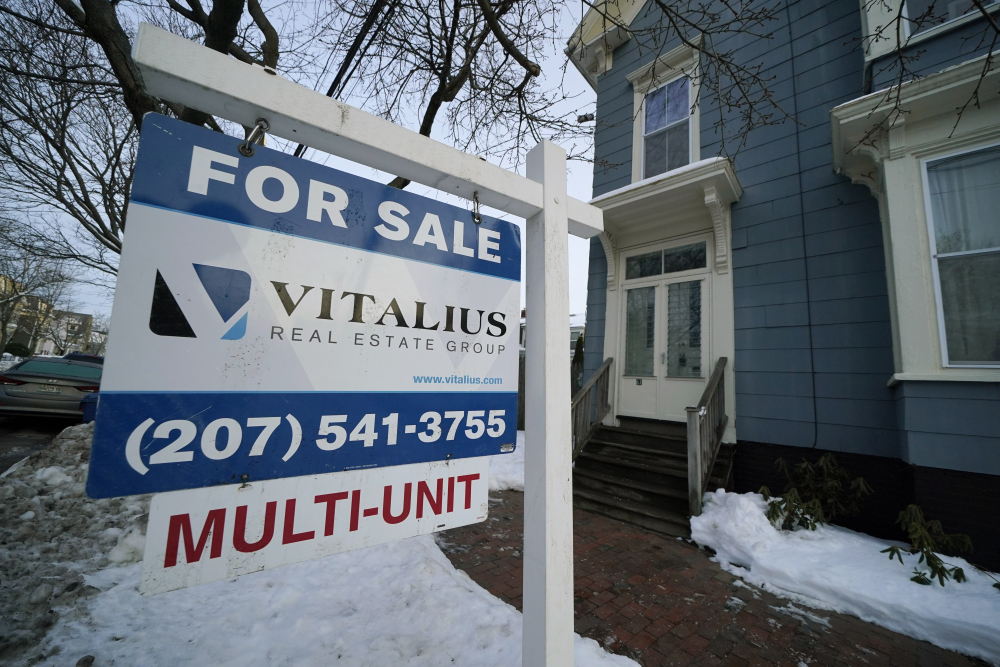
If Maine’s real estate market got off to a sluggish start in January, it slowed to a snail’s pace in February.
Last month, Maine real estate agents sold the fewest number of homes since at least the pandemic (and possibly ever), despite an overall increase in inventory and prices that, while still high, are showing signs of leveling out.
Data released Tuesday by the Maine Association of Realtors suggests it hasn’t been an auspicious start to the year, but a better spring market could be on the horizon.
Here are three takeaways from the February sales report.
S-L-O-W
Just 691 homes changed hands last month, an almost 9% decrease from February 2025. Prices increased to a median of $395,000, about 3.5% above the prior year.
The median means that half of the homes sold for more while half sold for less.
January, February and March historically are the slowest months for Maine’s seasonally driven housing market, but last month’s numbers were the first time since at least 2019 that agents sold fewer than 700 homes.
It wasn’t immediately clear if it was the fewest on record, but home sales generally started slowing down during the pandemic.
Maine’s low inventory has not helped spur more sales, but the 3,484 homes on the market last month — while a smidge fewer than the 3,769 in January — is significantly higher than it was even a year ago when there were 2,902 homes listed, according to data from the Federal Reserve Bank of St. Louis.
Comparatively, the state’s for-sale inventory hit an all-time low of 1,550 in March 2022, when 1,031 homes were sold.
Homes are lingering on the market for longer, with an average of 47 days in February, up from 40 days in February 2025 and up from the record-low six days in June 2023, according to data from MaineListings.
That’s not necessarily bad news for Maine’s prospective homebuyers.
Judy Oberg, president of the Maine Association of Realtors, said the data indicates that more buyers and sellers are negotiating and that some parts of the state may be returning to a more even keel.
LOWER RATES
There are other bright spots on the horizon.
Mortgage rates in February dipped below 6% for the first time since 2022 and were a full percentage point below this time in 2024, according to mortgage buyer Freddie Mac.
Rates have since stabilized at 6%, “spurring activity from buyers, sellers and owners,” Freddie Mac said in a news release. “As a result, refinance activity is up and purchase applications are ahead of last year’s pace.”
Prices may also be on their way down.
The Maine Association of Realtors also looks at three months of data in county-by-county comparisons to get a larger sample size of sale transactions.
During the last rolling quarter, prices inched downward by just over 1%. The median home sale price from Dec. 31 to Feb. 28 was $389,000, compared to $393,000 over the same span the year before.
Prices also decreased for more than half of Maine’s 16 counties during that period, with Washington County’s median of $192,000 representing an almost 13% decrease, the sharpest in the state.
Washington County also saw the biggest drop in sales, with a roughly 19% decrease.
NOT OUT OF THE WOODS
While things are trending in an encouraging direction for home-buying hopefuls who may have been sidelined over the last few years, Lawrence Yun, chief economist for the National Association of Realtors, urged caution.
Maine’s sales figures were a more dramatic version of the national trend of increasing prices and dwindling sales.
The median home sale price across the country was $401,800 last month, the National Association of Realtors reported Tuesday, a 0.2% increase from the year before. Sales fell by 1.1%.
Regionally, prices in the Northeast increased just over 3% to a median of $479,800, while sales decreased about 4%.
“There is a long way to go to return to pre-pandemic levels of transaction activity. There are more than 6 million more jobs than in 2019, yet home sales per year are down by 1 million,” Yun said.
Inventory is growing, he said, but not fast enough.
“If demand picks up notably in the coming months and outpaces supply growth, home prices will inevitably rise,” he said. “That is why increasing supply is so important to help limit home price growth, improve housing affordability and boost transactions.”

We invite you to add your comments. We encourage a thoughtful exchange of ideas and information on this website. By joining the conversation, you are agreeing to our commenting policy and terms of use. More information is found on our FAQs. You can update your screen name on the member's center.
Comments are managed by our staff during regular business hours Monday through Friday as well as limited hours on Saturday and Sunday. Comments held for moderation outside of those hours may take longer to approve.
Join the Conversation
Please sign into your CentralMaine.com account to participate in conversations below. If you do not have an account, you can register or subscribe. Questions? Please see our FAQs.