

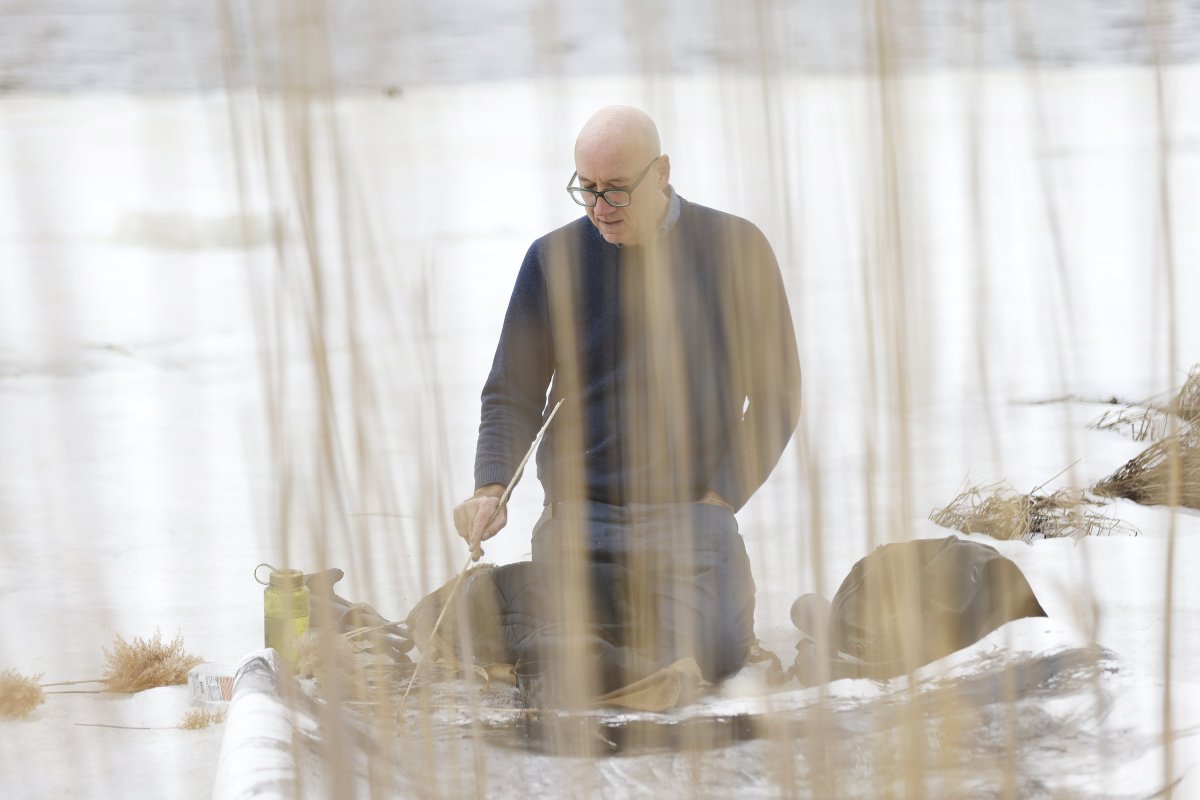
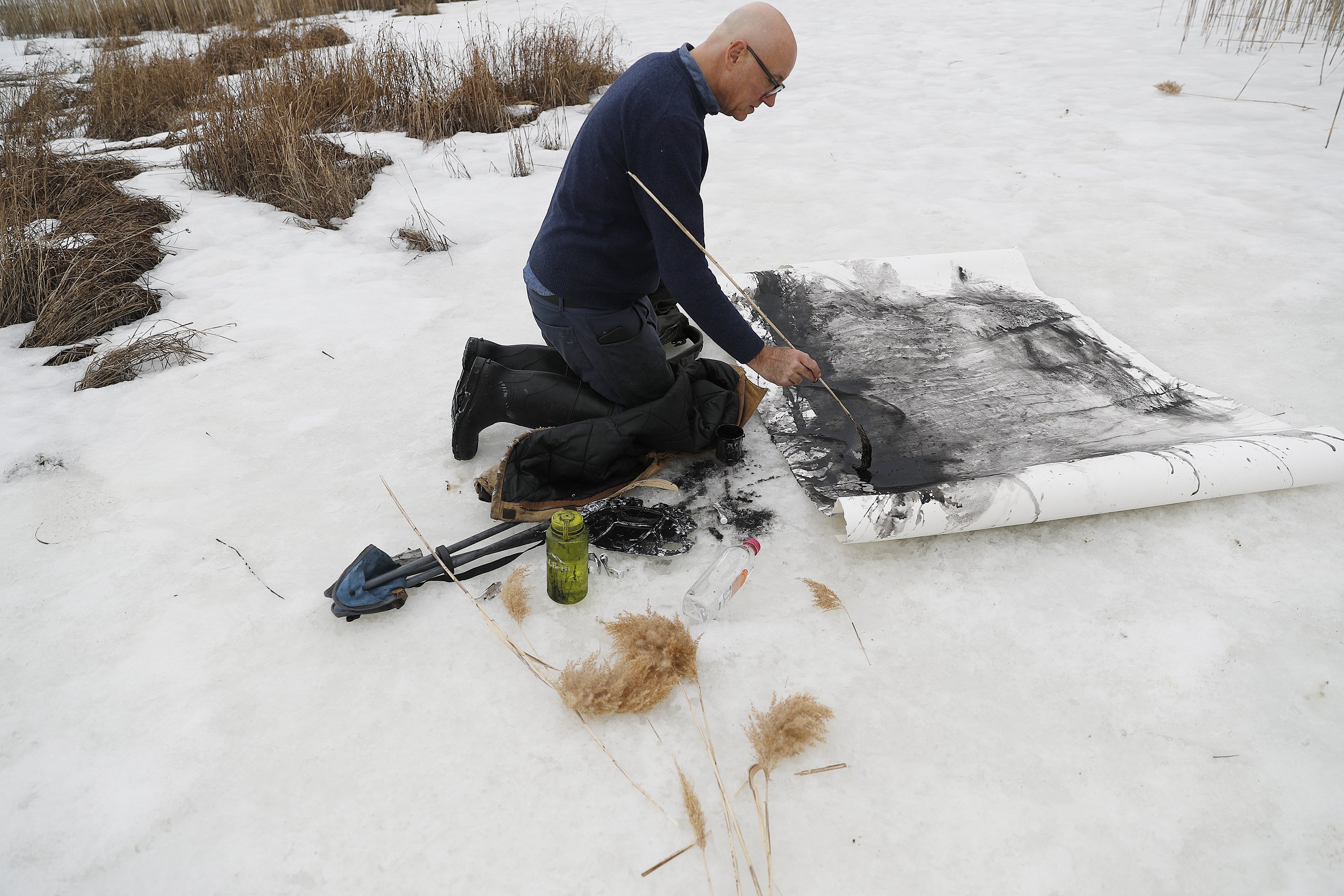
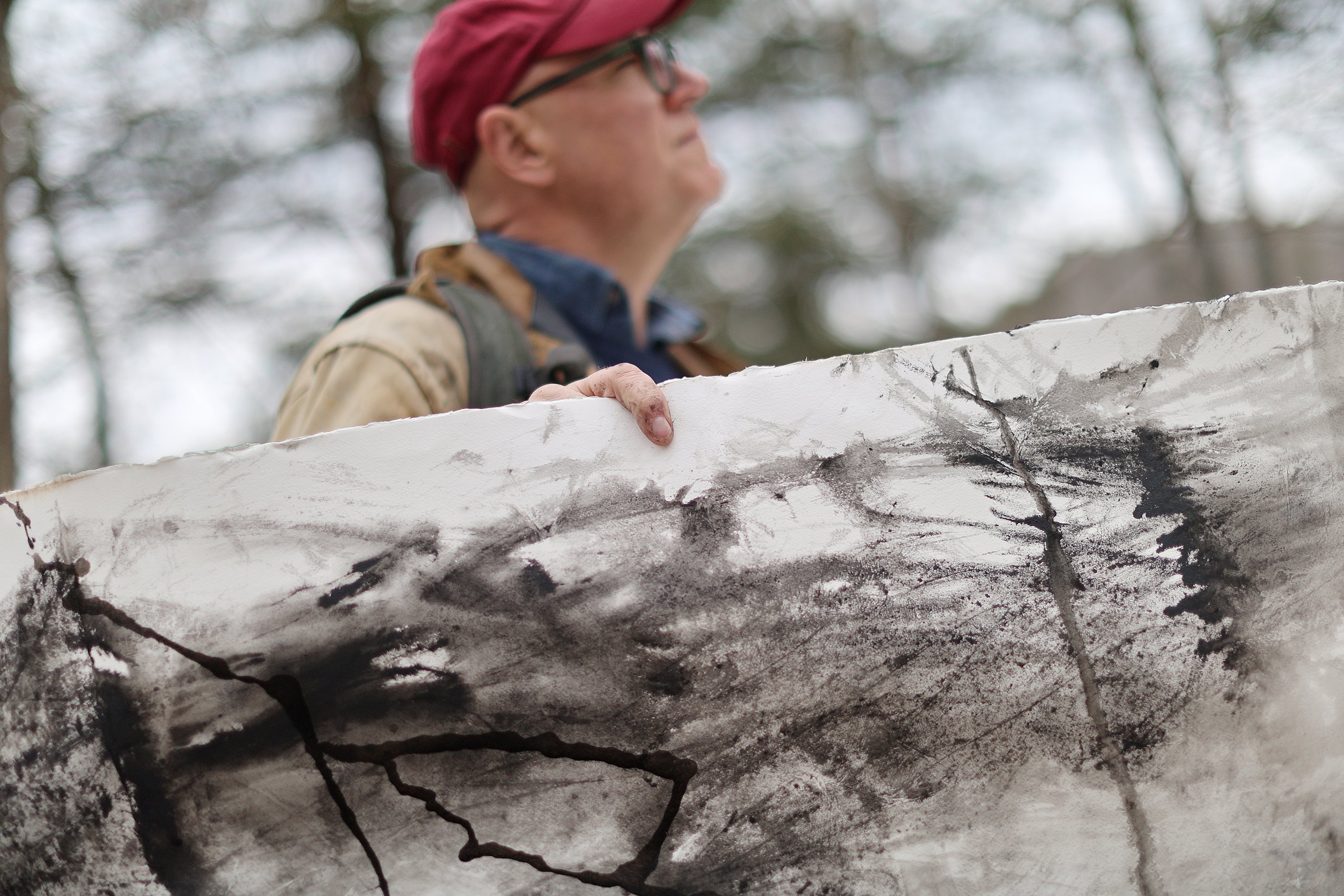
YARMOUTH — Mitchell Rasor is kneeling on some ice near the Royal River, with a piece of marsh reed in his hand. He uses his 30-year-old barn coat as a mat, to keep the ice from soaking his pants.
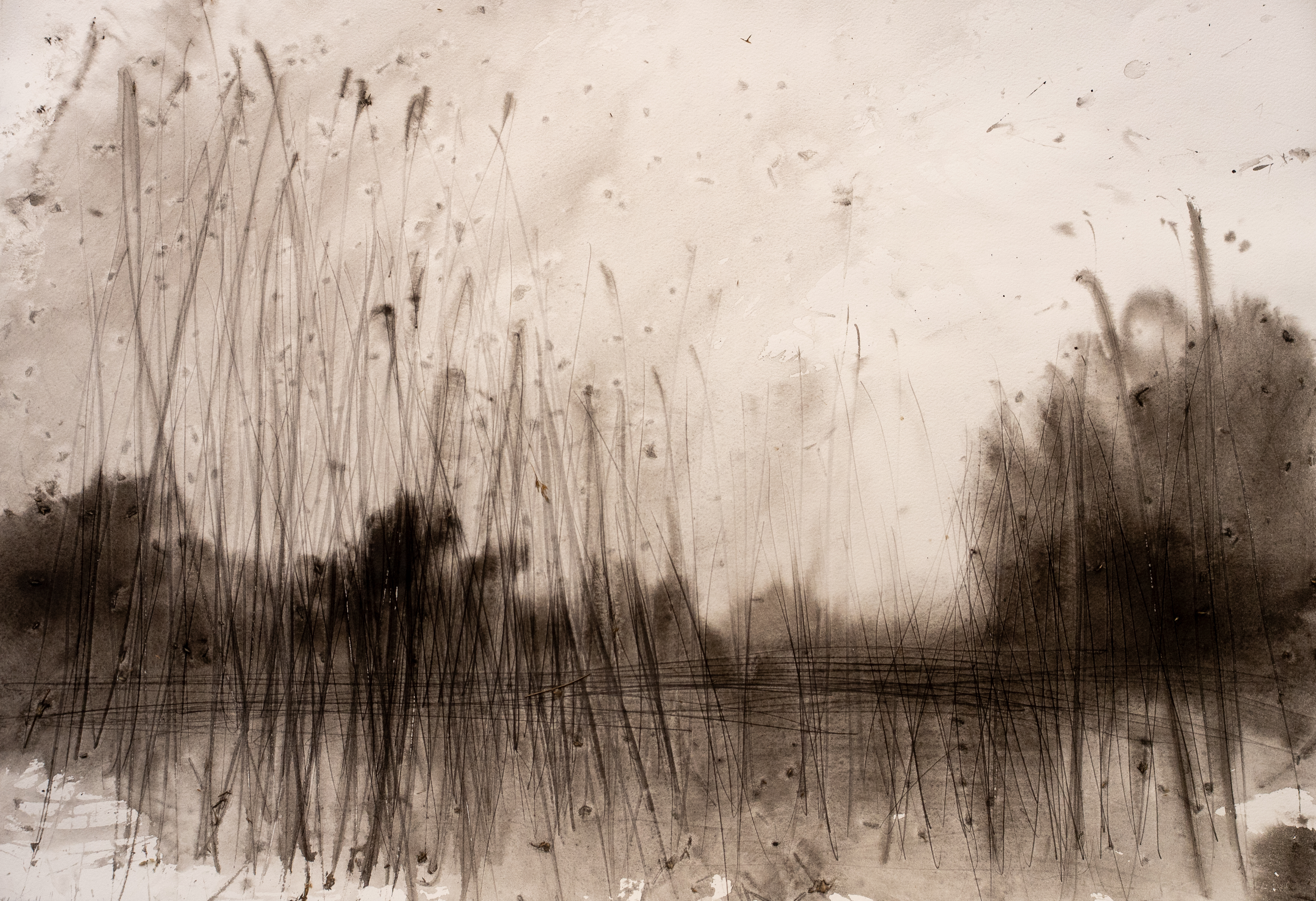
He dips the brush-like flowering end of the reed into black watercolor paint and strokes dark lines onto a thick paper canvas, capturing the essence of the plants and trees in front of him. Sometimes he uses water from the marsh, which in winter can create little ice crystals on his art. Sometimes the seeds from the marsh plants, called phragmites, get embedded in the paint.
“There’s a level of uncertainty and I have to embrace that,” said Rasor, 58. “On any given day, depending on the temperature or the wind, the drawing becomes a record of that moment.”
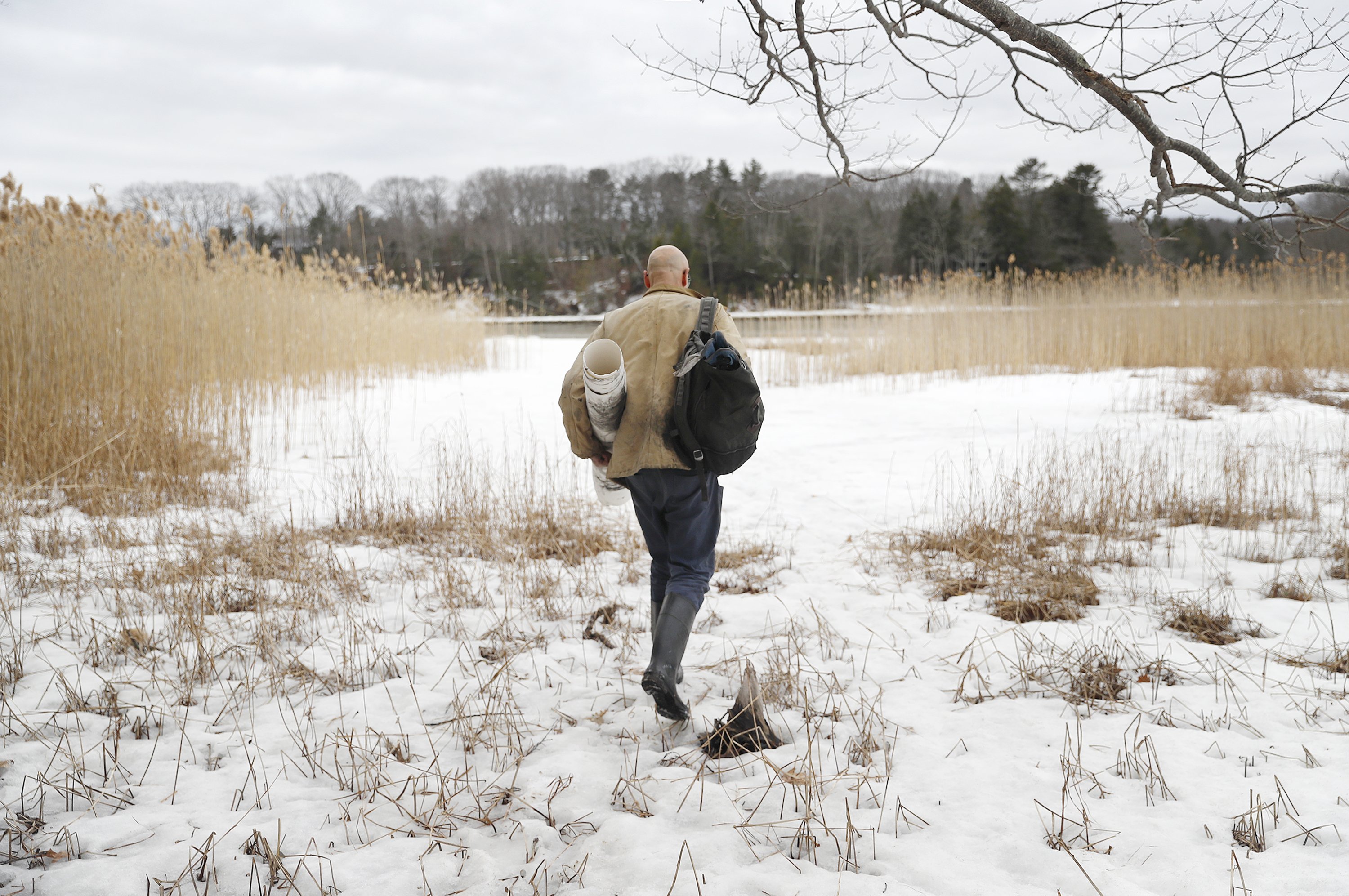
Rasor, a landscape architect, artist and musician, has been creating his salt marsh art along the Royal River for about four or five years. Just about every day in winter, he drives a few minutes from his Yarmouth home, parks at the Spear Farm Estuary Preserve and drags his painting supplies and paper canvases — some are 10 feet long — through the woods and down to the marsh. At low tide he might go knee-high into the water, while he works on a thick floating canvas.
Rasor’s outdoor painting process has been captured in a 15-minute film by Maine filmmaker and former Press Herald reporter Tom Bell, with a soundtrack by Lee Ranaldo of the 90s alt-rock band Sonic Youth. The film, titled “Salt Marsh,” will be shown Sunday, March 29, at 4 p.m. at the Portland Museum of Art. An artist talk with Rasor and a Q&A with Rasor and Bell follows.
The film first screened in Maine last September at the Camden International Film Festival and has played at other festivals and museums. It won best artist film at the Berlin Indie Film Festvial and best original score at the East Village New York Film Festival.
Cinematic process
Rasor says he first thought about creating maybe a 30-second TikTok video to show people how he works in the marsh. But he says Ranaldo, a friend and fellow musician, saw his work online and suggested it might be a good film subject. Bell, a neighbor of Rasor’s, agreed.
“I went down and watched and saw the process had a lot of potential, in terms of being cinematic,” said Bell, who spent parts of three winters working on the film. “Every time I went down there (into the marsh), it was a fresh experience.”
The music in the film is a piece Ranaldo composed during the pandemic, when he was spending time in the Catskill Mountains of New York. He played all the instruments, including piano, guitar, bells, gong, percussion and other string instruments. The music is alternately somber and stirring, capturing in sound the movement of the salt marsh plants in a breeze.
Ranaldo said he loved the way Bell used his music and the way it blends with the visuals.
“I just felt like the music worked perfectly with those landscape views and I loved seeing Mitchell’s process,” said Ranaldo.
Rasor grew up in Rochester, New York, but has been in Maine for more than 30 years. In the 1980s, he was part of the alt-rock band Absolute Grey, a staple of college radio. He still creates and records music, and today his Yarmouth studio contains several of his guitars. He studied at Oberlin College in Ohio and Harvard University in Cambridge, Massachusetts. He teaches at Maine College of Art & Design while working as a landscape architect on design projects in public spaces all over the world.
He’s also created art most of his life, while persuing music and architecture. He calls his salt marsh creations drawings, even though he acknowledges the process is basically water-color painting, often literally in the water.
Sitting in the uncertainty
During the COVID-19 pandemic, Rasor began spending more time outside, especially at the Spear Farm Estuary Preserve. And then he began doing his art there, on very heavy watercolor paper that can float in the water. He embraced the uncertainty of the weather by accepting that sometimes the watercolor would freeze into crystals, sometimes the wind would move the paint or that phragmites seeds would get stuck on the canvas.
Rasor said he started drawing again daily about 10 years ago after going through a divorce, as a way to connect with his feelings and the world. He had been interested in phragmites and marshy spaces since his days in graduate school studying landscape architecture. In the “Salt Marsh” film he talks about how renowned landscape architect Frederick Law Olmstead used marshland to create the Back Bay Fens, part of Boston’s Emerald Necklace park system, in the 1870s.
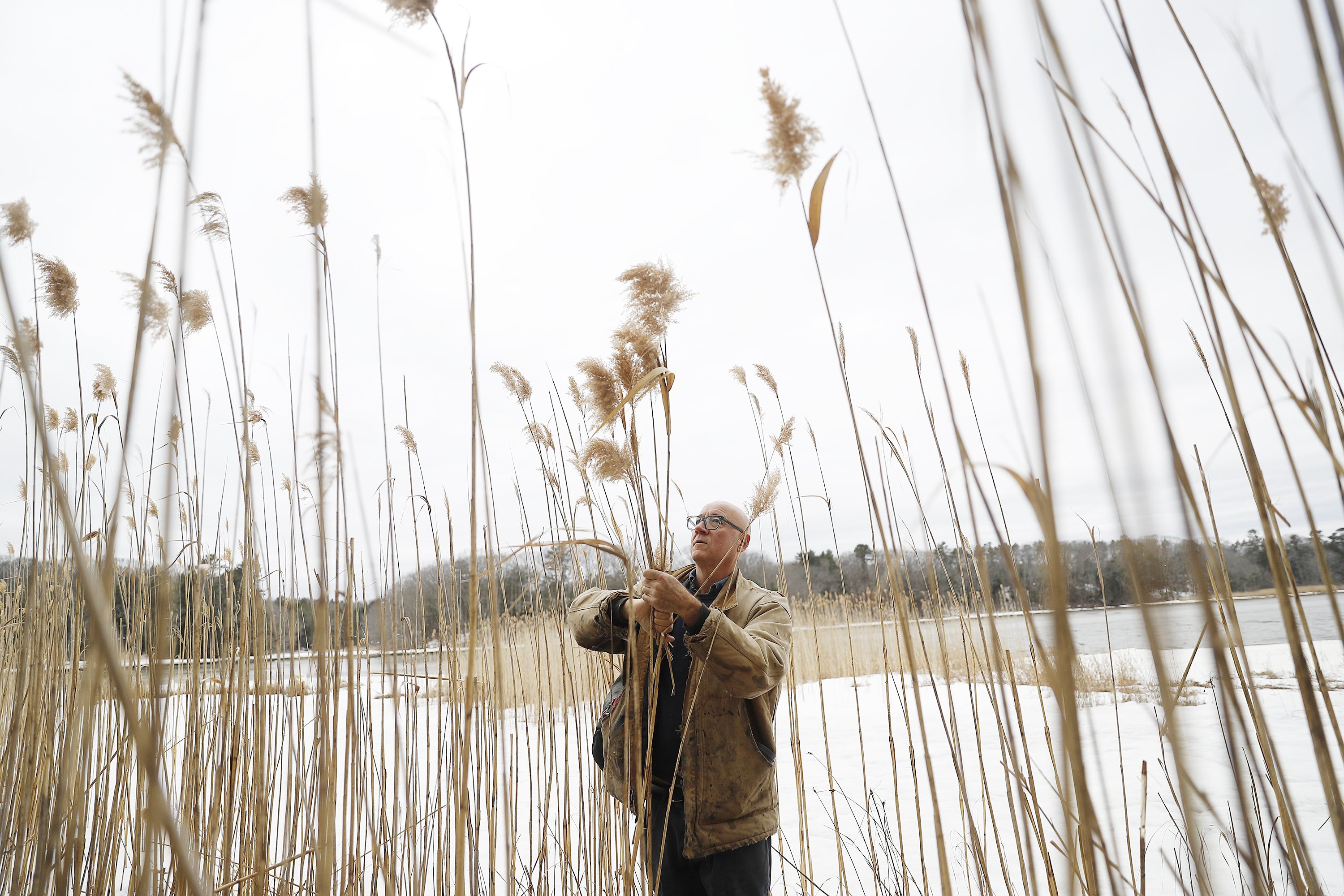
Rasor uses natural paints, and sometimes charcoal, which leave a mess on the snow and ice and but don’t harm the environment, he says. He picks phragmites, which are dormant in the winter and have flowering ends that make nice brushes. The root end of the plant can act like a pen or pencil. When working on a large canvas, maybe 10 feet long, he’ll have to drag it along the ground during his 15-minute walk back to the car. It’s usually too wet to roll up or fold, Rasor said.
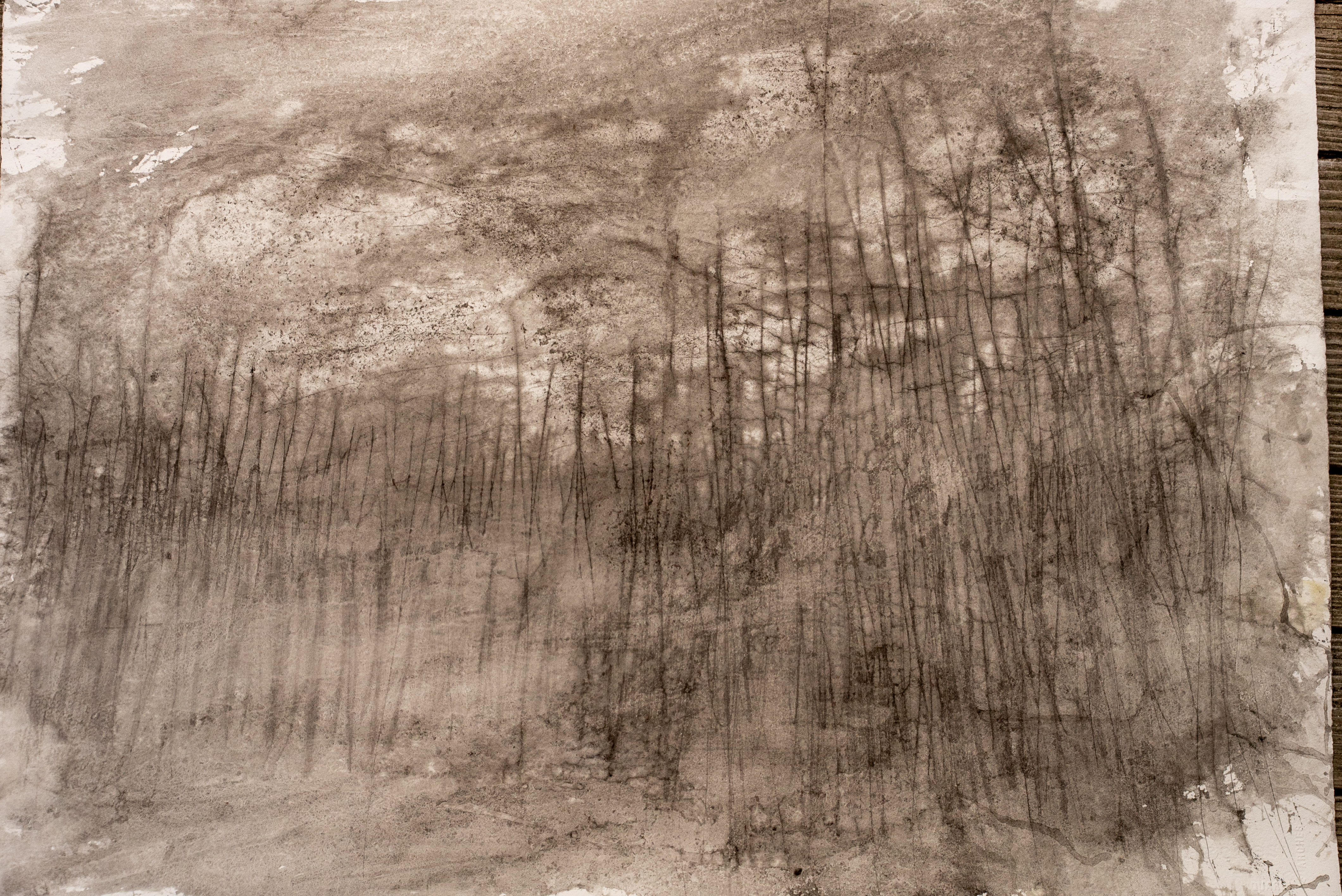
Rasor paints in the marsh largely for the experience, so he doesn’t keep all the work he’s done, especially if he feels they’re not that good. He thinks he’s probably done thousands of scenes over the years, and has kept several hundred in his home. Most are interpretations of the river, marsh and woods around him. He hasn’t shown them at any Maine museums or galleries but some are scheduled to be displayed at the University of Virginia later this year, Rasor said.
“The drawings for me are sort of an exercise in sitting in the uncertainty and sitting in the doubt of what we all have to deal with on a daily basis,” said Rasor. “It became a ritual where I could explore the world and try to understand my place in the world.”

We invite you to add your comments. We encourage a thoughtful exchange of ideas and information on this website. By joining the conversation, you are agreeing to our commenting policy and terms of use. More information is found on our FAQs. You can update your screen name on the member's center.
Comments are managed by our staff during regular business hours Monday through Friday as well as limited hours on Saturday and Sunday. Comments held for moderation outside of those hours may take longer to approve.
Join the Conversation
Please sign into your CentralMaine.com account to participate in conversations below. If you do not have an account, you can register or subscribe. Questions? Please see our FAQs.