

AUGUSTA — A group of about 100 medical cannabis growers and patients gathered Thursday outside the State House to protest the latest proposal to mandate product testing and plant tracking.
What many assume is already required in an industry dubbed “medical” has become the subject of perennial debate in Maine’s cannabis industry. But the latest proposal to enforce stricter safeguards is gathering steam, and garnering fierce opposition in the process.
“This will kill businesses,” said Mark Barnett, policy director for the Maine Craft Cannabis Association.
“This is just for greed,” said Paul McCarrier, a grower in Belfast.
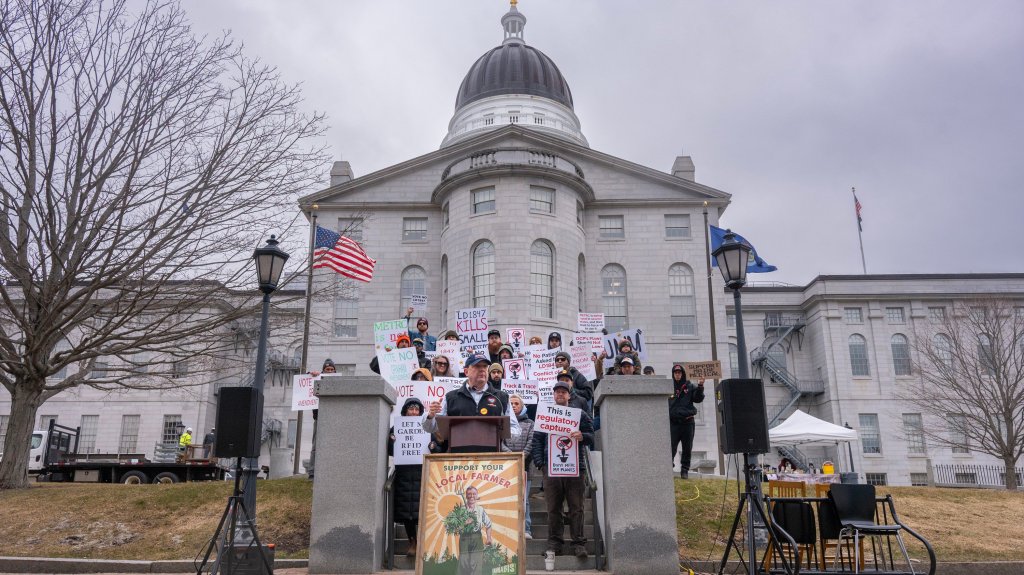
“It’s a giveaway to big corporations,” Troy Jackson, a Democratic candidate for governor, told the crowd.
Maine is the only state with legal medical cannabis that does not require seed-to-sale plant tracking and product testing for mold, pesticides and other contaminants, even though such measures are mandatory in the state’s recreational market. The state Office of Cannabis Policy has the ability to test medical products during some annual dispensary inspections, but even caregivers say that seldom happens.
There have been repeated proposals to require testing and tracking in Maine before. But each has died at the hands of industry opposition and legislators whose campaigns were fueled with cannabis cash.
A new bill put forth this year by Rep. Anne Graham, D-North Yarmouth, aims to unify testing and tracking standards among Maine’s medical and recreational cannabis industries. Unlike previous proposals, which sought to entirely overhaul the medical program, LD 1847 is more tightly focused on testing and tracking.
The bill was voted out of committee with several amendments. Each proposes different ways for the state office to go about implementing testing and tracking. Graham’s amendment, which received the majority report, would implement “batch testing.” Growers would be required to submit at least one sample for testing from each batch to be processed or sold.
Advocates of the bill see it as an issue of crime and public health. In recent years, hundreds of suspected illegal cannabis grows believed to be run by Chinese transnational criminal groups have moved legally into Maine’s sparsely-regulated medical market.
Multiple state law enforcement associations have endorsed the bill, saying it is the most effective way to keep illegal grows out of legal markets.
“Bad actors are succeeding in inappropriately working through the medical use infrastructure due to its lack of testing and tracking requirements,” the Maine Chiefs of Police and Sheriff’s associations said in a joint statement last month.
Testing of some seized product has found high levels of mold and chemicals, while search warrants have found illicit pesticides inside the homes. Without testing and tracking, proponents argue, cannabis could be laundered through Maine’s medical industry and sold to consumers. Some medical business owners have said that’s exactly what’s happening.
The fact that Jackson, a candidate for governor, delivered a headlining speech at Thursday’s protest marked another escalation.
Debate over the issue has long been limited to the Veterans and Legal Affairs Committee, which handles all cannabis legislation at the State House. But by stepping up to the podium Thursday, Jackson signaled the fight is moving further into the political mainstream.
“What they’re asking for is something that is just going to kill this program,” he said. “It’s what I’ve always seen in this building, which is the rich taking more away from the working class. And I say, to hell with that.”
Opponents have raised concerns that requiring testing could consolidate Maine’s cannabis market into the hands of just a few large corporations. Testing cannabis can cost several hundred dollars per test. And in a state with a uniquely high number of small-scale growers, pinning that cost on them could push many out of the market.
“No other industry has to cope with this level of oversight,” said Barnett, the owner of a recreational dispensary in Portland.
Maine has long been the only state in the country where medical cannabis sales outpace recreational, though that gap has narrowed in recent years. The state has also seen what regulators have described as a “mass exodus” of growers from the industry in recent years.
Many at Thursday’s protest held signs calling out Metrc, a software company specializing in cannabis plant tracking. Metrc already tracks sales in Maine’s recreational market.
But many in the medical industry worry about the costs plant tracking would incur, as well as Metrc’s growing reach over the U.S. cannabis market. The company already manages sales in two dozen states across the country.
“Why would we implement a policy that sees small businesses shut down, allowing corporate operators to increase their market share and take in more profit out of our state for their shareholders?” said Elizabeth Hayes, a medical grower in Mercer.
Editor’s note: This story was updated April 3 to clarify that the state Office of Cannabis Policy has the authority to test medical products during some annual dispensary inspections, but it is not required.

We invite you to add your comments. We encourage a thoughtful exchange of ideas and information on this website. By joining the conversation, you are agreeing to our commenting policy and terms of use. More information is found on our FAQs. You can update your screen name on the member's center.
Comments are managed by our staff during regular business hours Monday through Friday as well as limited hours on Saturday and Sunday. Comments held for moderation outside of those hours may take longer to approve.
Join the Conversation
Please sign into your CentralMaine.com account to participate in conversations below. If you do not have an account, you can register or subscribe. Questions? Please see our FAQs.