

Public payphones have all but vanished from most street corners and storefronts across Maine, but a small and uneven network still survives, including state-supported “public interest payphones” or PIPs, and a scattering of older legacy phones that never quite went away.
Although their numbers are few, their value remains significant, especially for people without reliable cell service, without a working personal phone or who need a certain, fail-safe way to call for help.
However, an informal survey of most of the state’s PIPs by the Livermore Falls Advertiser revealed some problems with the mostly aging equipment across the state, including phones that don’t ring, quirky dialing requirements, instruction placards that are illegible and incorrect locations listed on official program information.
The first coin-operated payphone was introduced in 1889 at a bank in Hartford, Connecticut, by inventor William Gray. According to the Smithsonian and early Gray Telephone Pay Station records, Gray’s design shifted public calling away from attendant-operated pay stations and made unsupervised, pay-per-use calling possible for people who did not have a private telephone line.
By the early 20th century, payphones spread to wharves, general stores, train stations and rural crossroads across New England. Island communities in Maine relied on them well into the late 20th century. Cliff Island maintained a public phone at the landing, and longtime residents recall phoning the mainland from the payphone at Whitlock’s Wharf long before cellular coverage reached Casco Bay.
For many, those phones were the only dependable link when fog, storms or ferry delays made communication difficult.
Even as payphones continue serving practical needs in locations where they still exist, many have taken on a secondary life as local curiosities. Visitors might stop to take photos or selfies, documenting the phones as relics of a fading era. There has been mention of turning remaining payphones and public interest payphones into community art installations that also function as emergency phones, merging usefulness with public history.
FILLING A NEED
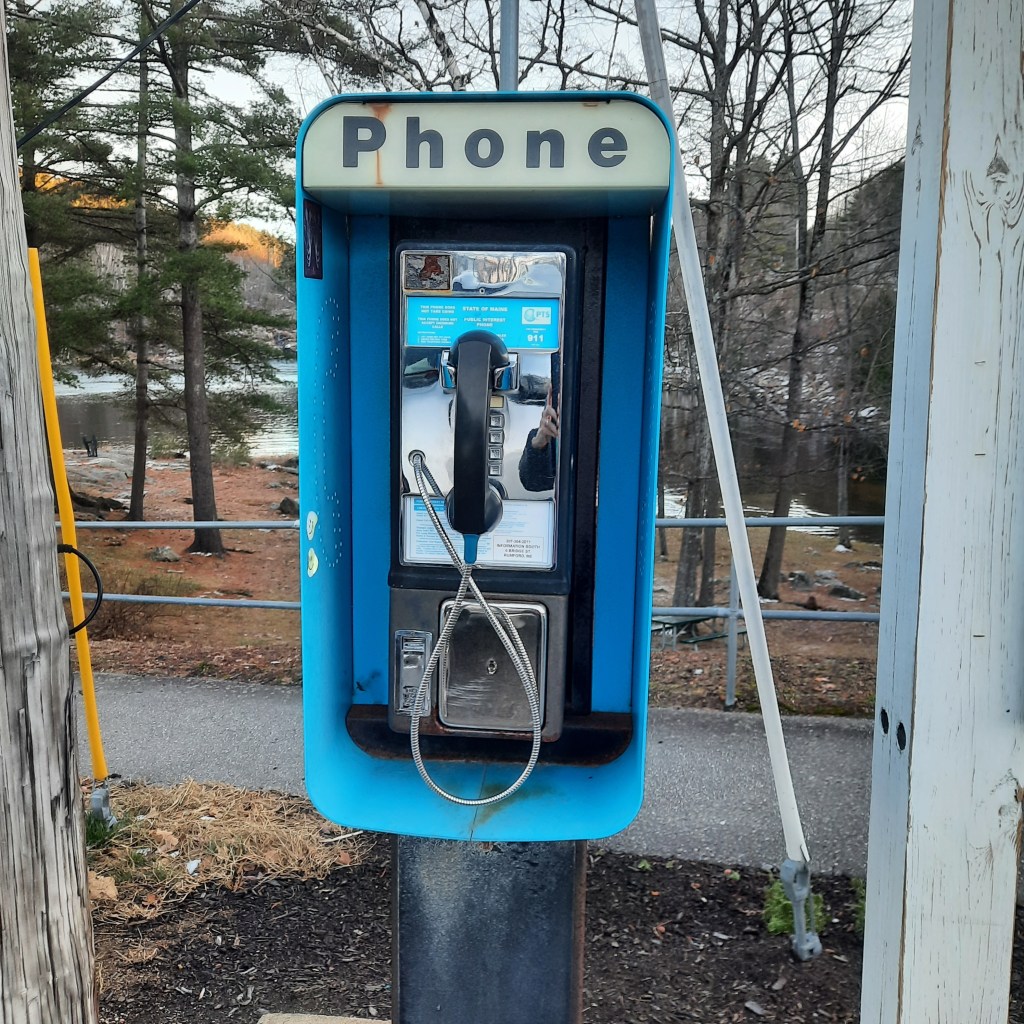
After most commercial payphones disappeared in the early 2000s, the Maine Public Utilities Commission established the Public Interest Payphone (PIP) program. State rules require PIPs to serve locations where landline, cellular or internet access is unreliable, unavailable or financially out of reach.
PIPs are coinless public phones that are required to provide free 911 and local calling, and installed indoors or outdoors at municipal buildings, police stations, libraries, ferry landings and other locations. State law designates them specifically for places where no other public phone exists to meet health, safety or welfare needs.
According to PUC program data, Maine’s 33 operational PIPs cost about $28,000 per year to operate, funded through the Maine Universal Service Fund, which may allocate up to $50,000 annually for PIPs.
PUC records list phones in Fryeburg, Stockton Springs, Cranberry Isles, Machiasport, Raymond, Rumford, Newry, Biddeford and more. Some were newly installed, like at the Bangor Public Library. Others were established as PIPs using the old payphones, such as the longstanding payphone at 10 Jefferson St. in Biddeford in 2016, even though the hardware on the phones was decades old. The program was established by law in 2005 and more have been formally designated since.
PIPs are approved through an application process in which the PUC ranks requests using factors such as income levels in the area, wireless coverage, public welfare considerations and the cost of providing service at the proposed location.
In many rural and coastal areas, cellphone coverage remains unreliable. Residents and visitors also lose phones, run out of battery, cannot afford a device or have service shut off. During storms or power failures, when towers or home Voice Over Internet Protocall systems go down, a PIP may be the only reachable line.
According to PUC rules, if a PIP is removed, a replacement should be installed within 1 mile of the original location whenever technically feasible, ensuring continued access for the surrounding community.
‘NEED TO COMMUNICATE’
Lithgow Public Library in Augusta was recently approved for a PIP. Director Sarah Curra Schultz-Nielsen said the library pursued it because demand is constant among people using the building as a safe, accessible point of contact with the outside world.
“The library serves as a third space for anyone to come and have access to the same things, no questions asked,” she wrote. The library sits “within walking distance of the Kennebec County Jail, the Augusta Emergency Overnight Warming Center, and we are often the first stopping point when (inmates are) being released, and when the overnight shelter closes at 7 a.m.”
Schultz-Nielsen said the library regularly serves “citizens who are chronically homeless, veterans, adults with mental illness and substance abuse disorders,” many of whom must call case managers, probation officers, health providers, family or crisis lines such as 211 and 988.
“There is a need to communicate … that we are not meeting with the library phone,” she said.
The library allows brief calls on its own phones, she wrote, but “longer calls tie up our lines for regular library business and are not allowed.”
She cited Augusta’s 19.4% poverty rate and the 2024 Point-in-Time survey, which recorded 184 people experiencing homelessness across Kennebec and Somerset counties, with about 100 in Augusta.
LEGACY PAYPHONE
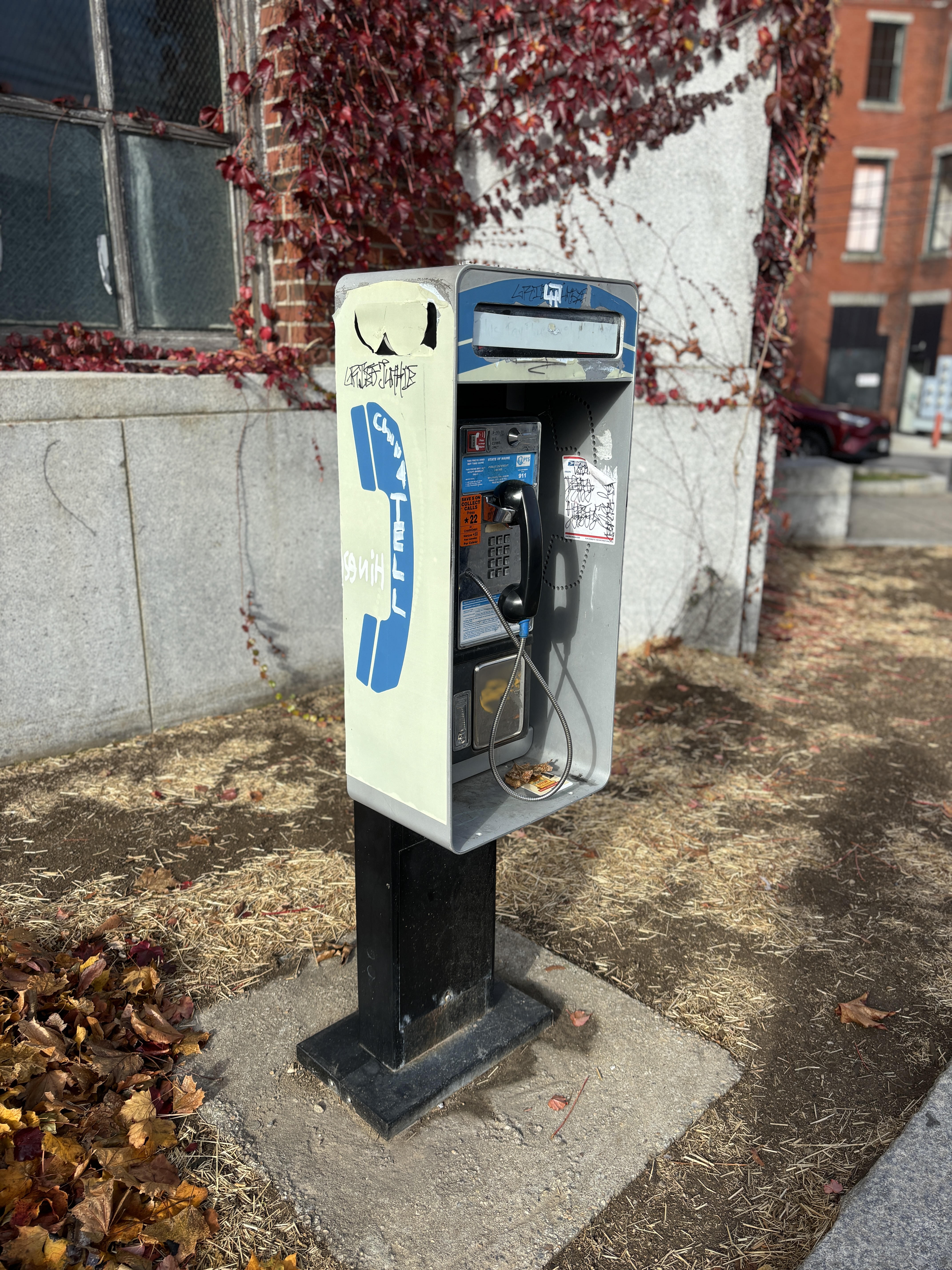
At 10 Jefferson St. in Biddeford, a long-standing legacy payphone has been in place for decades. Danica Lamontagne, assistant to the city manager, said her father remembers the phone from his youth, suggesting it may date to the 1960s or 1970s.
The building at that location is owned by Northern New England Telephone Operations LLC, and the city has no record of installing the phone. Lamontagne said she recently lifted the handset and heard a dial tone, confirming it still works.
“At times, we have folks who come into City Hall and ask to use a phone and we send them to the payphone, but I am not sure who uses it otherwise. I have never personally seen someone using it,” she said.
In 2016, the PUC formally designated the site as a Public Interest Payphone, incorporating an existing payphone into the modern program.
UNRELIABLE EQUIPMENT
In Franklin County, the PIP at the Jay Police Department is mounted outdoors beside the station door. Its metal housing remains intact but its information placard is completely blank, bleached by years of sun.
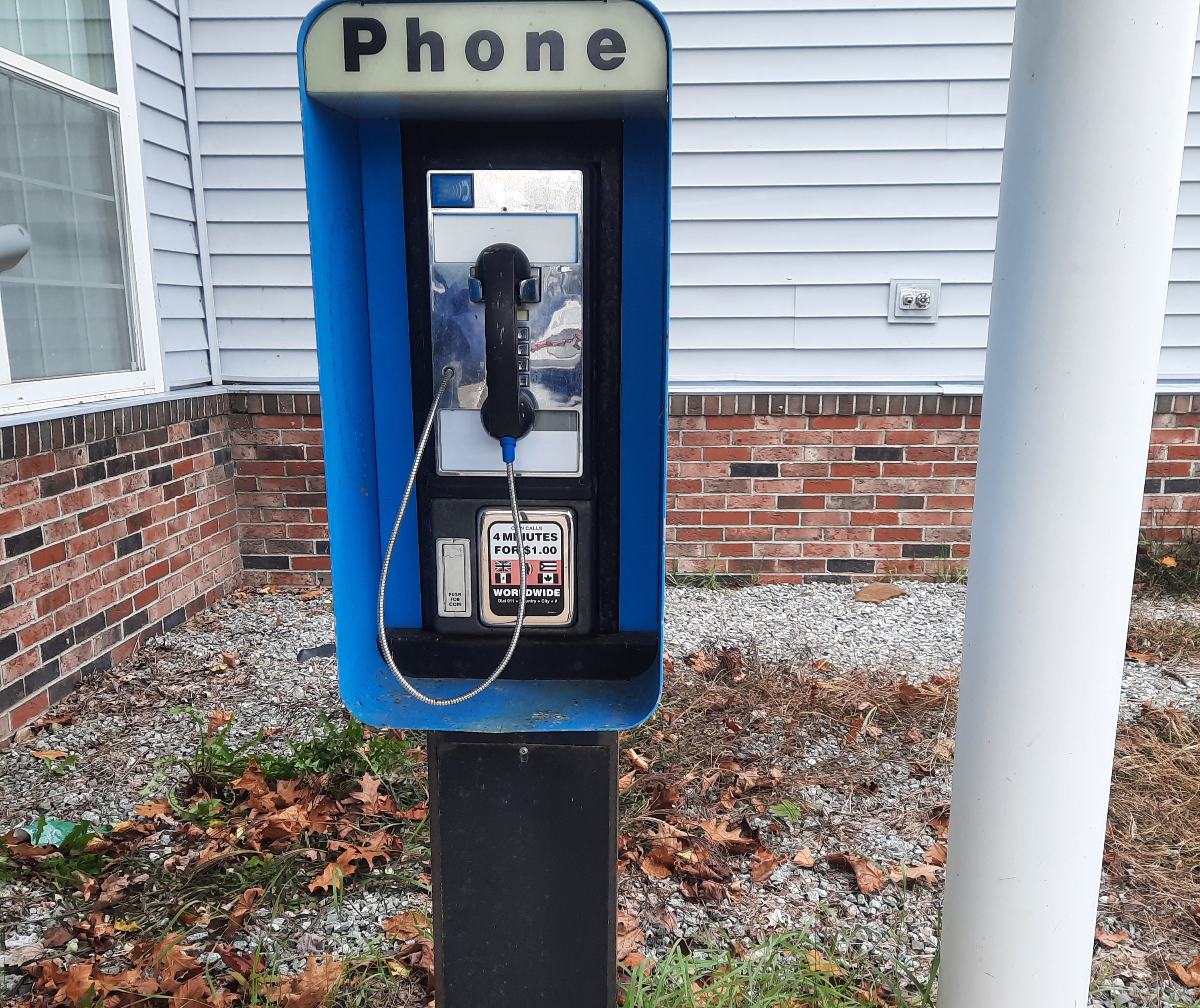
Dialing behavior has been inconsistent. Because of how the line is configured, outgoing calls work only if the caller dials just the seven-digit number; adding “207” causes calls to fail. Incoming calls can sometimes connect, but the phone does not ring, meaning a caller must pick up the handset at exactly the right moment. The PUC map lists the wrong address for the phone.
Jay Police Chief Joseph Sage said he long assumed the phone was simply “always there.” After learning more, he dialed 911 from the phone; the call went through, but dispatch did not receive an automatic address. He said he would follow up with dispatch and the service provider.
Officer Cory Veilleux said he knew the phone still worked because he recalled a man and his son who used it periodically.
In Jay, the public interest line is part of the Livermore Falls and Wilton rate-center cluster, which links it to multiple surrounding exchanges. A telephone exchange is the three-digit prefix after the area code and identifies the switching center that routes local calls.
The Jay PIP can reach seven-digit local numbers in several nearby prefixes, including 897 (Livermore Falls), 645 and 516 (Wilton), 778 and 779 (Farmington), 524 (Leeds), 597 (Canton), 293 (Mount Vernon), 224 and 225 (North Turner/Turner), and 685 or 931 (Readfield), as well as a number of Voice Over Internet Protocol-assigned local blocks. This regional calling area covers much of Canton, Farmington, Leeds, Mount Vernon, North Turner, Readfield, Turner and Wilton.
Under current PUC standards, a Public Interest Payphone must complete at least 70 calls per month to retain its designation, a threshold used to confirm that the phone is serving a demonstrable public need.
Emergency responders emphasize the need for a reliable callback path when someone dials 911. At phones like Jay’s, where incoming calls arrive silently, a dispatcher calling back may be unable to reach the person who made the original call.
Unlike traditional payphones, many PIPs use modern coinless equipment that allows outgoing and 911 calls but may not support certain types of ringing or may suppress audible ring tones. Problems can also occur if the unit’s configuration, address registration or internal alerting system has degraded over time.
PUC guidance also notes that public interest payphones are expected to remain operational during power outages and broader telecommunications disruptions whenever technically feasible, underscoring their intended role as emergency lifelines when other systems fail.
For residents in crisis or for someone with no phone of their own, the inability to hear a callback raises safety concerns that towns and carriers say they are still evaluating.
CALLING CARDS, COIN SLOTS
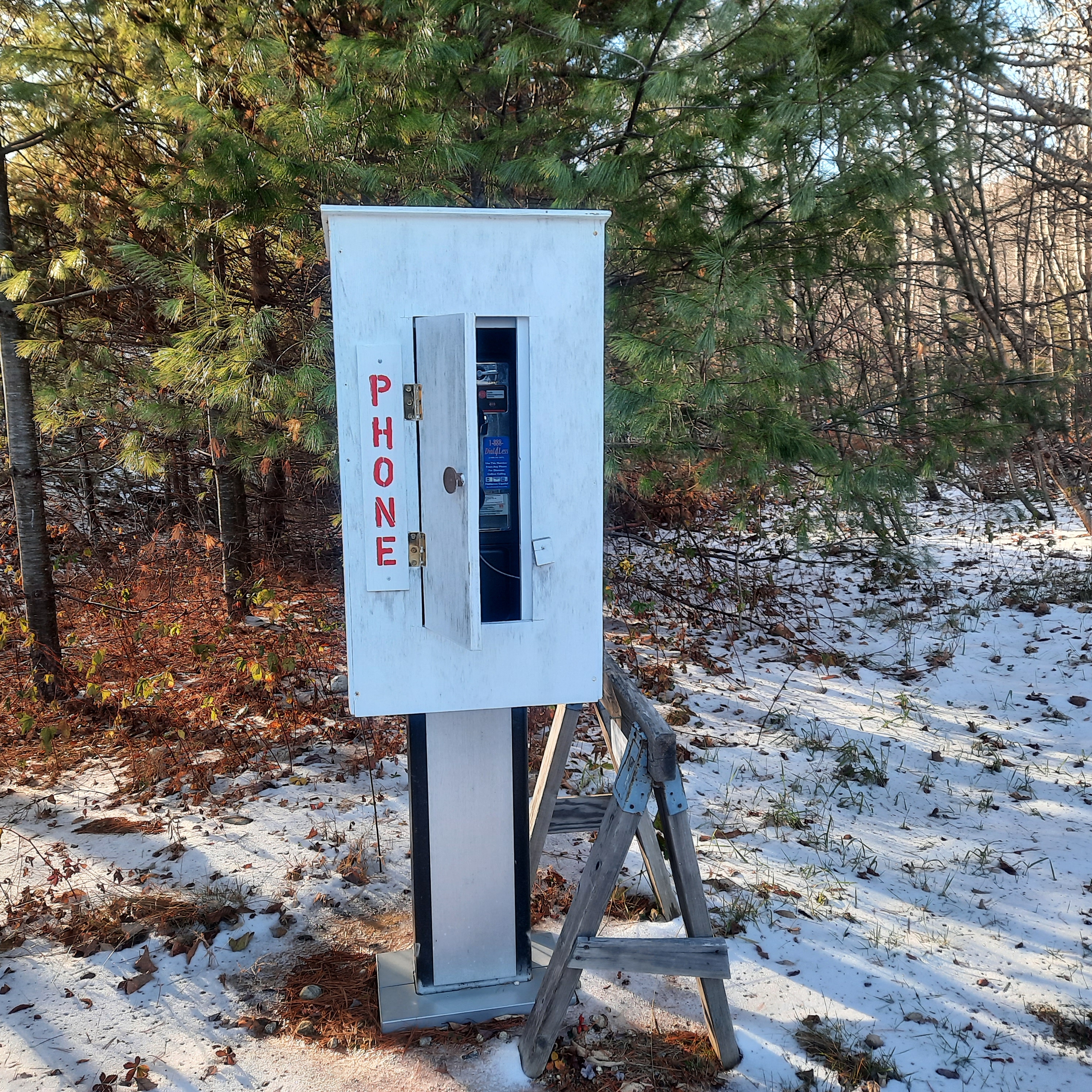
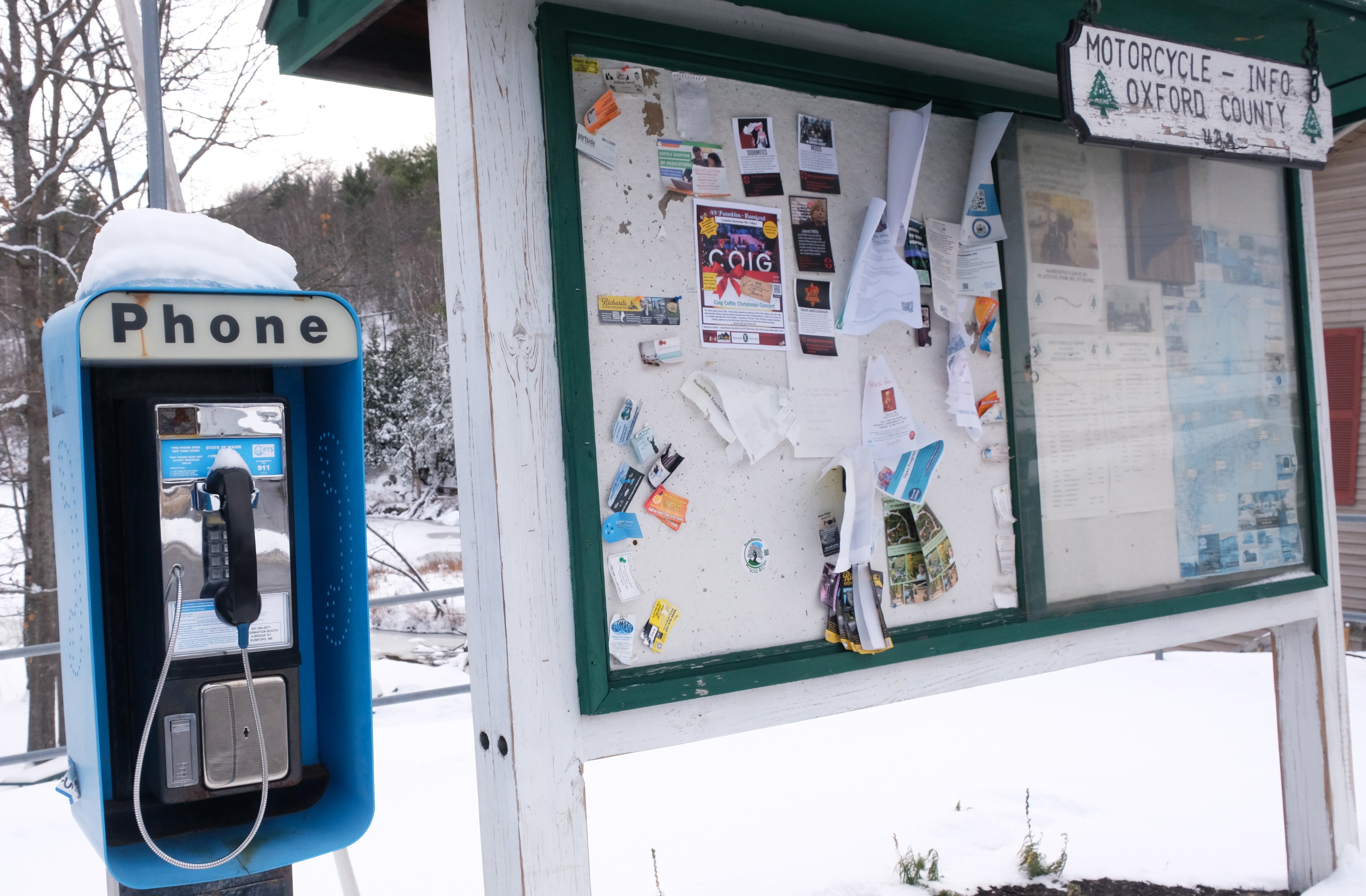
Public interest payphones are required by state rules to be coinless, yet many still rely on legacy housings originally built to accept coins. As a result, a PIP may display a metal coin slot, carry old “insert coins” instructions, or include other remnants of its former design even though none of those features work. That mismatch can confuse callers who approach the phone expecting to use coins only to find the slot sealed or nonfunctional.
Long-distance calling typically requires either operator assistance or a calling card — a prepaid or account-based system in which the user dials an access number, enters a PIN and has the charges billed to the card rather than the phone. Calling cards remain a niche option sold through pharmacies, major retailers and online vendors, offering people without long-distance service a practical way to place calls on coinless public phones.
In some cases, recorded prompts reference coins even though the hardware no longer accepts them. These mismatches can make the phones confusing to people who rely on them most.
UNEVEN PERFORMANCE
Testing various public and legacy payphones around Maine reveals inconsistent behavior:
• Some ring normally.
• Some continue ringing in the caller’s ear after being picked up.
• Some return “disconnected” and “no longer in service” messages despite appearing on PUC lists. These phones are no longer in service.
• Some accept calls but never audibly ring.
• Some return “Error 48,” which may mean the incoming calls are blocked or disabled, as reported at Step Falls Preserve in Newry.
A recent statewide field check done either in person or remotely by calling each PIP on the PUC list found 31 PIPs, of which only five connected to a modem, three returned busy signals, 15 would ring without answering and eight appeared to be out of service entirely.
Several locations listed in past PUC records now appear to be out of service, including phones once located at Hosmer Field in Rumford, Searsmont General Store, Sidney’s recreational fields and town office, the Stetson Town Office, the Stockton Springs Cape Docks, and the Winn General Store in Winn.
Responsibilities for cleaning, label replacement and maintenance vary. It is unclear if some PIPs are regularly serviced; some show cracked housings, faded numbers, unclear provider information or no posted instructions.
The PUC confirmed several details about how the PIP system functions statewide. According to PUC media liaison Susan Faloon, the contracted PIP provider, not the municipality, is responsible for installation, maintenance, cleaning and ensuring posted information is accurate. Local Exchange Carriers supply and bill for the access lines, but the provider is the entity officially “in charge” of each phone.
All PIPs are required to allow incoming calls, she said; if a 911 callback does not connect or goes unanswered, law enforcement will typically be dispatched to the phone’s location.
Faloon said Maine law allows up to $50,000 per year to be collected for the program, but actual annual expenditures are closer to $29,000 for roughly 35 PIPs, about $800-$900 per phone per year. Because expenditures remain below the statutory cap, funding is available for additional installations if applications are approved. Municipalities and public institutions can apply directly through the PUC’s website.
With Maine’s geography, weather, dead zones and economic challenges, public phones continue to fill communication gaps no other system fully covers. Cellular towers fail. Power goes out. People lose phones, run out of minutes or cannot afford service. And in moments of crisis, at a station, library, landing, trailhead or roadside, a working landline may be the only reliable option.
Payphones may no longer line every street, but the few that remain, imperfect, aging and sometimes unpredictable, still provide what Mainers have always needed: a way to reach help when nothing else works.

We invite you to add your comments. We encourage a thoughtful exchange of ideas and information on this website. By joining the conversation, you are agreeing to our commenting policy and terms of use. More information is found on our FAQs. You can update your screen name on the member's center.
Comments are managed by our staff during regular business hours Monday through Friday as well as limited hours on Saturday and Sunday. Comments held for moderation outside of those hours may take longer to approve.
Join the Conversation
Please sign into your CentralMaine.com account to participate in conversations below. If you do not have an account, you can register or subscribe. Questions? Please see our FAQs.