
Coleen Elias of Litchfield served five years of active duty in the U.S. Coast Guard. She has also worked in clinical and administrative roles in nonprofit health care.
In the summer of 2007, at 22 years old, I found myself thousands of miles from my hometown of Buckfield, Maine, standing on the deck of a U.S. Coast Guard cutter deployed to Key West, Florida. My first duty station had been a quiet one in Newport, Rhode Island — servicing aids to navigation (buoys), the humble infrastructure that keeps mariners safe.
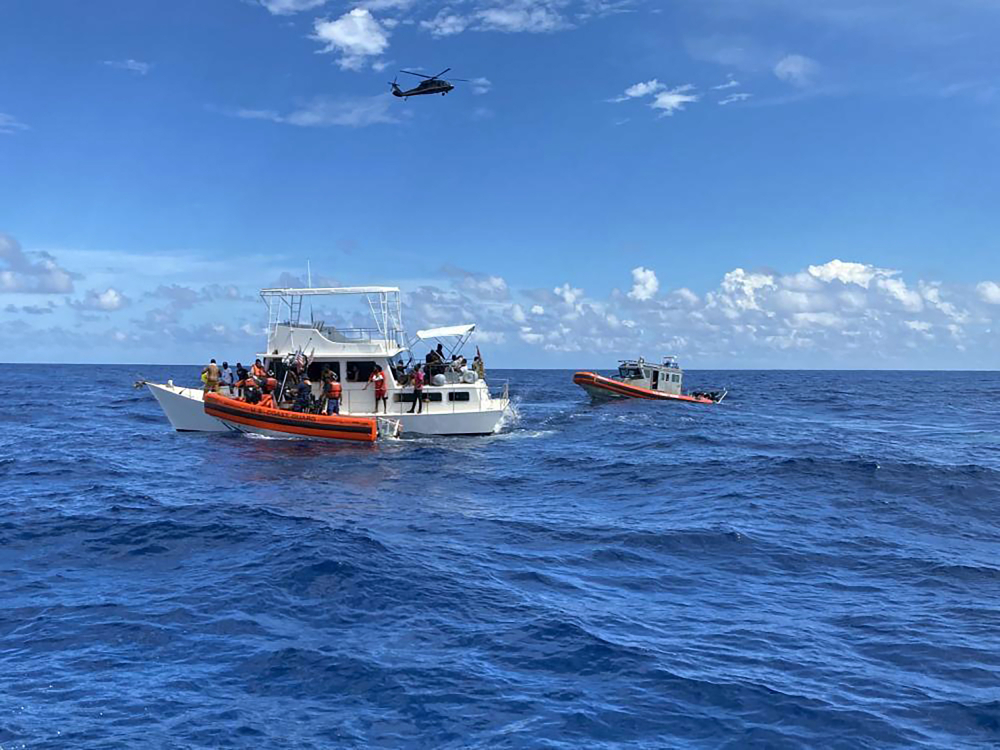
But this mission was different. Our ship had been deployed to Key West to assist in Cuban and Haitian migrant interdiction operations, a reality I had never imagined when I enlisted.
Our cutter was tasked as a temporary holding platform for people intercepted on the 90-mile stretch of water between Cuba and the United States — a navigational waterway that is small in distance, but vast in meaning for those who risked everything to cross it.
Most who came aboard our ship were children and women — several of them pregnant. Young men who were around my same age. Families who carried nothing with them except the clothes they were wearing, and the hope they carried inside.
Coming from a small town in Maine, I had never seen desperation so closely intertwined with determination. I had never seen so clearly how geography — where any of us happens to be born — can set the course of an entire life.
During that deployment, I witnessed scenes that have remained with me ever since. A man with a tattoo that filled his back of the Statue of Liberty, with the word “FREEDOM” etched below in bold, capital letters. Children sitting cross-legged on the concrete deck of our ship, drawing pictures from both memory and imagination: flowers, families and their visions of “EUA the beautiful” — America the beautiful. These images were drawn not from experience, but from a dream of a place that existed just beyond the waters we were on.
I remember the internal conflict that I grappled with — the understanding of our mission’s purpose, but also the weight of knowing that many of these families would be returned to the very circumstances they had risked their lives to escape. That conflict forced me to confront something I had never acknowledged with real clarity: I had privilege simply because I was born a U.S. citizen.
I could not change the outcome of that mission. But I could choose what to do with the perspective it gave me. Somewhere on that ocean, I made a quiet vow to myself: to be the best American citizen I could possibly be. Not just in uniform, but long after I took it off.
That vow has never left me and has turned into a lifelong belief that citizenship is not passive. It is active. It is a responsibility. And it begins with a willingness to seek understanding — to see one another with compassion, even when our experiences are vastly different.
Here in Maine, we pride ourselves on community, on hard work, on looking out for our neighbors. But we are also living through a moment in time where political division can feel sharper than it has in decades.
In our debates — both at the national and local levels — it has become too easy to retreat into corners, to assume the worst about those with whom we disagree, or to disengage entirely out of frustration, exhaustion or the belief that our voices don’t matter.
But democracy does not function if we stop showing up. It does not improve if we stop listening. And it cannot possibly meet the needs of our communities if good people decide that participation is optional, or that it doesn’t matter.
My time at sea taught me something about America that I could never have learned in a classroom: for millions around the world, the United States represents possibility. The families who came aboard our cutter believed deeply in the idea of America. They believed in fairness, opportunity, dignity and freedom. They believed in “America the beautiful.”
If they could risk everything for the chance to participate in the American story, then I believe that those of us who inherited this responsibility can commit ourselves to participating, too.
That doesn’t have to mean running for office or organizing large events. It can be as simple as showing up to vote (in every election), attending a town meeting, reading proposed legislation before forming an opinion, asking questions out of curiosity or sharing your own story about why civic engagement matters to you. But, participation starts with recognizing that we share this place, and that understanding each other is not an obstacle to civic life, but the foundation of it.
I often think back to the drawings the children made on the deck of our ship. I have kept a notebook filled with several pieces of their works of art as a treasure I will always cherish — their innocent visions of an America they had never seen but believed in wholeheartedly. An America full of promise, fairness and beauty.
We have the extraordinary privilege of being able to participate in civic engagement and it is up to us to remember that citizenship is much more than a status — it is a responsibility that belongs to all of us.
That responsibility is worth rising to.
We invite you to add your comments. We encourage a thoughtful exchange of ideas and information on this website. By joining the conversation, you are agreeing to our commenting policy and terms of use. More information is found on our FAQs. You can update your screen name on the member's center.
Comments are managed by our staff during regular business hours Monday through Friday as well as limited hours on Saturday and Sunday. Comments held for moderation outside of those hours may take longer to approve.
Join the Conversation
Please sign into your CentralMaine.com account to participate in conversations below. If you do not have an account, you can register or subscribe. Questions? Please see our FAQs.