

With a relatively cold start to winter, ice is shaping up across Maine, providing ample opportunity for winter recreation. However, experts caution that ice can vary dramatically in thickness, making it risky for walking, skating or snowmobiling.
Ice conditions are affected by local factors such as currents, springs, inlets, shallow areas and proximity to bridges and other structures, as well as fluctuating temperatures and wind.
Mark Latti, spokesman for the Maine Department of Inland Fisheries and Wildlife, said that while it has been a cold December and many water bodies appear to have solid ice, people should not assume ice is safe without checking it firsthand.
“You can’t tell how thick the ice is just by looking at it, so drill a hole, chop a hole with a hatchet or an axe or if you’ve got an ice auger, use that,” Latti said. “Look for 4 to 6 inches of ice. And ice conditions can change rapidly on a water body, so don’t just drill a hole in one place — go another 20 feet and try again and that way it gives you some assurance.”
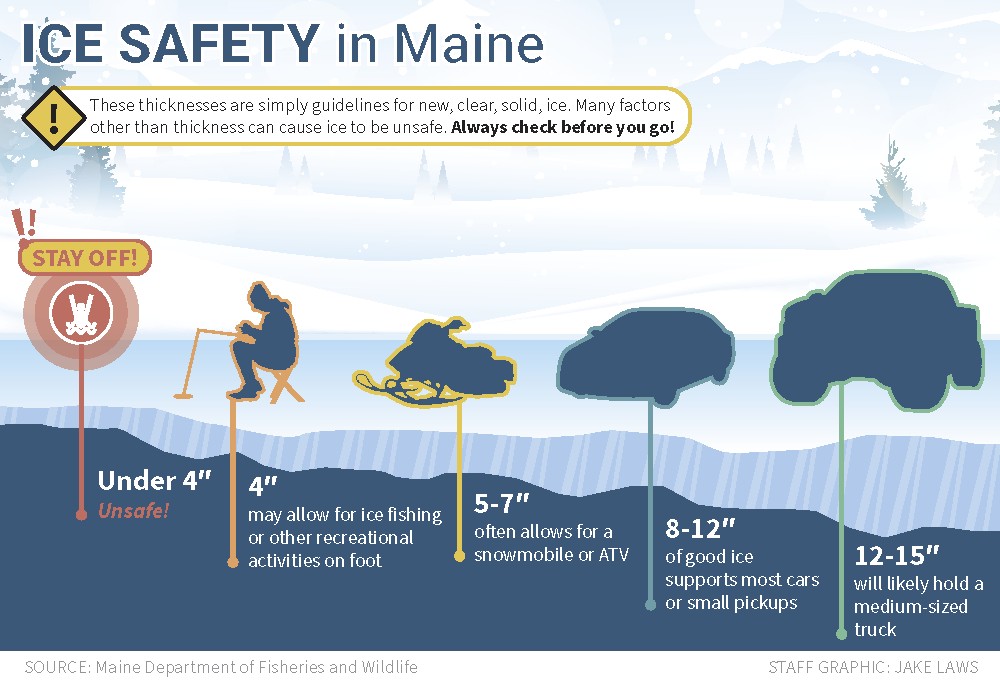
The department provides ice safety tips online including an ice thickness guideline. Starting at the edge of the water body, check for a minimum thickness of 4 to 6 inches for lower weight activities like walking, snowshoeing, skating and ice fishing, and continue checking as you move outward on the ice. Latti said ice is often weaker near inlets and outlets, bridges, culverts and any areas of current, especially rivers.
For heavier activities like snowmobiling or ATV use, 5 to 7 inches is generally safe; 8 to 12 inches for smaller vehicles; and 12 to 15 inches for medium-size trucks.
Ice color and quality also matter, according to the tips. Clear or “blue” ice is usually the strongest, while white or opaque ice, oftentimes formed from frozen snow, is typically weaker. Gray or black ice usually indicates melting and can be dangerous.
After testing for ice thickness, even if conditions are favorable, recreationists should still take proper safety precautions, like bringing ice picks, throw ropes, float coats and inflatable life jackets.
Lake Stewards of Maine, a nonprofit focused on monitoring waterbodies for scientific purposes, also emphasizes the importance of ice safety. Tristan Taber, the group’s water-quality program director, said volunteers track ice primarily to understand thaw and freeze patterns over several years.
Taber said volunteers have learned over time that ice conditions can vary dramatically between waterbodies. From a scientific standpoint, the areas near shore can be slightly weaker due to intrusion along the shoreline, he said.
“Lake Auburn, for example, has ice very solidly across it, but there are a couple of spots that have natural groundwater seeps,” Taber said. “That groundwater coming in is usually more in the 45-degree temperature range and will actually melt and thin the ice in some of those places.”
These weak spots, Taber said, can exist even on lakes that appear uniformly frozen. He echoed Latti’s advice that testing ice in multiple locations is paramount, as is carrying safety equipment as precautions no matter how solid conditions may look from shore.
Perhaps the most important precaution, Latti said, is not going on the ice alone. And letting someone know when to expect you back from your trip out on the ice.
“If you do fall in, don’t panic — lay flat, kick to get back onto the ice, and roll away from the hole toward shore, toward the way you came,” Latti said, adding that having a partner out on the ice offers the best chance of getting out of the water if you break through.
“They can call 911 … use the throw rope or a branch (or something nearby) if you didn’t bring one. … If you’re helping someone get out, stretch out on the ice and don’t get too close to the hole.”

We invite you to add your comments. We encourage a thoughtful exchange of ideas and information on this website. By joining the conversation, you are agreeing to our commenting policy and terms of use. More information is found on our FAQs. You can update your screen name on the member's center.
Comments are managed by our staff during regular business hours Monday through Friday as well as limited hours on Saturday and Sunday. Comments held for moderation outside of those hours may take longer to approve.
Join the Conversation
Please sign into your CentralMaine.com account to participate in conversations below. If you do not have an account, you can subscribe here. Questions? Please see our FAQs.