

BIDDEFORD — Vassie Fowler feels a heavy burden when the doors of the warming center open.
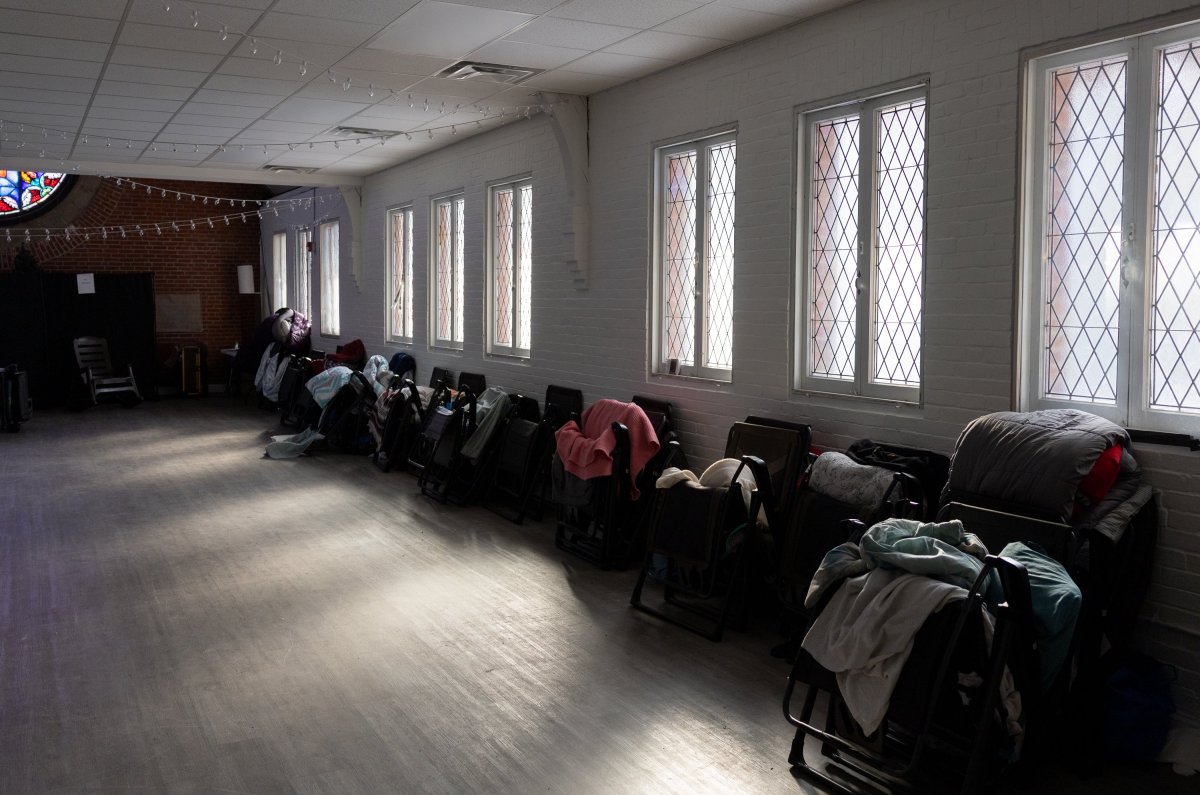
On the top floor of a former church, more than 50 homeless people unfold antigravity chairs and blankets to settle in and try to sleep each night. On evenings when temperatures dip into the single digits, the center will squeeze in up to 60.
But Seeds of Hope can’t make room for everyone.
“We know if we say no, there’s no other option for people,” said Fowler, executive director of the nonprofit on South Street. “We are tasked with what feels like life and death decisions.”
Advocates for the homeless population say warming centers are essential in Maine, where it can be dangerous and deadly to go unsheltered during winter months. But in a state with limited services, they say it is increasingly difficult to meet the need in many communities, including those in York County, where there are no spots at overnight facilities for most of the hundreds of people who are homeless.
In September, Gov. Janet Mills and MaineHousing announced $2.3 million in grants to support 12 emergency warming centers across the state this winter in Bangor, Portland, Ellsworth, Presque Isle, Waterville, Lewiston, Biddeford, Sanford, Augusta and Brunswick.
Some, like Seeds of Hope, are open every night.
Others are more restricted: Portland only opens its shelter when the temperature is below 15 degrees or more than 10 inches of snow are expected; and in Sanford, the only center has 16 beds and is limited to families with children.
People who are unsheltered in Sanford feel helpless and discouraged, said Rebecca Jackson, co-founder of It Takes a Village 207, a nonprofit that provides support and resources to people in the city.
“When temperatures reach dangerously low levels, access to warmth is not a luxury — it is a matter of survival,” Jackson said. “Without accessible, low-barrier places to warm up, people are left with impossible choices that put their health and lives at risk.”
‘NEED BEYOND CAPACITY’
Carter Friend, CEO of York County Community Action Corp., estimates there were about 350 homeless people in the county in late fall, based on an annual count and data from a coordinated assessment system. That number dips slightly in winter when some people are able to find others to stay with, he said.
Warming centers are an important resource to get people out of dangerous weather and to help connect them to resources, Friend said, but “there is certainly need beyond (our) capacity.”
Fowler, from Seeds of Hope, was part of a group looking to open a warming center in Sanford, but they couldn’t find a suitable space.
And, in May, the situation worsened when York County Shelter Programs in Alfred closed its adult homeless shelter because it could no longer afford to operate. It was the only facility of its kind in the county and served about 650 people each year.
The program’s family shelter in Sanford stayed open, but transitioned into a warming center for the winter after the city received a MaineHousing grant, said Barbara Crider, the interim director.
“We’ve always had requests from folks we can’t accommodate,” she said. “We do our best to refer them to other resources, but those other resources are really, really limited. It’s not ideal.”
‘WE CAN ONLY DO SO MUCH’
On Tuesday afternoon, the community room at Seeds of Hope was full. Some people talked quietly while eating chili and chowder. At the long tables in the room, others rested their heads on folded arms.
On the second floor, sun filtered through the stained glass windows into the room where some of them would sleep that night. Dozens of chairs, most draped with blankets, sat folded against the wall.
Seeds of Hope, which also works with partners to help people get supportive services and find permanent housing, started running a year-round overnight center in summer 2024, with financial support from Biddeford.
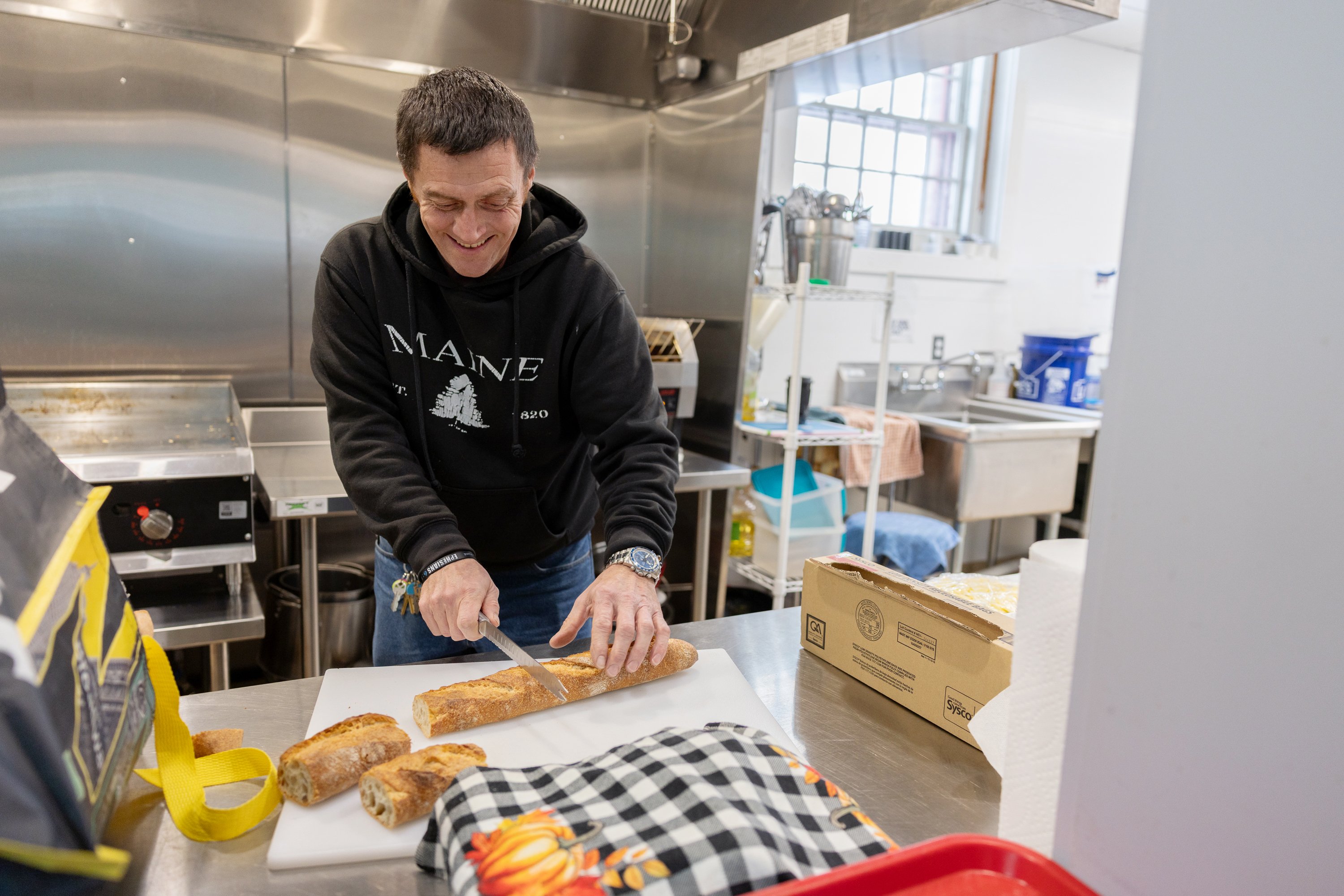
Don Babb Jr. said he stayed at the center for seven months after he fell on hard times and became homeless. Seeds of Hope hired him last year to do maintenance and help with the cooking. He moved into an apartment in December.
“Once it gets cold, you don’t want to be outside if you can help it,” Babb, 50, said.
He sees the growing need for such programs and credits the support he received there with helping him find permanent housing.
Last winter, Seeds of Hope typically had 36 to 46 people stay in the center each night, only seeing more than 50 show up during the biggest storms. Now, Fowler said, more than 50 is the norm and staff members often have to tell people there are no spots for them.
The program used to primarily serve people from Biddeford, but Fowler said 35% of people staying there now come from outside the city.
“We’re trying to accommodate as many people as we can,” Fowler said, “but we can only do so much.”
‘IT’S BARELY SURVIVAL’

During winter, It Takes a Village 207 passes out food, hand and toe warmers, blankets, socks, hats and gloves to people in Sanford.
“We are met each week with shaking hands. What we are witnessing is not safety,” said Jackson, a co-founder. “It’s barely survival.”
She said the lack of warming options has led to “a growing sense of defeat and exhaustion.”
On Wednesday afternoon, 28-year-old Brooke Paul huddled near a doorway at a shopping plaza in downtown Sanford. She said she has been homeless for six years and sleeps in a tent in the woods near a walking trail.
During the day, she tries to warm up by going into local businesses until she is asked to leave. At night, she layers her clothes and uses as many blankets as she can.
“The other night was freezing. It sucks,” she said. She wishes there was a nearby warming center.
“Why wouldn’t there be?” she said.
The Sanford Police Department has a team, which includes a social worker, that tries to help, but with no space at warming centers, there are often limited options, Major Mark Dyer said.
“We offer them resources and try to mitigate the cold as best we can,” he said.
Often, that includes suggesting people go to the Salvation Army and local churches for cold weather gear. When people who need it are willing, the team will try to get them into substance use treatment, Dyer said.
He said police aren’t aware of issues with weather-related injuries this winter, but Jackson said the people she works with have reported experiencing frostbite. She said one homeless friend, a 67-year-old man, was “alone and cold” when he died in his van in early December. Police confirmed the man’s death and said he died from an unknown medical issue.
“He often spoke about feeling forgotten and discouraged,” Jackson said, “and that reality still weighs heavily on us.”

Comments are not available on this story. Read more about why we allow commenting on some stories and not on others.
We believe it's important to offer commenting on certain stories as a benefit to our readers. At its best, our comments sections can be a productive platform for readers to engage with our journalism, offer thoughts on coverage and issues, and drive conversation in a respectful, solutions-based way. It's a form of open discourse that can be useful to our community, public officials, journalists and others.
We do not enable comments on everything — exceptions include most crime stories, and coverage involving personal tragedy or sensitive issues that invite personal attacks instead of thoughtful discussion.
You can read more here about our commenting policy and terms of use. More information is also found on our FAQs.
Show less