


Amid announcements about proposed affordability checks and free community college tuition, Gov. Janet Mills took time during her State of the State address last week to call for a measure that a growing number of other states have already adopted: a statewide ban on cellphones during school days.
“It’s time to get cellphones out of our classrooms,” Mills said last month to raucous applause from lawmakers. “When cellphones are removed from classrooms, research shows that student performance improves, test scores improve, behavior improves, attendance improves and social dynamics improve. Makes sense.”
Specifically, Mills called for a bell-to-bell ban, an especially strict phone policy where students must surrender or secure their devices at the start of the school day and cannot access them again until after the last bell.
Many Maine districts have policies that restrict students from having or using phones in class, but still allow them to use their phones in the halls between class periods. Advocates, however, say bell-to-bell bans are the only way to take the burden off teachers to police phone use.
A few individual districts have adopted complete bans, including Portland, the state’s largest school system. While students are often resistant to the policies, teachers and administrators say they decrease distractions and behavior issues, and improve socialization.

A spokesperson for Mills said Tuesday that she found emerging research about the positive outcomes of the policies in Maine and other states persuasive, and said the governor was also moved by groups like school resource officers who support bans “as a way to improve student attention and safety in school.”
The policy was included in the governor’s proposed supplemental budget, released Wednesday, with a $700,000 price tag. It directs every school board in the state to adopt a cellphone ban by Aug. 1, 2026, and tasks the Department of Education with creating a model policy to provide to school boards.
The proposal comes less than a year after the Legislature considered a statewide cellphone ban (not a bell-to-bell ban) before heavily amending it to avoid overstepping local control. Mills could face the same hurdle, although school phone bans are often grounds for bipartisan agreement.
WHO IS ADOPTING THE BANS?
Bath-based Regional School Unit 1 was the first district in Maine to take the leap when it adopted a bell-to-bell ban in June 2024. Leaders there say the results have been overwhelmingly positive.
“I’ve had teachers that have been in the business for 40 years say this is the single best thing, best policy change, they’ve seen in their 40 years,” Eric Varney, principal of Bath’s Morse High School, told the Press Herald last spring.
Varney said a ‘tremendous’ number of districts reached out to do site visits at Morse and learn how to adopt policies of their own, and in 2025 several districts have followed suit, including Portland, Topsham-based Maine School Administrative District 75, and Livermore Falls-based MSAD 73.
Portland’s school board approved a ban last June, despite the objections of students. Now, the district’s secondary schools use Yondr Pouches, magnetically sealed pockets that allow students to keep their devices with them while preventing access.
Administrators and school board members have hailed the policy as a success, and in September, students acknowledged that it wasn’t as bad as they had expected.
Overall, Maine is behind much of the nation in taking up a school phone ban.
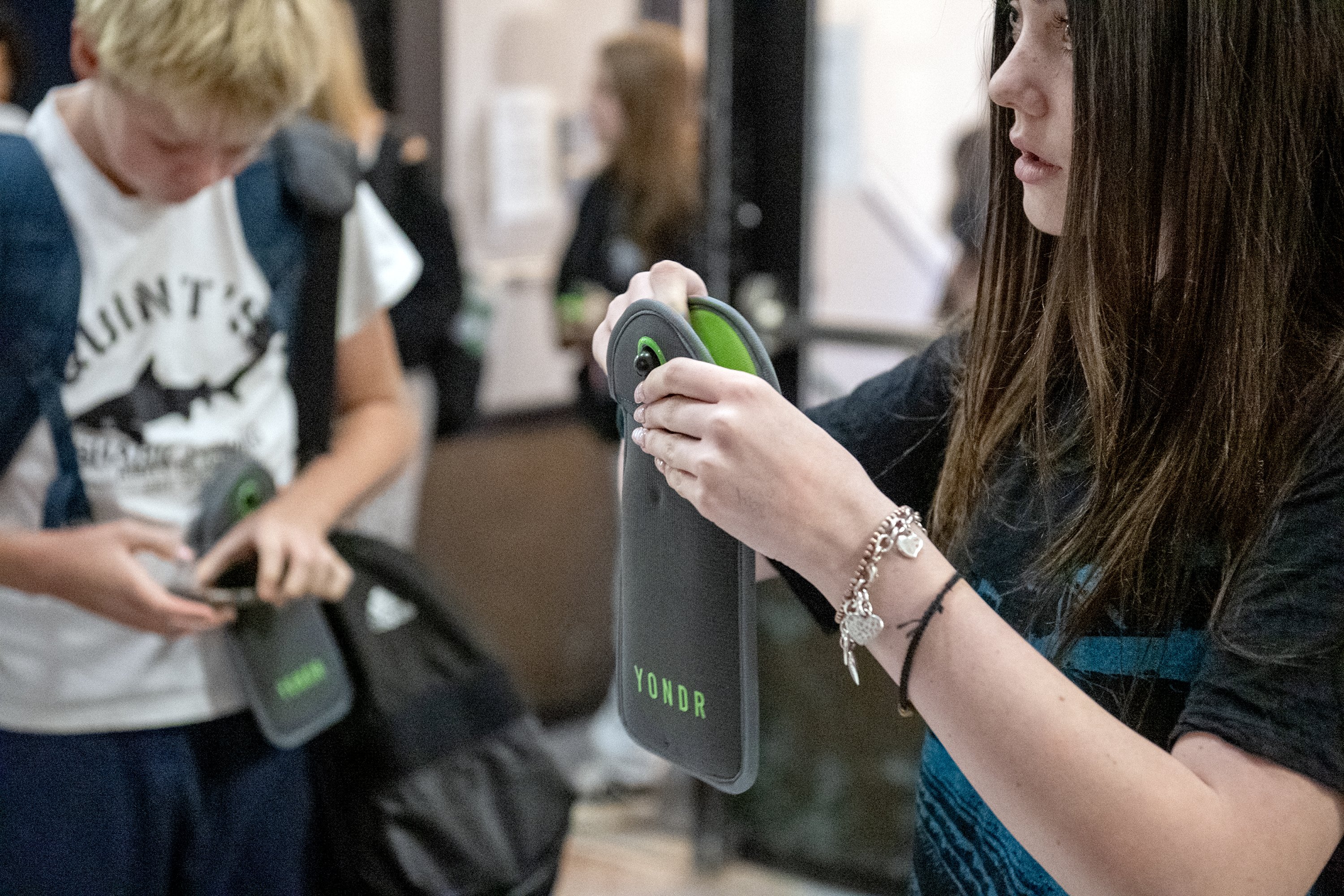
Almost half of all states — 23, according to Education Week — had statewide bell-to-bell bans as of January, ranging from deep-red Alabama and Arkansas to liberal New York and Vermont, and another nine require schools to restrict phones during instructional time.
Leaders in those states say the bans result in better test scores and improved student mental health.
Turn the Tide Coalition, a statewide group that advocates for less technology access for children, praised Mills’ announcement.
“For years, parents, teachers, and students have witnessed firsthand how nearly constant access to smartphones during the school day interferes with learning, social connection and student well-being,” the organization said in a statement.
WHAT ARE THE CHALLENGES?
Mills acknowledged during her address that most students don’t like the idea.
“Some students may be upset with the idea of a ban on cellphone use at school, and it will be
a significant change for some,” she said. But she also mentioned a Morse student who said the policy had given him more time to talk with his friends in person.
Another barrier will likely be Maine’s long-standing tradition of local control, especially when it comes to schools. That has stymied many statewide mandates in the past, including the attempt to pass a statewide phone ban during the last session.
Instead, members of the Education and Cultural Affairs Committee passed a heavily amended version of the bill that required school districts to have a comprehensive policy around cellphones in schools, not necessarily a ban, in place by August 2026.
During a work session on that bill, Sen. Teresa Pierce, D-Cumberland, acknowledged the negative impact of cellphones in schools.
“But we live in the reality of Maine, of a local control state, where everything really is driven by what your local community does and the decisions that they make,” Pierce said.
That bill, LD 1234, was introduced by a Republican Rep. Richard Campbell, but it doesn’t mean Republicans will necessarily line up behind Mills’ mandate.
“Republicans take the concept of local control seriously and are reluctant to support statewide mandates,” said John Bott, director of communications for House Republicans. “We expect the response to a mandate of this kind will be up to individual members based on feedback from their constituents.”

We invite you to add your comments. We encourage a thoughtful exchange of ideas and information on this website. By joining the conversation, you are agreeing to our commenting policy and terms of use. More information is found on our FAQs. You can update your screen name on the member's center.
Comments are managed by our staff during regular business hours Monday through Friday as well as limited hours on Saturday and Sunday. Comments held for moderation outside of those hours may take longer to approve.
Join the Conversation
Please sign into your CentralMaine.com account to participate in conversations below. If you do not have an account, you can register or subscribe. Questions? Please see our FAQs.