

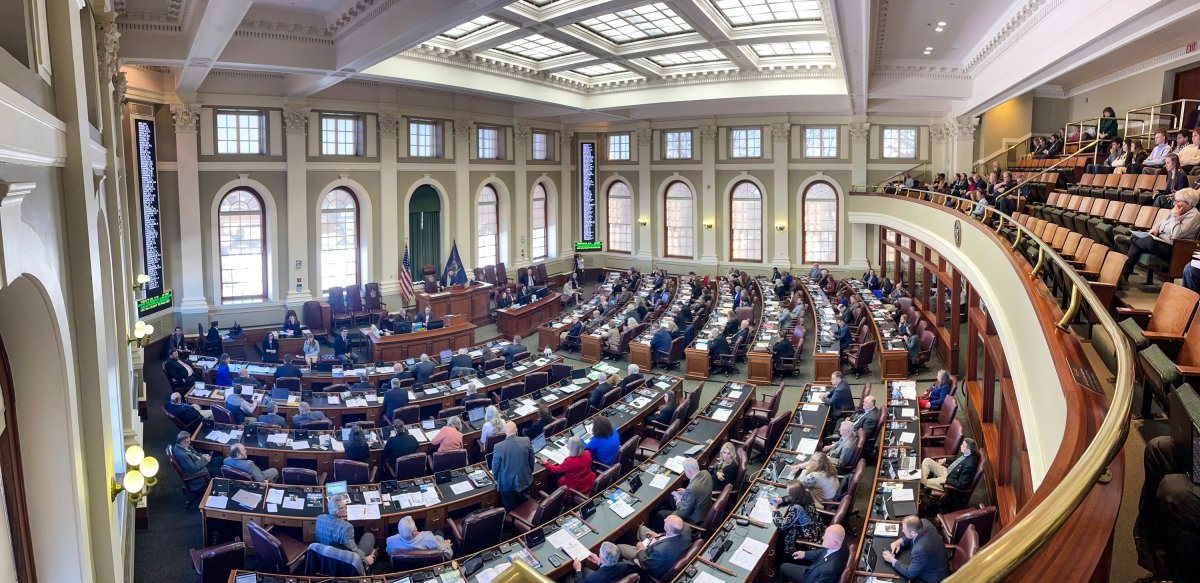
The Maine House of Representatives on Tuesday advanced a measure that would limit the amount of digital data that businesses and other groups can collect and use to target consumers with advertisements.
The bill, sponsored Rep. Amy Kuhn, D-Falmouth, would mandate that companies can only collect and store the data necessary to provide a good or service. It also would prohibit companies from collecting an individual’s biometric information, such as fingerprints, unless necessary. And it would ban targeted advertising to minors and the sale of their information.
Supporters pointed to the rapid deployment of artificial intelligence and increased government surveillance, including the use of location data to identify protesters, as reasons to support the types of digital data that can be collected and used.
“We don’t know where AI is going,” Kuhn said. “Even the people who are developing it don’t know where it is going, but we do know that our data is the fuel. The single most important thing we can do to protect Mainers in this AI-enabled world is to pass strong data privacy protections.”
The measure, LD 1822, cleared the House Tuesday by a 71-60 vote. It now heads to the state Senate, which killed a similar bill in 2024.
Opponents argued the restrictions are too harsh and would prohibit small businesses from providing targeted advertising to consumers so they can compete with larger corporations.
Rep. Rachel Henderson, R-Rumford, urged lawmakers to adopt a competing data privacy bill that would allow consumers to consent to allowing companies to collect and store their data.
Henderson said the strict bill advanced by the House is opposed by the Maine State Chamber of Commerce, Retail Association of Maine and Maine Hospitality, which represents restaurants and hotels.
“There needs to be protections in place — we can agree across the board on that,” Henderson said. “But this measure just takes it way too far.”
Kuhn said tight restrictions are needed because people don’t always know to what they’re consenting when they download an app or interact with a website.
Nineteen states have passed data privacy laws, according to the Electronic Privacy Information Center, which advocates for strict laws.
Kuhn said her proposal is similar to one in Maryland, which took effect on Oct. 1.
The American Civil Liberties Union of Maine applauded the House’s passage of the bill.
“The world’s largest tech companies gather, sell, analyze, and exploit our most personal data for financial gain,” ACLU of Maine Executive Director Molly Curren Rowles said in a written statement. “This surveillance-driven economy intrudes into our private lives and allows even the government to spy on us without our knowledge or consent. This reduces our freedom and safety, and threatens our democracy.”

Comments are not available on this story. Read more about why we allow commenting on some stories and not on others.
We believe it's important to offer commenting on certain stories as a benefit to our readers. At its best, our comments sections can be a productive platform for readers to engage with our journalism, offer thoughts on coverage and issues, and drive conversation in a respectful, solutions-based way. It's a form of open discourse that can be useful to our community, public officials, journalists and others.
We do not enable comments on everything — exceptions include most crime stories, and coverage involving personal tragedy or sensitive issues that invite personal attacks instead of thoughtful discussion.
You can read more here about our commenting policy and terms of use. More information is also found on our FAQs.
Show less